UN climate deal increases money to countries hit by climate change, but no explicit fossil fuel plan

1 / 2
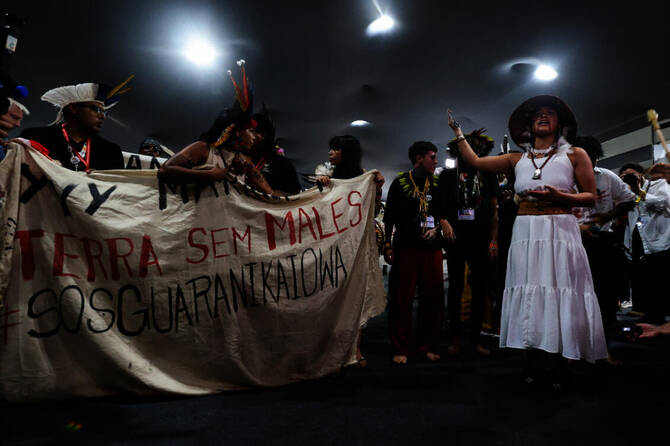
Young indigenous people from various continents perform during the UN Climate Change Conference in Belem, Brazil, on November 21, 2025. (REUTERS)
2 / 2
Young indigenous people from various continents perform during the UN Climate Change Conference in Belem, Brazil, on November 21, 2025. (REUTERS)
Short Url
Updated 23 November 2025
Follow

UN climate deal increases money to countries hit by climate change, but no explicit fossil fuel plan

  • Critics complained there was not much to the deal. Colombia responded angrily to the deal, citing the absence of wording on fossil fuels
  • But for UN chief, deal shows “that nations can still come together to confront the defining challenges no country can solve alone” COP

BELEM, Brazil: United Nations climate talks in Brazil reached a subdued agreement Saturday that pledged more funding for countries to adapt to the wrath of extreme weather. But the catch-all agreement doesn’t include explicit details to phase out fossil fuels or strengthen countries’ inadequate emissions cutting plans, which dozens of nations demanded.
The Brazilian hosts of the conference said they’d eventually come up with a road map to get away from fossil fuels working with hard-line Colombia, but it won’t have the same force as something approved at the conference called COP30. Colombia responded angrily to the deal after it was approved, citing the absence of wording on fossil fuels.
The deal, which was approved after negotiators blew past a Friday deadline, was crafted after hours of late night and early morning meetings in COP30 President André Corrêa do Lago’s office.


Do Lago said the tough discussions started in Belem will continue under Brazil’s leadership until the next annual conference “even if they are not reflected in this text we just approved.”
UN Secretary-General Antonio Guterres said the deal shows “that nations can still come together to confront the defining challenges no country can solve alone.” But he added: “I cannot pretend that COP30 has delivered everything that is needed. The gap between where we are and what science demands remains dangerously wide.”
Deal gets mix of lukewarm praise and complaints
Many gave the deal lukewarm praise as the best that could be achieved in trying times, while others complained about the package or the process that led to its approval.
“Given the circumstances of geopolitics today, we’re actually quite pleased with the bounds of the package that came out,” said Palau Ambassador Ilana Seid, who chaired the coalition of small island nations. “The alternative is that we don’t get a decision and that would have been a worse alternative.”
“This deal isn’t perfect and is far from what science requires,” said former Ireland President Mary Robinson, a fierce climate advocate for the ex-leaders group The Elders. “But at a time when multilateralism is being tested, it is significant that countries continue to move forward together.”
“This year there has been a lot of attention on one country stepping back,” UN climate chief Simon Stiell said, referring to the United States’ withdrawal from the landmark 2015 Paris agreement. “But amid the gale-force political headwinds, 194 countries stood firm in solidarity — rock-solid in support of climate cooperation.”
Some countries said they got enough out of the deal.


“COP30 has not delivered everything Africa asked for, but it has moved the needle,” said Jiwoh Abdulai, Sierra Leone’s environment minister. What really matters, he said, is “how quickly these words turn into real projects that protect lives and livelihoods.”
UK Energy Minister Ed Miliband said the agreement was “an important step forward,” but that he would have preferred it to be “more ambitious.” He added: “These are difficult, strenuous, tiring, frustrating negotiations.”
Swift final push prompts complaints
The deal was approved minutes into a plenary meeting open Saturday to all nations that were present.
After the main package was approved — to applause by many delegates — angry nations took the floor to complain about other parts of the package and about being ignored as do Lago moved quickly toward approval. The objections were so strong that do Lago temporarily halted the session to try to calm things down.
Colombia’s Daniela Duran Gonzalez objected to sections on helping nations cut emissions and reaching worldwide temperature limits that were previously agreed upon. She blasted the conference’s president for ignoring her, saying: “The COP of the truth cannot support an outcome that ignores science.”
An area that usually gets less attention became a big point of contention. The approved deal established 59 indicators for the world to judge how nations are adapting to climate change. Before the Belem conference, experts crafted 100 precisely worded indicators, but negotiators changed the wording and cut the total.
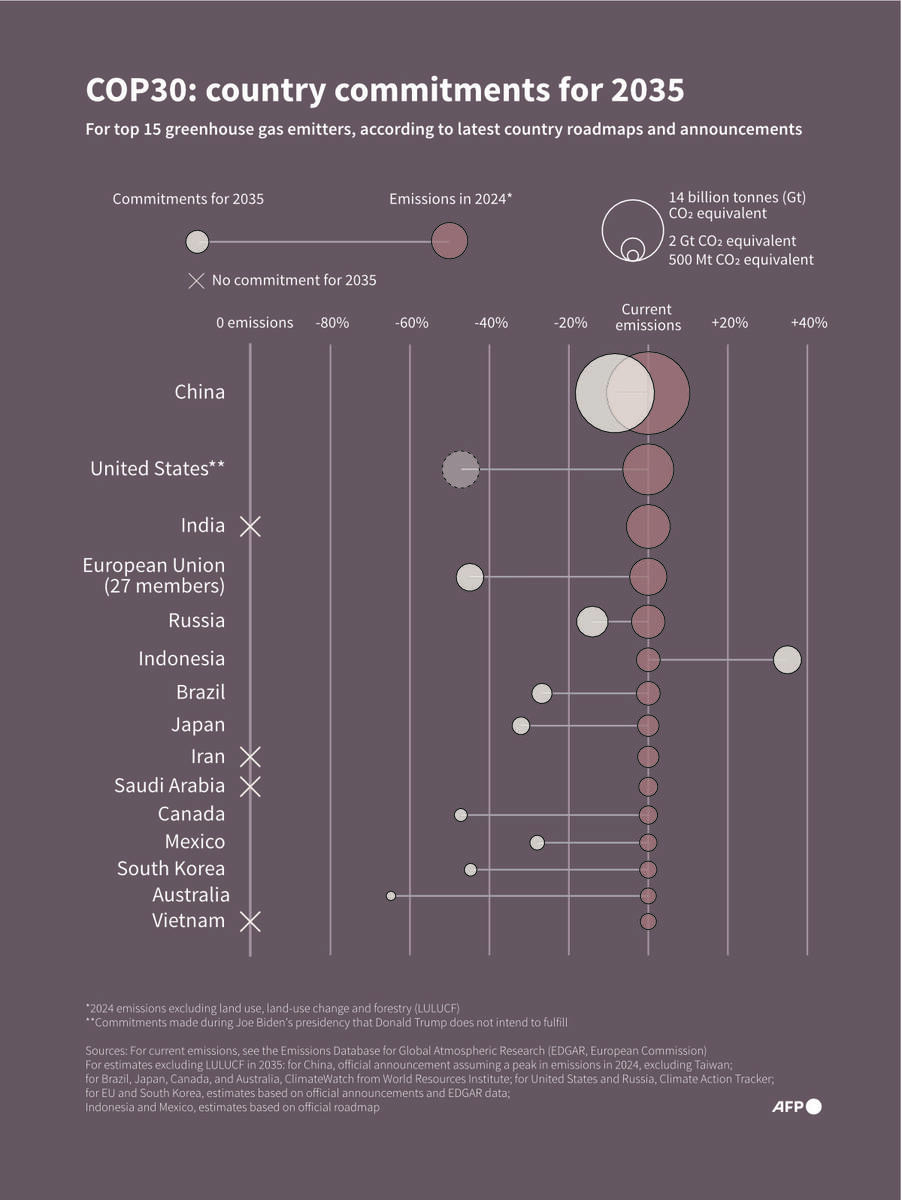
The European Union, several Latin American countries and Canada said they had severe problems with it, calling it unclear and unworkable. They complained that they tried to object but were ignored.
Do Lago apologized.
How major issues were handled
A handful of major issues dominated the talk. Those included coming up with a road map to wean the world from fossil fuels, telling countries that their national plans to curb emissions were inadequate, tripling financial aid for developing nations to adapt to extreme weather and reducing climate restrictions on trade.
“COP30 gave us some baby steps in the right direction, but considering the scale of the climate crisis, it has failed to rise to the occasion,” said Mohamed Adow, director of Power Shift Africa.
Critics complained there was not much to the deal.
“Strip away the outcome text and you see it plainly: The emperor has no clothes,” said former Philippine negotiator Jasper Inventor, now at Greenpeace International.


READ MORE:

What did countries agree to at COP30?


Panama negotiator Juan Carlos Monterrey Gomez railed against the deal.
“A climate decision that cannot even say ‘fossil fuels’ is not neutrality, it is complicity. And what is happening here transcends incompetence,” Monterrey Gomez said. “Science has been deleted from COP30 because it offends the polluters.”
Many nations and advocates wanted something stronger because the world will not come close to limiting warming to 1.5 degrees Celsius (2.7 degrees Fahrenheit) since the mid 1800s, which was the goal the 2015 Paris agreement set.
The financial aid for adapting to climate change was tripled to a goal of $120 billion a year, but the goal was pushed back five years. It was one of several tough issues to dominate the late stage of talks. Vulnerable nations have pressed the wealthier countries most responsible for climate change to help out with money to rebuild from damaging extreme weather and to adapt to more of it in the future.
Pushing back the goal leaves “vulnerable countries without support to match the escalating needs,” Adow said.
After the main deal was approved, tempers flared as the open meeting stretched on. Russia’s ambassador at large, Sergei Kononuchenko, lectured Latin American delegates who were objecting frequently that they were “behaving like children who want to get your hands on all the sweets, and aren’t prepared to share them with everyone.”
An angry Eliana Ester Saissac of Argentina said Latin Americans “are in no way behaving like spoiled children who want to stuff our mouths full of sweets” to a roar of cheers and applause.


Around the world, refugees are shut out of the US by Trump’s new policies

U.S. Chief Border Patrol Agent, Gregory Bovino talks to a detained migrant on December 5, 2025 in New Orleans, Louisiana. (AFP)
Updated 3 sec ago
Follow

Around the world, refugees are shut out of the US by Trump’s new policies

  • About 600,000 people were being processed to come to the US as refugees around the world when the program was halted, according to the administration

WASHINGTON: When President Donald Trump suspended the refugee program on day one of his current administration, thousands of people around the world who had been so close to a new life in America found themselves abandoned.
Many had already sold possessions or ended leases in preparation for travel. They had submitted reams of documents supporting their cases, been interviewed by US officials and in many cases already had tickets to fly to America.
As part of Trump’s crackdown on both legal and illegal migration, the Republican president has upended the decades-old refugee program that has served as a beacon for those fleeing war and persecution. In October, he resumed the program but set a historic low of refugee admissions at just 7,500 — mostly white South Africans.
A litany of new restrictions was announced after an Afghan national became the suspect in the shooting of two National Guard members last week. The Trump administration also plans a review of refugees let in during the Democratic Biden administration. Trump’s administration has cited economic and national security concerns for its policy changes.
About 600,000 people were being processed to come to the US as refugees around the world when the program was halted, according to the administration. Dozens of white South Africans have been let in this year. But only about 100 others have been admitted as a result of a lawsuit by advocates seeking to restart the refugee program, said Mevlüde Akay Alp, a lawyer arguing the case.
“It’s important that we don’t abandon those families and that we don’t abandon the thousands of people who were relying on the promise of coming here as refugees,” said Akay Alp, with the International Refugee Assistance Project.
The Associated Press spoke to three families whose lives have been thrown into disarray because of the changing policies.
A family separated by tightened restrictions
The Dawoods had waited years for the opportunity to come to the US After fleeing civil war in Syria, they settled in northern Iraq. They hoped to find a home that could provide better medical care for a daughter who had fallen from the fourth floor of the family’s apartment building.
After they were accepted as refugees to the US, son Ibrahim and his sister Ava relocated to New Haven, Connecticut, in November 2024. His parents and one of his brothers were scheduled to fly in January.
But just two days before they were to board their flight, mother Hayat Fatah fainted at a medical check and her departure was postponed. Mohammed, another sibling, didn’t want to leave his parents behind.
“I said: ‘This is it. The chance is gone.’ But I had to stay with my father and mother,” Mohammed said.
Nearly a year later, he and his parents are still waiting. Without a residency card, Mohammed can’t work or travel outside of their home in the city of Irbil. The family gets by on money sent from relatives abroad.
Mohammed had dreams for his hoped-for new life in America: starting a business or finishing his studies to become a petroleum engineer; getting married and building a family.
“Whether it was now, a year from now, two years later or four years, I will wait and hope that I will go,” he said.
In America, Ibrahim often wakes up early to tutor people online before going to his job as a math teacher at a private school, and then he takes care of his sister when he gets home. He said his mother often cries when they talk because she wishes she were in America to help care for her daughter.
Ibrahim said one solace has been the welcome he’s received in the US Volunteers have stepped in to take him and his sister to frequent doctor appointments and helped them adjust to their new lives.
“I really appreciate the kindness of the people here,” he said.
After a decade in limbo, a Chinese pastor wonders when his turn will come
Chinese Christian Lu Taizhi fled to Thailand more than a decade ago, fearing persecution for his beliefs. He’s lived in legal limbo since, waiting to be resettled in the United States.
Lu said he has long admired the US for what he calls its Christian character — a place where he feels he and his family “can seek freedom.” He said he was disappointed that people like him and his family who applied for refugee status legally face so many difficulties in going to the US
“I oppose illegal immigration. Many are fake refugees, or illegal immigrants, they’ve never faced oppression. I’m opposed to this,” Lu said. “But I hope America can accept people like us, real refugees who faced real oppression. … It’s really disappointing.”
Lu comes from a long lineage of dissent: He was born into a family branded as “hostile elements” by the Chinese Communist Party for its land ownership and ties to a competing political party. A teacher and poet, Lu grew interested in history banned by the Chinese state, penning tributes to the bloody 1989 Tiananmen crackdown on pro-democracy protests in Beijing.
In 2004, Lu was arrested after police found poems and essays he secretly published criticizing Chinese politics and the education system. After his release, Lu became a Christian and began preaching, drawing scrutiny from local authorities. Year after year, officers knocked on his door, warning him not to organize protests or publish commentary criticizing the Party.
With Chinese leader Xi Jinping’s rise to power, controls tightened. When Beijing arrested hundreds of rights lawyers in 2015, Lu took his family and fled, worried police would come for him. After traveling across Southeast Asia, Lu and his family settled in Thailand, where they applied for refugee status with the United Nations.
Eight years later, the UN notified Lu the US had accepted his application. But their first flight, in April 2024, was postponed because Lu’s sons’ passports had expired. A second, scheduled for Jan. 22, 2025, was canceled without explanation, and the most recent one, scheduled for Feb. 26, was canceled shortly after Trump’s inauguration. His application has been put on hold indefinitely, Lu said.
Today, Lu is scraping a meager living as a teacher and pastor in Northern Thailand. He’s separated from his wife and children in Bangkok, Thailand’s capital, but says he has no choice if he wants to earn money and support his family.
“I am very supportive of all of Trump’s policies because I think only President Trump can dismantle the CCP,” Lu said, using an acronym referring to the Chinese Communist Party. “So I don’t have any complaints. I just wait silently.”
‘I don’t want to lose her’
Louis arrived in the United States as a refugee in September 2024. He left his wife and two children in East Africa, hoping they could soon be reunited in the US
But that dream faded a few months later with Trump’s return to the presidency.
Louis, who insisted on being identified only by his first name out of concern that speaking publicly could complicate his case, was told in January that a request he had made to bring his family to the US had been frozen due to changes in refugee policies.
Now, the family members live thousands of miles apart without knowing when they will be reunited. His wife, Apolina, and the children, 2 and 3 years old, are in a refugee camp in Uganda. Louis is in Kentucky.
“I don’t want to lose her, and she does not want to lose me,” said Louis, who resettled in Kentucky with the help of the International Rescue Committee. “The hope that I had went slowly down. I thought that we would never meet again,” he said referring to the moment when he received the notice.
Louis and Apolina’s families applied for refugee status after fleeing war in the Democratic Republic of Congo.
Louis’ application, initiated by his parents, was approved, Apolina’s, made separately by her parents, was not. They hoped if Louis applied for family reunification in the US, that would ease the way to bring over Apolina and the two children.
Apolina thought that, as the wife of a refugee, it would take her no more than one year to reunite with her husband, who now works in an appliance factory and has already applied for permanent residency.
The separation hasn’t been easy for her and the children, who live in a tent in the refugee camp. The younger one, who was 7 months old when Louis left, cries every time he sees his father in a video call. The older one keeps asking where Louis is and when he will see him.
Apolina fears that as time drags on, the children will forget their father.
“I feel terrible because I miss my husband very much,” said Apolina in a phone interview from Uganda. “I pray for him that God enables him to be patient until we meet again.”