

At least 2 kids killed per day in Gaza since ceasefire: UNICEF

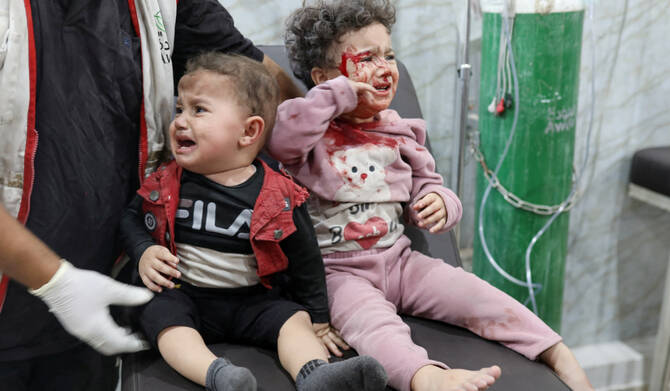
Palestinian children receive medical attention at Al-Awda Hospital, following an Israeli air strike, according to medics, in Gaza City November 22, 2025. (REUTERS)
Short Url
Updated 22 November 2025
Follow

At least 2 kids killed per day in Gaza since ceasefire: UNICEF

  • Medecins Sans Frontieres says it is treating women, children for fractures, gunshot wounds

GENEVA: At least 67 children have been killed in conflict-related incidents since the ceasefire began in Gaza, the United Nations children’s agency said.

“Dozens more have been injured. That is an average of almost two children killed every day since the ceasefire took effect,” UNICEF spokesperson Ricardo Pires said in Geneva.
UNICEF said on Thursday that a baby girl was killed in an airstrike in eastern Khan Younis in southern Gaza, alongside her parents. 
On Wednesday, seven children were killed in airstrikes in Gaza City and the south, UNICEF said.

FASTFACT

A nine-year-old girl was treated on Wednesday at a Gaza City hospital for an injury to her face caused by gunfire from an Israeli drone, MSF said, citing a nurse in Gaza.

Meanwhile, Medecins Sans Frontieres said that its medical teams in Gaza had treated Palestinian women and children this week for injuries from Israeli airstrikes and gunfire, almost six weeks into a fragile Israel-Hamas ceasefire.
Since Wednesday, medical staff in northern and southern Gaza have treated women and children with open fractures and gunshot wounds to their limbs and heads, according to Medecins Sans Frontieres, a charity also known as Doctors Without Borders.
MSF said that medical care had been provided in hospitals and clinics in Gaza City in the north and Rafah in the south.
A nine-year-old girl was treated on Wednesday at a Gaza City hospital for an injury to her face caused by gunfire from an Israeli drone, MSF said, citing a nurse in Gaza.
Under the ceasefire deal, Israel’s military pulled back to a so-called “yellow line,” leaving it in control of 53 percent of the Gaza Strip. Gaza City, the enclave’s largest urban area, is under Hamas control. Rafah is under Israeli control.
Both Israel and Hamas have accused each other of repeatedly violating the ceasefire, although it is still formally holding.
Israel’s military has said that since Oct. 10 it has killed individuals it described as “terrorists” crossing the yellow line, and carried out strikes it has said were in retaliation for attacks on its soldiers.
According to the Gaza Health Ministry, 312 Palestinians have been killed in Gaza by the Israeli military since Oct. 11.


Syria’s Kurds hail ‘positive impact’ of Turkiye peace talks

Updated 06 December 2025
Follow

Syria’s Kurds hail ‘positive impact’ of Turkiye peace talks

  • “The peace initiative in Turkiye has had a direct impact on northern and eastern Syria,” said Elham Ahmad
  • “We want a dialogue process with Turkiye, a dialogue that we understand as Kurds in Syria”

ISTANBUL: Efforts to broker peace between Turkiye and the Kurdish militant group PKK have had a “positive impact” on Syria’s Kurds who also want dialogue with Ankara, one of its top officials said Saturday.
Earlier this year, the Kurdistan Workers’ Party (PKK) ended its four-decade armed struggle against Turkiye at the urging of its jailed founder Abdullah Ocalan, shifting its focus to a democratic political struggle for the rights of Turkiye’s Kurdish minority.
The ongoing process has raised hopes among Kurds across the region, notably in Syria where the Kurds control swathes of territory in the north and northeast.
“The peace initiative in Turkiye has had a direct impact on northern and eastern Syria,” said Elham Ahmad, a senior official in the Kurdish administration in Syria’s northeast.
“We want a dialogue process with Turkiye, a dialogue that we understand as Kurds in Syria... We want the borders between us to be opened,” she said, speaking by video link to an Istanbul peace conference organized by Turkiye’s pro-Kurdish opposition DEM party.
Speaking in Kurdish, she hailed Turkiye for initiating the peace moves, but said releasing Ocalan — who has led the process from his cell on Imrali prison island near Istanbul where he has been serving life in solitary since 1999 — would speed things up.
“We believe that Abdullah Ocalan being released will let him play a much greater role... that this peace and resolution process will happen faster and better.”
She also hailed Ankara for its sensitive approach to dialogue with the new regime in Damascus that emerged after the ousting of Syrian strongman Bashar Assad a year ago.
“The Turkish government has a dialogue and a relationship with the Syrian government. They also have open channels with us. We see that there is a careful approach to this matter,” she said.
Turkiye has long been hostile to the Kurdish SDF force that controls swathes of northeastern Syria, seeing it as an extension of PKK, and pushing for the US-backed force to integrate into the Syrian military and security apparatus.
Although a deal was reached to that end in March, its terms were never implemented.
“In this historic process, as the Middle East is being reorganized, Turkiye has a very important role. Peace in both countries — within Turkish society, Kurdish society and Arab society.. will impact the entire Middle East,” Ahmad said.
Syria’s Kurdish community believed coexistence was “fundamental” and did not want to see the nation divided, she said.
“We do not support the division of Syria or any other country. Such divisions pave the way for new wars. That is why we advocate for peace.”