

G20 leaders meet in South Africa seeking agreement, despite US boycott

1 / 3
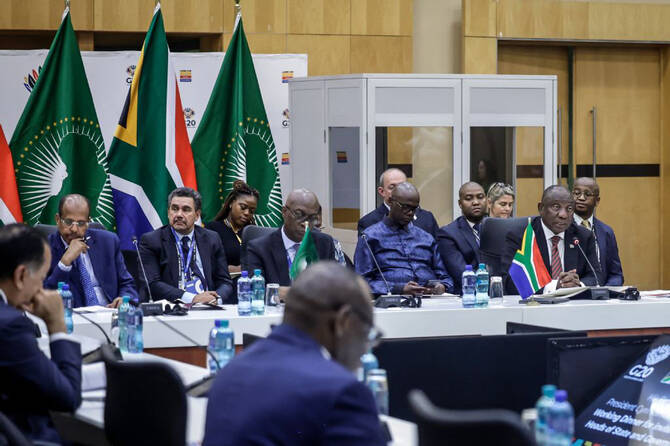
South Africa's President Cyril Ramaphosa delivers remarks during a working dinner for invited African heads of state and government at the Sandton Convention Centre on November 21, 2025, ahead of the G20 leaders' Summit. (AFP)
2 / 3
South Africa's President Cyril Ramaphosa (2nd R) delivers remarks during a working dinner for invited African heads of state and government at the Sandton Convention Centre in Sandton on November 21, 2025, ahead of the G20 leaders' Summit. (AFP)
3 / 3
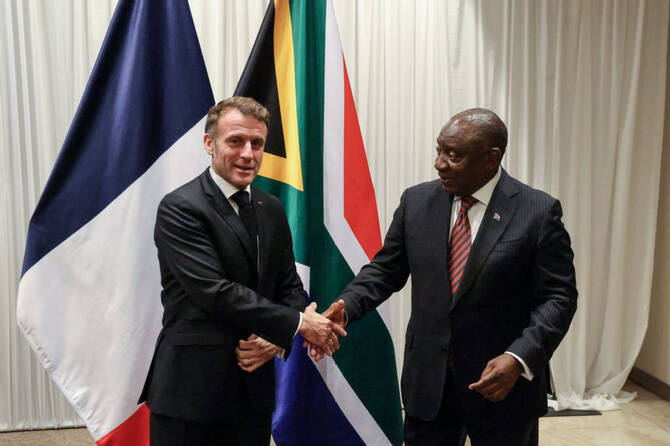
France’s President Emmanuel Macron (L) shakes hands with South Africa's President Cyril Ramaphosa (R) during their bilateral meeting at the Sandton Convention Centre in Sandton on November 21, 2025, ahead of the G20 leaders' Summit. (POOL / AFP)
Short Url
Updated 22 November 2025
Follow

G20 leaders meet in South Africa seeking agreement, despite US boycott

  • US boycotts summit over alleged persecution of white South Africans
  • Climate change a contentious issue in summit discussions

JOHANNESBURG : Leaders of the Group of 20 top economies gathered for a US-boycotted summit in South Africa on Saturday, seeking a deal on a draft declaration drawn up without US input in a surprise move that a senior White House official described as “shameful.”
G20 envoys have agreed on a draft leaders’ declaration ahead of the weekend summit in Johannesburg, in which several of the top agenda items are about climate change. The draft was drawn up without seeking US consensus, four sources familiar with the matter said on Friday.
One of those sources confirmed late on Friday that the draft made references to climate change, despite objections from the administration of US President Donald Trump, who doubts the scientific consensus that warming is caused by human activities.


UN Secretary-General Antonio Guterres attends a media briefing inside the G20 Summit venue at the Nasrec Expo Centre, ahead of the summit in Johannesburg, South Africa, on November 21, 2025. (REUTERS)

Trump has indicated that it will boycott the summit because of allegations, widely discredited, that the host country’s Black majority government persecutes its white minority.
The US president has also rejected the host nation’s agenda of promoting solidarity and helping developing nations adapt to weather disasters, transition to clean energy and cut their excessive debt costs.
The boycott had put a dampener on President Cyril Ramaphosa’s plans to trumpet South Africa’s role in promoting multilateral diplomacy, but some analysts suggested it might benefit it, if other members embrace the summit’s agenda and make headway on a substantive declaration.
It was not clear what concessions had to be made on the language to get everyone to agree. The United States had objected to any mention of climate or renewable energy in the discussion, and some other members are often reticent about it.
Three out of four of South Africa’s planned top agenda items — preparing for climate-induced weather disasters, financing the transition to green energy, and ensuring the rush for critical minerals benefits producers — are largely about climate change.
The fourth is about a more equitable system of borrowing for poor countries.
The United States will host the G20 in 2026 and Ramaphosa said he would have to hand over the rotating presidency to an “empty chair.” The South African presidency has rejected the White House’s offer to send the US charge d’affaires for the G20 handover.


Taiwan says China deploys warships in ‘military operations’

Updated 5 sec ago
Follow

Taiwan says China deploys warships in ‘military operations’

TAIPEI: Taiwan said Friday that China had deployed warships for “military operations” stretching hundreds of kilometers from the Yellow Sea to the South China Sea, posing a “threat” to the region.
Beijing, which claims self-ruled Taiwan as part of its territory, neither confirmed nor denied the maneuvers.
Taiwan’s defense ministry and other security agencies were monitoring China’s activities and had a “complete grasp of the situation,” presidential office spokeswoman Karen Kuo told reporters.
She did not say how many Chinese ships were involved in the deployment, but a security source told AFP the number was “significant.” The source spoke on condition of anonymity because they were not authorized to speak to the media.
The operations were not limited to the Taiwan Strait, but extended from the southern Yellow Sea, to the East China Sea near the disputed Diaoyu Islands and on into the South China Sea and even the Western Pacific, Kuo said.
“This indeed poses a threat and impact on the Indo-Pacific and the entire region,” she said.
Taiwan urged China to “exercise restraint,” Kuo said, adding: “We are also confident that we can handle this matter well.”
Neither China’s armed forces nor state media have announced any increased military activity in the region where Taiwan said Chinese ships had been detected.
Beijing’s foreign ministry did not answer directly when asked if the military was amassing a large number of naval vessels in those waters.
“I want to emphasize that China has consistently followed a defensive policy,” spokesman Lin Jian told a regular press briefing.
“The Chinese navy and coast guard strictly operate in relevant waters according to Chinese domestic law and international law,” Lin said.
He urged “relevant parties” not to “overreact or... engage in groundless hype.”
China has refused to rule out using force to take Taiwan, and also claims contentious sovereignty over nearly all of the South China Sea.
Taiwan’s intelligence chief Tsai Ming-yen said Wednesday that October to December was the “peak season” for China’s “annual evaluation exercises.”
There was a possibility that China’s ruling Communist Party could turn seemingly routine military activities into drills targeting Taiwan, Tsai warned.