

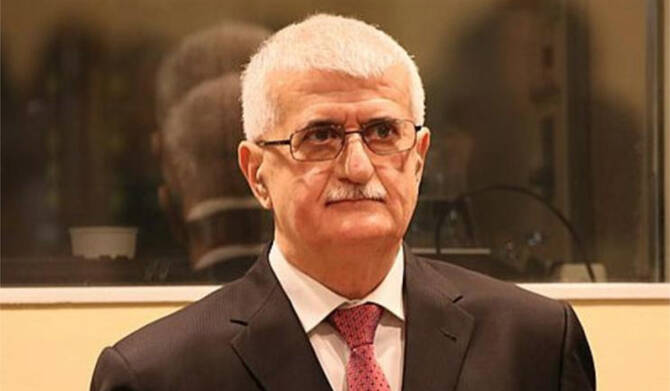
Early release granted to Bosnian Croat war criminal

Bruno Stojic. (Supplied)
Short Url
Updated 10 November 2025
Follow

Early release granted to Bosnian Croat war criminal

  • “The gravity of Stojic’s crimes is high and weighs against granting early release. However, there are a number of positive factors that weigh in favor of early release,” she noted

THE HAGUE: A United Nations court on Monday granted early release to a former Bosnian Croat defense minister convicted of war crimes, including murdering and deporting Muslims in Bosnia in the early 1990s.
The International Residual Mechanism for Criminal Tribunals, based in The Hague, ordered Bruno Stojic released from detention in Austria to return to Croatia.
The 70-year-old had behaved well in prison, admitted the gravity of his crimes and was unlikely to reoffend, said presiding judge Graciela Gatti Santana in her decision.
“The gravity of Stojic’s crimes is high and weighs against granting early release. However, there are a number of positive factors that weigh in favor of early release,” she noted.
She cited “acceptance of personal responsibility for the crimes,” “expression of regret for the consequences” of his actions, “very good behavior in prison” and “good prospects of successful reintegration.”

Stojic was sentenced to 20 years in jail in 2013 along with former Bosnian Croat President Jadranko Prlic and four others.
He had already surrendered to the International Criminal Tribunal for the former Yugoslavia in April 2004. His sentence was due to expire in September 2027.
In 2013, when convicting Stojic and the others, judge Jean-Claude Antonetti said they had aimed to establish reunification with Croatia.
To achieve that, they wanted to “modify the ethnic composition” of the land claimed by Bosnian Croats.
This, Antonetti said, they achieved by force, intimidation and terror “by conducting mass arrests of Bosnian Muslims who were then either murdered, beaten, sexually assaulted, robbed of their property and otherwise abused.”
The bloody 1992-1995 war in Bosnia mainly pitted Bosnian Muslims against Bosnian Serbs, but for a period also saw vicious fighting between Bosnian Muslims and Bosnian Croats. Some 100,000 people lost their lives in the conflict.
In 1992, the Bosnian Croats established a Croatian entity, known as the HVO, which was both an army and a government. In August 1993, they proclaimed the Croatian “state” of Herceg-Bosna in Bosnia.
Stojic was encouraged to “continue, even following his early release, to reflect on his conduct and responsibility and to consider concrete steps he could take to facilitate reconciliation,” according to the court statement.


In show of support, Canada, France open consulates in Greenland

Updated 50 min 11 sec ago
Follow

In show of support, Canada, France open consulates in Greenland

  • Decisions taken in a strong show of support for Greenland government amid threats by US President Trump to seize the island

COPENHAGEN, Denmark: Canada and France, which both adamantly oppose Donald Trump’s wish to control Greenland, will open consulates in the Danish autonomous territory’s capital on Friday, in a strong show of support for the local government.
Since returning to the White House last year, Trump has repeatedly insisted that Washington needs to control the strategic, mineral-rich Arctic island for security reasons.
The US president last month backed off his threats to seize Greenland after saying he had struck a “framework” deal with NATO chief Mark Rutte to ensure greater American influence.
A US-Denmark-Greenland working group has been established to discuss ways to meet Washington’s security concerns in the Arctic, but the details of the talks have not been made public.
While Denmark and Greenland have said they share Trump’s security concerns, they have insisted that sovereignty and territorial integrity are a “red line” in the discussions.
“In a sense, it’s a victory for Greenlanders to see two allies opening diplomatic representations in Nuuk,” said Jeppe Strandsbjerg, a political scientist at the University of Greenland.
“There is great appreciation for the support against what Trump has said.”
French President Emmanuel Macron announced Paris’s plans to open a consulate during a visit to Nuuk in June, where he expressed Europe’s “solidarity” with Greenland and criticized Trump’s ambitions.
The newly-appointed French consul, Jean-Noel Poirier, has previously served as ambassador to Vietnam.
Canada meanwhile announced in late 2024 that it would open a consulate in Greenland to boost cooperation.
The opening of the consulates is “a way of telling Donald Trump that his aggression against Greenland and Denmark is not a question for Greenland and Denmark alone, it’s also a question for European allies and also for Canada as an ally, as a friend of Greenland and the European allies also,” Ulrik Pram Gad, Arctic expert at the Danish Institute of International Studies, told AFP.
“It’s a small step, part of a strategy where we are making this problem European,” said Christine Nissen, security and defense analyst at the Europa think tank.
“The consequences are obviously not just Danish. It’s European and global.”

Recognition

According to Strandsbjerg, the two consulates — which will be attached to the French and Canadian embassies in Copenhagen — will give Greenland an opportunity to “practice” at being independent, as the island has long dreamt of cutting its ties to Denmark one day.
The decision to open diplomatic missions is also a recognition of Greenland’s growing autonomy, laid out in its 2009 Self-Government Act, Nissen said.
“In terms of their own quest for sovereignty, the Greenlandic people will think to have more direct contact with other European countries,” she said.
That would make it possible to reduce Denmark’s role “by diversifying Greenland’s dependence on the outside world, so that it is not solely dependent on Denmark and can have more ties for its economy, trade, investments, politics and so on,” echoed Pram Gad.
Greenland has had diplomatic ties with the European Union since 1992, with Washington since 2014 and with Iceland since 2017.
Iceland opened its consulate in Nuuk in 2013, while the United States, which had a consulate in the Greenlandic capital from 1940 to 1953, reopened its mission in 2020.
The European Commission opened its office in 2024.