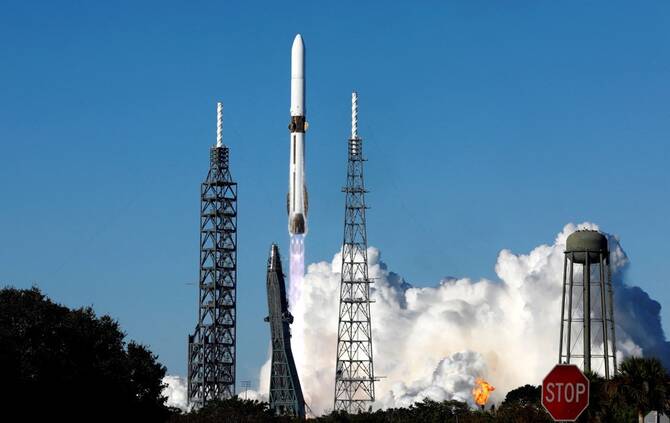
WASHINGTON: Jeff Bezos’ space company Blue Origin said on Thursday it will build a bigger, more powerful variant of its New Glenn rocket, drawing early plans for a family of orbital satellite launchers akin to the fleet of Falcon rockets from Elon Musk’s dominant SpaceX.
The new rocket, announced after New Glenn’s second mission launched last week, will be called New Glenn 9x4, a name referencing nine engines that will power its first stage and four engines on its second stage. That is an increase of two engines for each stage from New Glenn’s current design.
“The next chapter in New Glenn’s roadmap is a new super-heavy class rocket,” Blue Origin said in a statement outlining other rocket upgrades.
Blue Origin did not say when it expects to fly the larger rocket variant. “We aren’t disclosing a specific timeframe today. The iterative design from our current 7x2 vehicle means we can build this rocket quickly,” a spokesman said in response to timeline questions.
The two New Glenn variants, the company said, “will serve the market concurrently, giving customers more launch options for their missions, including mega-constellations, lunar and deep space exploration, and national security imperatives such as Golden Dome.”
US launch companies such as Rocket Lab, SpaceX and United Launch Alliance, which Boeing and Lockheed Martin own, are either building or have early plans for larger rockets that can put bigger batches of satellite constellations into space.
Blue Origin spent billions of dollars and roughly a decade developing New Glenn, a 29-story rocket with a reusable first stage meant to compete with SpaceX’s Falcon fleet and more powerful Starship, a fully reusable rocket that remains in development.
Dave Limp, Blue Origin’s CEO, posted on X digital renderings of the super-heavy New Glenn standing taller than Saturn V, the 17-story rocket that sent humans to the moon under the US Apollo program. The 9x4 rocket has a larger payload fairing and appears far taller than the original New Glenn design.

Blue Origin unveils plan for bigger New Glenn rocket variant to take on SpaceX
https://arab.news/ns9fz
Blue Origin unveils plan for bigger New Glenn rocket variant to take on SpaceX
St. Francis relics go on public show for first time in Italy
Assisi, Italy: Saint Francis of Assisi’s skeleton is going on public display from Sunday for the first time for the 800th anniversary of his death, drawing hundreds of thousands of visitors.
Inside a nitrogen-filled plexiglass case with the Latin inscription “Corpus Sancti Francisci” (The Body of St. Francis), the remains are being shown in the Italian hill town’s Basilica of St. Francis of Assisi.
St. Francis, who died on October 3, 1226, founded the Franciscan order after renouncing his wealth and devoting his life to the poor.
Giulio Cesareo, director of communications for the Franciscan convent in Assisi said he hoped the display could be “a meaningful experience” for believers and non-believers alike.
Cesareo, a Franciscan friar, said the “damaged” and “consumed” state of the bones showed that St. Francis “gave himself completely” to his life’s work.
His remains, which will be on display until March 22, were transferred to the basilica built in the saint’s honor in 1230.
But it was only in 1818, after excavations carried out in utmost secrecy, that his tomb was rediscovered.
Apart from previous exhumations for inspection and scientific examination, the bones of Saint Francis have only been displayed once, in 1978, to a very limited public and for just one day.
Usually hidden from view, the transparent case containing the relics since 1978 was brought out on Saturday from the metal coffer in which it is kept, inside his stone tomb in the crypt of the basilica.
The case is itself inside another bullet-proof and anti-burglary glass case.
Surveillance cameras will operate 24 hours a day for added protection of the remains.
St. Francis is Italy’s patron saint and the 800th anniversary commemorations of his death will also see the restoration of an October 4 public holiday in his honor.
The holiday had been scrapped nearly 50 years ago for budget reasons.
Its revival is also a tribute to late pope Francis who took on the saint’s name.
Pope Francis died last year at the age of 88.
‘Not a movie set’
Reservations to see the saint’s remains already amount to “almost 400,000 (people) coming from all parts of the world, with of course a clear predominance from Italy,” said Marco Moroni, guardian of the Franciscan convent.
“But we also have Brazilians, North Americans, Africans,” he added.
During this rather quiet time of year, the basilica usually sees 1,000 visitors per day on weekdays, rising to 4,000 on weekends.
The Franciscans said they were expecting 15,000 visitors per day on weekdays and up to 19,000 on Saturdays and Sundays for the month-long display of the remains.
“From the very beginning, since the time of the catacombs, Christians have venerated the bones of martyrs, the relics of martyrs, and they have never really experienced it as something macabre,” Cesareo said.
What “Christians still venerate today, in 2026, in the relics of a saint is the presence of the Holy Spirit,” he said.
Another church in Assisi holds the remains of Carlo Acutis, an Italian teenager who died in 2006 and who was canonized in September by Pope Leo XIV.
Experts said the extended display of St. Francis’s remains should not affect their state of preservation.
“The display case is sealed, so there is no contact with the outside air. In reality, it remains in the same conditions as when it was in the tomb,” Cesareo said.
The light, which will remain subdued in the church, should also not have an effect.
“The basilica will not be lit up like a stadium,” Cesareo said. “This is not a movie set.”