Fire forces evacuation at UN climate talks

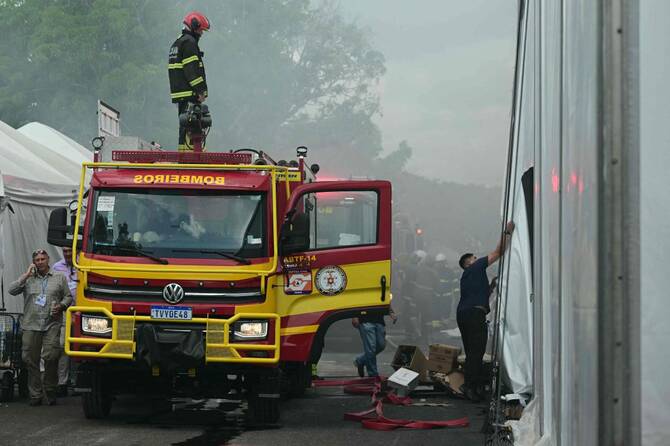
Firefighters battle a fire that broke out in a pavilion at the COP30 UN Climate Change Conference venue in Belem, Para state, Brazil, Nov. 20, 2025. (Pablo PORCIUNCULA / AFP)
Short Url
Updated 20 November 2025
Follow

Fire forces evacuation at UN climate talks

  • UN and security crews rushed with extinguishers to put out the fierce blaze
  • Authorities said the fire might have resulted from an electrical malfunction

BELEM: A fire erupted in a pavilion of the UN climate talks in Brazil on Thursday, forcing panicked delegates to run for the exits and interrupting negotiations.
UN and security crews rushed with extinguishers to put out the fierce blaze, which quickly tore a hole in the fabric roof of the COP30 summit site in Belem as smoke engulfed the corridor and people shouted “fire!“
The fire was brought under control and no injuries were reported, Brazilian Tourism Minister Celso Sabino said. The cause was not immediately known but Sabino said it might have resulted from a short circuit or other electrical malfunction.
The UN body that oversees the COP talks said there had been “limited damage” but the site would reopen no sooner than 8:00 p.m. (2300 GMT).
Firefighters arrived at the scene as smoke billowed inside and out of the conference, which is being held in a compound that includes a permanent structure and large tents in the city at the edge of the Amazon, with tens of thousands of people in attendance.
The fire started in a country pavilion inside the site’s “blue zone,” meaning under UN control, near the entrance of COP30. A light drizzle caused people outside to cheer and cleansed an acrid stench, but it was unclear when the site would reopen.
The fire took place as ministers were deep in negotiations aimed at breaking a deadlock over fossil fuels, climate finance and trade measures, with one day left in the two-week conference.
“It will absolutely delay the process because this is like the crucial time, this is the time when we have to decide on the process that started last week,” Windyo Laksono, a member of the Indonesian delegation, told AFP.
“Some of us were still negotiating inside the room but due to the fire I think the process will stop for a while,” he said.

- Smoke inhalation -

Dr. Kimberly Humphrey, an emergency medicine specialist attending COP30 with Doctors for the Environment Australia, was working in a room when she received messages about a fire.
Humphrey left the site and volunteered at a medical center where some people were treated for smoke inhalation and others suffered emotional distress.
“It’s not what you expect to happen when you are at a conference,” she told AFP.
“Initially, there’s a sense of disbelief. ... The first thing I thought was, ‘oh, this isn’t real,’” Humphrey said.
“It’s really a combination of terror and not having a good emergency plan, not knowing where the exits are, but also what I need to do as a doctor and needing to help people, too.”
Two women who worked in a pavilion belonging to an international organization told AFP that the facilities had been fitted with makeshift electrical wiring.
There were exposed wires and water dripped from the roof onto their electrical panel, they said on condition of anonymity, adding that they reported the issues but to no avail.
Delegates said neither the fire alarms nor the sprinklers went off, though Brazilian volunteers handled the evacuation smoothly.
“It’s a COP of strange events,” said an African delegate, recalling an instance last week when Indigenous protesters forced their way inside.

- ‘World is watching Belem’ -

Joao Paulo Capobianco, executive secretary of Brazil’s environment ministry, told television channel GNews that there were apparently “no serious consequences” from the fire and the electrical system was up and running again.
“No negotiation room was affected. No area used by delegations was affected,” he said.
Nearly 200 countries have spent the past two weeks hashing out issues at COP30 — from a “roadmap” to transition away from fossil fuels proposed by host Brazil, to concerns over weak emissions-reduction plans, finance for developing countries, and trade barriers.
Earlier in the day, UN Secretary-General Antonio Guterres urged negotiators to reach an “ambitious compromise.”
“The world is watching Belem,” he told reporters during a morning news conference, as nations awaited a new draft negotiating text before the summit officially closes on Friday evening.


Olympic organizers invoke an ancient pledge to call for the suspension of all wars

Updated 3 sec ago
Follow

Olympic organizers invoke an ancient pledge to call for the suspension of all wars

  • In ancient Greece, a truce was respected by warring city-states, allowing athletes and spectators to travel safely to Ancient Olympia for competitions and ceremonies
ATHENS: If the rules of ancient Greece were observed today, drone and missile fire over Ukraine would stop on Friday as guns fall silent in the Olympic tradition.
The Milan Cortina Winter Olympics begin in one week, and the United Nations and organizers are calling for a 7-week pause of all wars worldwide — as they do every time the Olympics take place.
It serves to set a moral baseline at a time when some researchers say there are more armed conflicts than ever before and Earth is at its closest to destruction.
An ancient pause, a modern plea
In ancient Greece, a truce was respected by warring city-states, allowing athletes and spectators to travel safely to Ancient Olympia for competitions and ceremonies of supreme athletic and spiritual significance.
The Olympics were revived in their modern form in 1896. The truce’s resurgence followed nearly a century later, in 1994, as war raged through the former Yugoslavia.
The proposed timeout starts one week before the Winter Games open on Feb. 6 and runs until one week after the March 15 Paralympics’ close. It is backed by a UN General Assembly resolution.
If history is any indication, no sudden worldwide peace is imminent: The truce has a dismal 0-17 record, having failed to halt a single war.
Sarajevo, Korea and the power of sport
The first modern Olympic truce, during the 1994 Winter Games in Lillehammer, Norway, did produce a one-day pause in the siege of Sarajevo, allowing aid convoys to deliver food and medicine to the Bosnian capital’s desperate residents. In Sydney six years later, North and South Korea marched together at the opening ceremony.
Governments around the world overwhelmingly agree that sport can unite and heal.
“Wherever possible, we should strive toward creating even a small space for peace,” Constantinos Filis, director of the International Olympic Truce Center, told The Associated Press.
Ceasefire initiatives still count in an era of global disorder and political polarization, as unilateral aggression increasingly threatens international cooperation, argues Filis, who is also director of the Institute of Global Affairs in Athens.
“This may not always be achievable in practice,” he said, “but the message reaches every corner of the globe.”
Arithmetic of a world’s wars
Outside the Swedish capital of Stockholm, a group of academics has tracked global war trends for more than 80 years. It reported that 2024 had the highest number of active armed conflicts in a single year: 61.
“We’ve seen quite a strong increase in the number of conflicts over the past five or six years,” said Shawn Davies, a senior analyst at Uppsala University’s Department of Peace and Conflict Research. And its upcoming annual report will show 2025 had even more conflicts than the prior year, he added.
As the US steps back from multilateralism, Davies said, countries are becoming more likely to test their neighbors, creating a more volatile, fragmented security landscape.
Some major conflicts remain largely unnoticed in the West, he said, pointing to western Africa, where Al-Qaeda and Daesh group affiliates continue to spread across borders.
And the “Doomsday Clock”, a symbolic gauge of Earth’s existential peril, edged closer to midnight this week, according to an announcement from members of the Bulletin of the Atomic Scientists.
Hope versus broken promises
UN truce resolutions typically pass with broad majorities. Yet signatories repeatedly break their own pledge. Russia’s full-scale invasion of Ukraine in 2022 infamously began during a truce period.
“I think the Olympics are an excellent moment to symbolize peace, to symbolize respect for international law, and to symbolize international cooperation,” UN Secretary-General António Guterres told reporters Thursday.
Kirsty Coventry, the multi-Olympic swimming champion who last year became the first woman to lead the International Olympic Committee, addressed the General Assembly at the latest vote in November.
Watching peaceful competition, she said, inspired her to begin her gold-medal journey as a young girl in Zimbabwe.
“Even in these dark times of division, it is possible to celebrate our shared humanity and inspire hope for a better future,” Coventry said.
“Sport — and the Olympic Games in particular — can offer a rare space where people meet not as adversaries, but as fellow human beings,” she said. “This is why the Olympic Truce is so important.”