

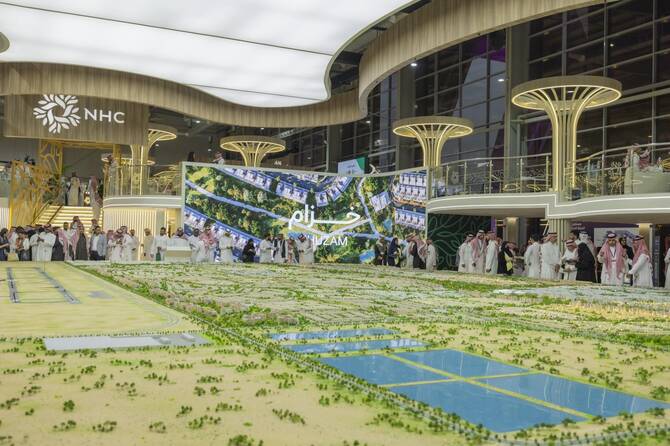

RIYADH: The final day of Cityscape Global 2025 wrapped up with a wave of high-value announcements and multibillion-dollar deals, reaffirming the strong momentum in Saudi Arabia’s real estate and urban development sectors.
The National Housing Co. was among the most active participants, signing several major agreements. NHC concluded an execution contract with AlMowatin Co. to construct 1,075 residential units in Riyadh’s Al-Fursan destination, a development valued at more than SR875 million ($233.4 million).
NHC also announced a major development agreement for the “Mashaal Al-Fursan” project within the same destination. The SR880 million investment will add 1,120 apartments across a 116,000-sq.-meter area, further expanding housing supply and diversity. Al-Fursan itself spans over 35 million sq. meters and is set to become one of Saudi Arabia’s largest mixed-use urban developments, ultimately offering more than 50,000 residential units.
Extending its footprint beyond the capital, NHC signed a development agreement for the “Dar Makkah” project at the “Gate to Makkah” destination. Valued at over SR899 million, the project will see the construction of more than 930 villas on a 236,000-sq.-meter site located 20 minutes from the Grand Mosque, supporting housing growth in the holy city.
In an initiative aimed at broadening homeownership opportunities, NHC, under the patronage of Minister of Municipalities and Housing Majid Al-Hogail, signed a partnership with Bank Albilad to offer exclusive financing options with rates starting at 2.95 percent. Additional collaboration with SHL Finance Co. will focus on developing tailored financing solutions for NHC projects.
The Real Estate Development Fund also played a prominent role, signing an MoU with the General Authority for Awqaf to develop real estate products that align with endowment requirements, strengthening the developmental impact of Awqaf assets. Another MoU with Sakani will integrate the two entities’ digital platforms to provide seamless access to housing and financing options.
The Ministry of Municipalities and Housing strengthened its partnerships through multiple agreements, including an MoU with Academia Arabia to provide training and development programs for beneficiaries of developmental housing. Additional cooperation agreements were signed with Al-Othaim Investment Co., Othaim Training Academy and GCC LAB to advance skills development and investment partnerships.
In a significant step toward smart community development, stc Group signed a strategic partnership with ROSHN Group to deploy neutral digital infrastructure for the SEDRA community under stc’s “newtrack” program, ensuring robust digital connectivity for residents and visitors.
The event also spotlighted the growing role of data and cross-sector collaboration in urban planning. Key panel discussions featured Eastern Province Mayor Fahd Al-Jubeir and Bahrain’s Urban Planning and Development Authority CEO Ahmed Al-Khayyat, who highlighted the use of data in shaping future Gulf cities. Public Investment Fund executive Saad Al-Khroud outlined the PIF’s vision for building integrated ecosystems that enhance quality of life.
On the regulatory front, ROSHN Group received the Kingdom’s first instant “Off-Plan Sales” license, a new service introduced by the Real Estate General Authority to streamline development procedures.
Underscoring the scale of market activity, Al-Hogail revealed that real estate transactions during the first two days of the exhibition exceeded SR161.2 billion. He also noted that the Kingdom’s five major cities will require more than 1.5 million additional housing units by 2030.
Cityscape Global 2025 concluded with a clear message: Saudi Arabia is rapidly reshaping its urban landscape, setting new standards for sustainable, connected and future-ready communities.


