

Pakistan to sell 75% stake in national airline, bidding to begin ‘soon’

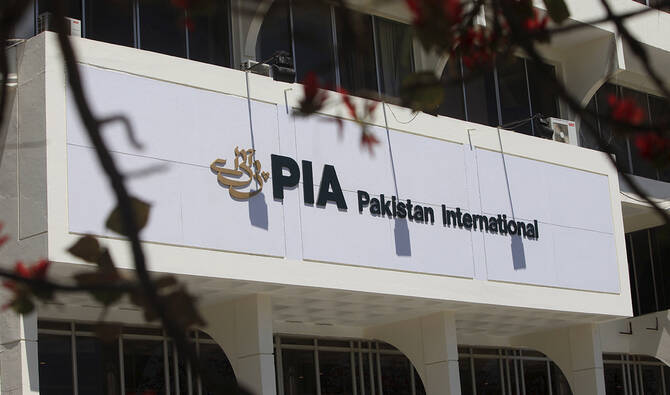
The logo of Pakistan International Airlines (PIA) is seen in Islamabad, Pakistan, April 12, 2016. (REUTERS)
Short Url
Updated 20 November 2025
Follow

Pakistan to sell 75% stake in national airline, bidding to begin ‘soon’

  • Move comes as debt-laden PIA struggles with losses, EU flight bans, past failed privatization attempts and IMF reform pressure 
  • Government plans to retain PIA name and branding, expand fleet and route network under new business plan, PM office says 

KARACHI: Pakistan will privatize 75 percent of its national carrier, Pakistan International Airlines (PIA), while retaining its name and branding, the Prime Minister’s Office said on Thursday, adding that bidding will begin soon among four shortlisted investor groups.

The decision marks Islamabad’s most aggressive push in decades to reform the debt-ridden airline, which has accumulated more than $2.5 billion in losses and become a major burden on the national budget. Once regarded as one of Asia’s premier carriers, PIA has struggled with chronic mismanagement, political interference, overstaffing, mounting debt and operational issues that led to a 2020 ban on flights to the European Union and United Kingdom after a pilot licensing scandal. Privatizing the airline is also a key requirement under Pakistan’s $7 billion International Monetary Fund (IMF) program agreed last year.

On Thursday, Prime Minister Shehbaz Sharif chaired a meeting on the airline’s privatization where officials briefed him on the transaction structure and business plan. He directed authorities to “swiftly and transparently” complete the long-delayed process.

“The bidding process will begin soon and 75 percent of PIA’s shares will be privatized,” the PM Office said in a statement.

“Under the privatization terms, PIA’s name and theme will not be changed after the transaction,” it added. “Under the business plan, the number of airworthy aircraft in PIA’s fleet will be increased from 18 to 38 by 2029.”

The statement said Sharif also directed authorities to prepare a plan to increase the number of airworthy aircraft in PIA’s fleet and ensure timely departure of PIA flights. The plan also envisions expanding PIA’s operations from 30 to over 40 cities by 2029.

In July, Pakistan prequalified four investor groups for the sale: A consortium of major industrial companies, Lucky Cement, Hub Power Holdings, Kohat Cement and Metro Ventures; a consortium led by Arif Habib Corporation with Fatima Fertilizer, The City School and Lake City Holdings; Fauji Fertilizer Company, part of a military-backed conglomerate; and Airblue, a private Pakistani airline.

PIA has relied on government bailouts for decades, with repeated attempts at privatization collapsing due to union resistance, legal challenges and limited investor interest. A deal late last year also fell through after a potential buyer reportedly offered just $36 million for a 60 percent stake, far below the asking price of roughly $303 million.

Earlier in November, Pakistan’s privatization chief Muhammad Ali had said the government aimed to finalize the airline’s sale by October, but the target was missed due to delays in restructuring and valuation.


Pakistan, global crypto exchange discuss modernizing digital payments, creating job prospects 

Updated 05 December 2025
Follow

Pakistan, global crypto exchange discuss modernizing digital payments, creating job prospects 

  • Pakistani officials, Binance team discuss coordination between Islamabad, local banks and global exchanges
  • Pakistan has attempted to tap into growing crypto market to curb illicit transactions, improve oversight

ISLAMABAD: Pakistan’s finance officials and the team of a global cryptocurrency exchange on Friday held discussions aimed at modernizing the country’s digital payments system and building local talent pipelines to meet rising demand for blockchain and Web3 skills, the finance ministry said.

The development took place during a high-level meeting between Finance Minister Muhammad Aurangzeb, Pakistan Virtual Assets Regulatory Authority (PVARA) Chairman Bilal bin Saqib, domestic bank presidents and a Binance team led by Global CEO Richard Teng. The meeting was held to advance work on Pakistan’s National Digital Asset Framework, a regulatory setup to govern Pakistan’s digital assets.

Pakistan has been moving to regulate its fast-growing crypto and digital assets market by bringing virtual asset service providers (VASPs) under a formal licensing regime. Officials say the push is aimed at curbing illicit transactions, improving oversight, and encouraging innovation in blockchain-based financial services.

“Participants reviewed opportunities to modernize Pakistan’s digital payments landscape, noting that blockchain-based systems could significantly reduce costs from the country’s $38 billion annual remittance flows,” the finance ministry said in a statement. 

“Discussions also emphasized building local talent pipelines to meet rising global demand for blockchain and Web3 skills, creating high-value employment prospects for Pakistani youth.”

Blockchain is a type of digital database that is shared, transparent and tamper-resistant. Instead of being stored on one computer, the data is kept on a distributed network of computers, making it very hard to alter or hack.

Web3 refers to the next generation of the Internet built using blockchain, focusing on giving users more control over their data, identity and digital assets rather than big tech companies controlling it.

Participants of the meeting also discussed sovereign debt tokenization, which is the process of converting a country’s debt such as government bonds, into digital tokens on a blockchain, the ministry said. 

Aurangzeb called for close coordination between the government, domestic banks and global exchanges to modernize Pakistan’s payment landscape.

Participants of the meeting also discussed considering a “time-bound amnesty” to encourage users to move assets onto regulated platforms, stressing the need for stronger verifications and a risk-mitigation system.

Pakistan has attempted in recent months to tap into the country’s growing crypto market, crack down on money laundering and terror financing, and promote responsible innovation — a move analysts say could bring an estimated $25 billion in virtual assets into the tax net.

In September, Islamabad invited international crypto exchanges and other VASPs to apply for licenses to operate in the country, a step aimed at formalizing and regulating its fast-growing digital market.