NEW YORK: A beloved Christmas tree tradition is returning to Manhattan for the holiday season next week. No, it’s not the towering spruce at Rockefeller Center, which is lit in early December.
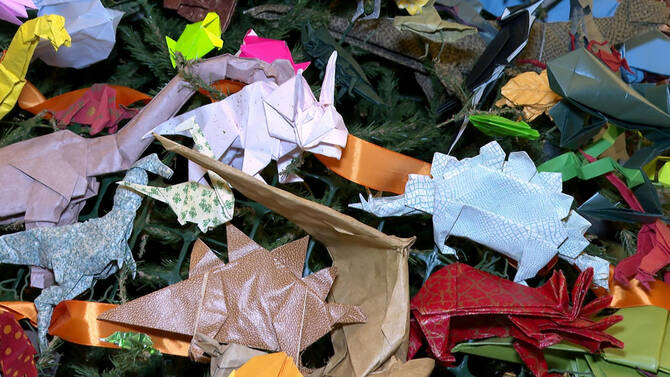
The comparatively smaller Origami Holiday Tree that’s delighted crowds for decades at the American Museum of Natural History opens to the public on Monday. The colorful, richly decorated 13-foot (4-meter) tree is adorned with thousands of hand-folded paper ornaments created by origami artists from around the world.
This year’s tree is inspired by the museum’s new exhibition, “Impact: The End of the Age of Dinosaurs,” which chronicles how an asteroid crash some 66 million years ago reshaped life on Earth.
Talo Kawasaki, the tree’s co-designer, said the tree’s theme is “New Beginnings,” in reference to the new world that followed the mass extinction.
Located off the museum’s Central Park West entrance, the artificial tree is topped with a golden, flaming asteroid.
Its branches and limbs are packed with origami works representing a variety of animals and insects, including foxes, cranes, turtles, bats, sharks, elephants, giraffes and monkeys. Dinosaur favorites such as the triceratops and tyrannosaurus rex are also depicted in the folded paper works of art.
“We wanted to focus more not so much the demise of the dinosaurs, but the new life this created, which were the expansion and the evolution of mammals ultimately leading to humanity,” Kawasaki explained on a recent visit.
The origami tree has been a highlight of the museum’s holiday season for more than 40 years.
Volunteers from all over the world are enlisted to make hundreds of new models. The intricate paper artworks are generally made from a single sheet of paper but can sometimes take days or even weeks to perfect.
The new origami pieces are bolstered by archived works stored from prior seasons, including a 40-year-old model of a pterosaur, an extinct flying reptile, that was folded for one of the museum’s first origami trees in the early 1970s.
Rosalind Joyce, the tree’s co-designer, estimates that anywhere from 2,000 to 3,000 origami works are embedded in the tree.
“This year there’s a lot of stuff stuffed in there,” she said. “So I don’t count.”


![]()
![]()

Holiday tree featuring thousands of origami works opens at NYC’s American Museum of Natural History

Short Url
https://arab.news/rhug9
Holiday tree featuring thousands of origami works opens at NYC’s American Museum of Natural History
- The Origami Holiday Tree at the American Museum of Natural History opens to the public on Monday
- This year’s tree is inspired by the museum’s new exhibit chronicling how an asteroid crash killed the dinosaurs and reshaped life on Earth


Latest updates





© 2026 SAUDI RESEARCH & PUBLISHING COMPANY, All Rights Reserved And subject to Terms of Use Agreement.