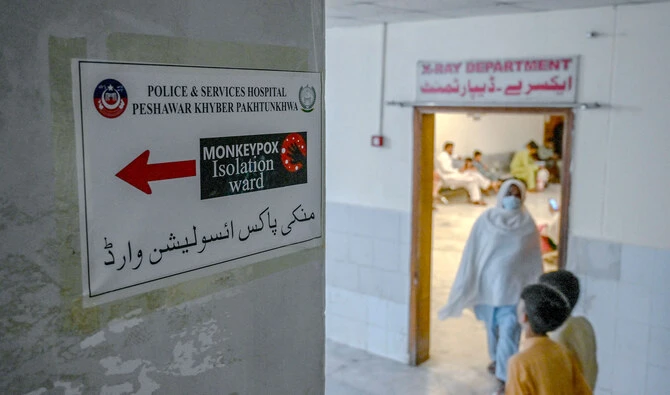
- Medical investigation reveals four deceased infants tested positive for viral infection
- Health authorities claim fatalities linked to birth complications, not the virus itself
ISLAMABAD: Health authorities in Pakistan’s southern Sindh province said on Saturday four of seven newborn babies who tested positive for Mpox in Khairpur district last month had died, prompting officials to shut hospital facilities and intensify containment measures.
Mpox is a viral zoonotic disease that can be transmitted from animals to humans and can also spread between people through close contact, respiratory droplets and contaminated materials. While historically localized to parts of Africa, a global outbreak in 2022 led to a surge in cases worldwide.
In Pakistan, the health ministry identified nine cases in 2023, resulting in one death. By 2024, the situation intensified globally with the emergence of the deadlier Clade 1b variant, leading the World Health Organization (WHO) to declare a Public Health Emergency of International Concern (PHEIC).
“During the investigation, Mpox was confirmed in four out of the seven children,” the provincial health department said in a statement. “However, according to medical experts’ review, these deaths did not occur directly due to Mpox.”
The statement said the deceased infants were “extremely weak by birth, with pre-existing complications such as low weight, premature birth (prematurity) and malnutrition.”
The cases first came to light on March 14 when unusual skin rashes were reported among children in Khairpur. Subsequent testing conducted by laboratories at Dow University and Aga Khan University confirmed the virus in seven newborns.
To contain the spread, provincial authorities have temporarily closed the Neonatal Intensive Care Unit (NICU) of Khairpur Medical College Hospital and a unit at a private hospital.
On the instructions of Provincial Health Minister Dr. Azra Fazal Pechuho, a team of medical experts has identified the “index case” and the likely source of the virus in the affected areas.
“Contact tracing and surveillance have been intensified in District Khairpur and surrounding areas,” the spokesperson said, adding that Infection Prevention and Control (IPC) protocols are now being enforced across all hospitals.
On Mar. 24, Dr. Waqar Memon, the Director General of Health Services for Sindh, issued a letter to Khairpur district officers identifying the cluster as a bacterial infection.
Local medical sources noted that a “wrong diagnosis” at a private facility led to worsening conditions before the provincial health department was finally alerted.
In response to the laboratory confirmation, Dr. Memon enforced an emergency in pediatric units across government hospitals in interior Sindh and appointed a focal person for the disease. The department also sought urgent support from the Aga Khan University (AKU) laboratory for priority testing.
“Early laboratory confirmation is critical for prompt case management, implementation of infection prevention and control measures and prevention of further transmission,” Dr. Memon stated in a letter to the AKU laboratory.
The outbreak has heightened concerns in Pakistan as the World Health Organization (WHO) continues to monitor deadlier variants of the virus globally. While the provincial government initially characterized the cluster as a bacterial infection, the confirmation of Mpox has shifted the response to an emergency footing.
Epidemiologist Dr. Rana Jawad Asghar noted that while the 2022 outbreak involved the milder Clade 2 variant, the current situation is complicated by the evolution of Clade 1.
“The emergence of the Clade 1b variant marks a significant shift, as this version of the virus has grown both more fatal and easier to spread,” Dr. Asghar told Arab News over the phone, highlighting young children are particularly at risk and noting that “preliminary figures indicate that 70% of infections and 90% of fatalities occur in children under the age of 15.”