

Israeli airstrikes kill 25 Palestinians in Gaza, rattling ceasefire, medics say

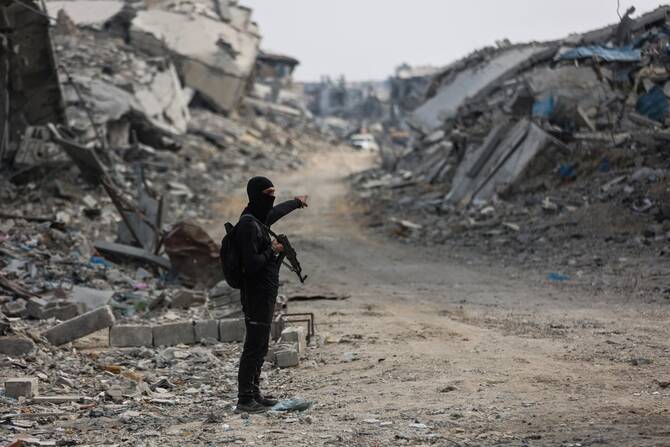
Gaza’s civil defense agency said 22 people were killed in Israeli strikes on Wednesday after Israel’s military announced it was hitting Hamas targets throughout the Palestinian territory. (AFP/File)
Short Url
Updated 19 November 2025
Follow

Israeli airstrikes kill 25 Palestinians in Gaza, rattling ceasefire, medics say

  • The Israeli military said its forces struck Hamas targets across Gaza
  • Hamas urged the US to “honor its stated commitments and exert immediate pressure on Israel”

CAIRO: At least 25 Palestinians were killed in four Israeli airstrikes on Wednesday in a part of Gaza under Hamas control since a shaky ceasefire took effect in October, health authorities said.
The Israeli military said its forces struck Hamas targets across Gaza after members of the Palestinian militant group fired on its troops in violation of the nearly six-week-old ceasefire. No Israeli forces were injured.
Hamas condemned the Israeli strikes as a dangerous escalation, and urged the United States to “honor its stated commitments and exert immediate pressure on Israel to enforce the ceasefire and halt its attacks.”
But a US official, who spoke anonymously, said Hamas was aiming to break the ceasefire and not fulfill its commitment to demilitarize.
“These desperate tactics will fail,” the official said.

INCIDENTS TEST FRAGILE CEASEFIRE
Medics said 10 people were killed in the Gaza City suburb of Zeitoun, two in the Shejaia suburb to the east, and the rest in two separate attacks in Khan Younis in the southern Gaza Strip.
Repeated shooting incidents have pointed to the fragility of the ceasefire. Israel and Hamas have traded blame for what both call violations of the US-brokered truce, the first stage of President Donald Trump’s 20-point plan for a post-war Gaza.
All four attacks were far beyond an agreed-upon imaginary “yellow line” separating the areas under Israeli and Palestinian control, according to medics, witnesses and Palestinian media.
The Zeitoun attack was on a building belonging to Muslim religious authorities and the Khan Younis attack was on a UN-run club, both of which house displaced families. The October 10 ceasefire in the two-year Gaza war has eased the conflict, enabling hundreds of thousands of Palestinians to return to Gaza’s ruins. Israel has pulled troops back from city positions, and aid flows have increased.
But violence has not completely halted. Palestinian health authorities say Israeli forces have killed 305 people in strikes on Gaza since the truce, nearly half of them in one day last week when Israel retaliated for an attack on its troops.
Israel says three of its soldiers have been killed since the ceasefire began and it has targeted scores of fighters.


Iran says missile attacks to continue, US talks ‘not on agenda’

Updated 3 sec ago
Follow

Iran says missile attacks to continue, US talks ‘not on agenda’

  • Abbas Araghchi: ‘I don’t think talking with the Americans would be on our agenda anymore’
  • Top envoy says Tehran had a “very bitter experience” during previous negotiations with the US
TEHRAN: Iran’s foreign minister said Tuesday that talks with the United States were not on the agenda as their war entered its 11th day.
“I don’t think talking with the Americans would be on our agenda anymore,” Abbas Araghchi told PBS News, saying Tehran had a “very bitter experience” during previous negotiations with the US.
On February 28, the US and Israel launched strikes against Iran that killed its supreme leader Ayatollah Ali Khamenei and triggered a war that has spread across the Middle East.
The Israeli and US attacks took place two days before Washington and Tehran were scheduled to hold talks following three prior rounds of negotiations. Omani mediators in those discussions had said there was “significant progress” in the talks.
Iran has responded to the US-Israeli attacks with drone and missile strikes targeting Israel and US interests across the region.
Shipping traffic through the strategic Strait of Hormuz, through which nearly 20 percent of the world’s crude oil usually transits, has been severely disrupted.
Iranian forces have repeatedly targeted oil tankers passing through the strategic waterway since the war began.
In the interview with PBS News, Araghchi insisted that Iran was acting in “self-defense.”
“We are prepared, we have been prepared to continue attacking them with our missiles as long as needed and as long as it takes,” he said.
Late Monday, Iranian deputy foreign minister Kazem Gharibabadi said some countries in the region and elsewhere had reached out to Iran to push for a ceasefire.
“China, Russia and France, and even some countries in the region, are in contact with us,” he told state TV.
“Some of them are willing to do something to stop this war or establish a ceasefire.”
French President Emmanuel Macron said France and its allies are preparing a “defensive” mission to reopen the Strait of Hormuz.
Gharibabadi said Iran “did not start the aggression and the war … we are defending ourselves.”