
ABIDJAN: Niger’s ruling General Abdourahamane Tiani has been criss-crossing the unstable country’s oft-poor highways in recent weeks, visiting regions hard-hit by the growing militant insurgency in an attempt to reassure fearful civilians.
Since toppling democratically elected president Mohamed Bazoum in a July 2023 coup, Tiani has been forced to contend with attacks from Islamist militants on multiple fronts.
While Boko Haram has dug itself in the southwest near the militant hotspot of Lake Chad, fighters linked to Al-Qaeda or the Daesh group have made a fiefdom of the western Tillaberi region.
It is in these lawless borderlands straddling Mali and Burkina Faso that Tiani embarked on a vast trip by car from early October with the aim of “seeing the state of the roads and talking with the people.”
For some analysts the round trip also serves to quell the concerns of both Nigerien civilians and the international community about the junta, which has struggled to keep a lid on the Sahel country’s various security crises since seizing power.
That boots-on-the-ground approach contrasts with counterparts and allies in his junta-run neighbors — especially Malian coup leader Assimi Goita who never takes road trips on the rare occasions he leaves the capital Bamako for fear of militants.
“He was labelled as fearful, incapable of leaving his palace, and he rises to the challenge with an unprecedented tour,” a resident of the southwest Dosso region told state television during Tiani’s visit.
- Niger first -
The tour also took the junta chief along the more than 600 kilometers (370 miles) of dilapidated desert road north to the mining town of Arlit, in a region where various armed groups slip across the porous Saharan borders with Libya and Algeria.
For Seidik Abba, the president of the International Center for Studies and Reflections on the Sahel, the trip aims “to show that the authority of the Nigerien state asserts itself across the entire territory” and to make sure that the junta “enjoys a certain level of popular support.”
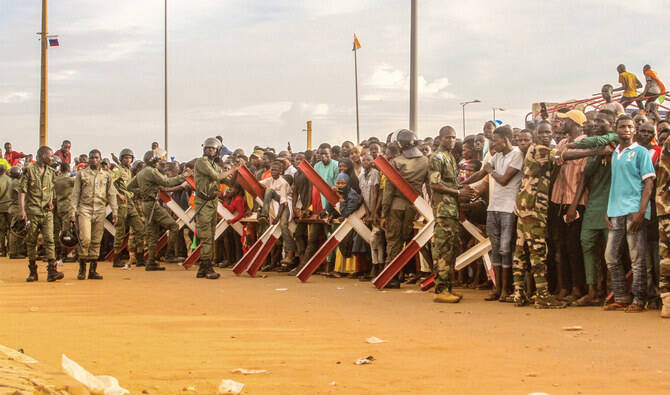
State television has upped broadcasts showing the general at meetings, visiting army barracks and greeting crowds, with the junta chief apparently unafraid of approaching locals.
Gauging the general’s popularity remains difficult, given the growing repression junta critics face.
On social media and in Niger’s press, many have remarked that Tiani’s tour is like a campaign trail even though his government does not plan to hold any elections.
Each stop allowed Tiani to hammer home his Niger-first policy — especially on uranium.
The junta argues that Niger should benefit more from being the world’s seventh-largest producer of the radioactive metal — leading to tensions with France, whose nuclear power plants have long relied on uranium extracted from its former colony.
“Look at the state Arlit is in after 55 years of uranium mining. Even electricity is in short supply... From now on, our uranium belongs to us,” he declared in Agadez.
- ‘Not so rosy’ -
In a speech to the army, Tiani insisted that “Niger will remain standing, ready to make the ultimate sacrifice to defend itself.”
But since March, the Daesh’s Sahel branch has managed to execute at least 127 people in five attacks across the Tillaberi region, according to Human Rights Watch.
In October, an American citizen was kidnapped in the heart of the capital Niamey, while two women, a Swiss and an Austrian, have been abducted in the north since the year began.
The junta has also lagged behind on paying government officials, with Tiani insisting that Niger’s economy is still hit by the regional sanctions imposed after the coup, despite the measures having been lifted nearly two years ago.
“The country is going through a not-so-rosy security and financial situation. This tour allows Tiani to get the populations behind his sovereignty policy,” a Nigerien analyst told AFP on condition of anonymity.
Hans-Jakob Schindler, director of the Counter-Extremism Project think tank, pointed to the failure of neighboring Burkina Faso and Mali in their “indifference” toward their faraway northern regions.
“You need to reassure the civilian population so that they see you as an ally, not as a threat,” said Schindler.