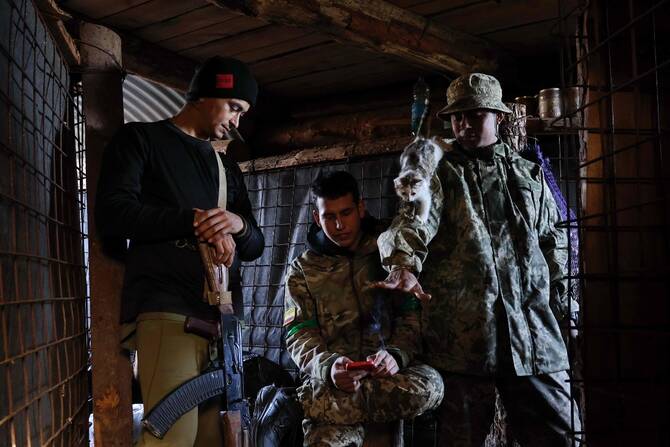

UNDISCLOSED: Ukrainian soldiers frowned as they pored over a small device plugged into a computer — a drone interceptor captured from the Russian side.
The green device with a dome-shaped nose and 30-centimeter wingspan epitomises the technological arms race playing out between Kyiv and Moscow as their troops battle on the sprawling front line.
Deployed in their hundreds by both sides every day, drones have become the chief technology of the war, scouting out enemy positions and packed with explosives to crash down into soldiers, vehicles and equipment.
They have transformed the front line into a 15-kilometer (9-mile) deep kill-zone and overhauled the very strategy of modern warfare.
Ukraine first deployed drone interceptors in spring 2024, having judged them effective against the thousands of Russian Geran-2 attack drones that bombard Ukrainian cities and infrastructure every month.
The specimen showed that Moscow has now caught up.
“They copied our model,” said Konstantin, the 27-year-old deputy commander of an anti-aircraft unit in Ukraine’s 3rd Army Corps.
But Russia printed theirs from a single block of material, meaning it is “faster and cheaper to produce.”
The 3D-printed interceptors, which race toward larger drones to take them out mid-air, have been a turning point in both the technology and economics of air defense.
US Patriot missiles, which Ukraine has and wants more of, cost about $3 million a shot.
Konstantin held up a Ukrainian drone interceptor that he said cost just $2,000 to make.
Such a price is more viable when facing hundreds of targets a day, and Ukraine’s defense ministry has ordered their mass production.
- ‘Chess’ -
But such is the pace of change that there are concerns about whether Ukraine’s models are up to date.
Russian attack drones have recently shown signs of being able to evade interceptors by using AI-driven sensors.
“We need to adapt every month, sometimes even faster,” Konstantin told AFP.
Earlier this year his unit was the first to shoot down a Russian attack drone using a small explosive drone that is usually used on ground targets.
“We thought, okay why not, let’s try?“
“It’s like a chess game. You always need to think ahead,” he added.
In a recent analysis, the US-based Center for Strategic and International Studies noted that “The last three years of warfare have dramatically accelerated technology innovation.”
Both sides are now locked in a “highly iterative game of cat and mouse,” seeking a brief upper hand by using artificial intelligence and tools to extend the range.
- Video games -
The dominance of technology has also changed the profile of a typical soldier.
Konstantin’s drone lab resembles a tech manufacturing startup — screens covered with lines of code and the smell of melted plastic from the 3D printers.
The young men working there, some with long hair, are engineers, pilots and computer scientists.
The younger the soldier, or the more video games they have played, the better drone pilot they tend to make, Konstantin said.
“They, like, play a lot of games with a controller, so they’re used to, you know, different controls.”
- ‘Late’ -
Soldiers say Ukraine’s front line has become a laboratory for military innovation, and Kyiv pitches itself as being at the forefront of low-cost, cutting-edge technology.
Now it hopes to leverage that expertise with its European partners, after years of reliance on whatever weapons its Western backers agreed to send.
And experts say drone warfare appears to have outdated some of NATO’s strengths, such as in heavy equipment and centralized logistics.
Some considered an incursion of Russian drones over Poland in September a wake-up call for the Western military alliance’s readiness.
To Konstantin, NATO’s techniques are “no longer very effective.”
“Their vision is really different from what’s happening here.”
Ukraine’s Foreign Minister Andriy Sybiga made the same observation earlier this month.
“The modern arms race is not about nukes — it is about millions of cheap drones,” he said.
Moscow fires several thousand drones at Ukraine every month, having massively ramped up production since the start of the war.
That should instill a sense of urgency not only in Kyiv, but across Europe, said Betsik, the brigade’s main commander.
“You’re not even in the future,” he said.
“You’re not in the present, either. You’re late.”