

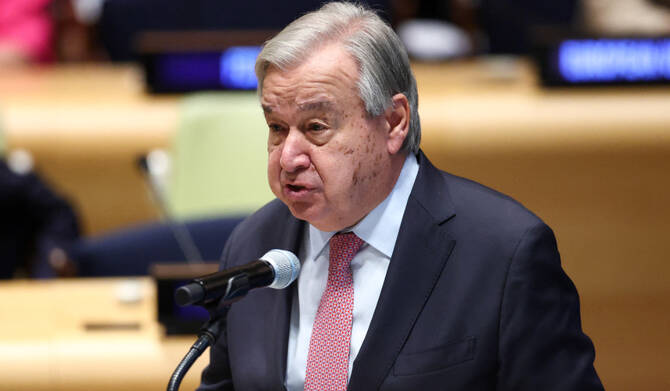

THE UNITED NATIONS, United States: UN Secretary-General Antonio Guterres called Tuesday for Sahel nations to put aside their differences to tackle mounting attacks by armed groups in a region beset by humanitarian crisis.
Attacks by Islamist militants and other armed groups are raging across the politically divided Sahel region, which has seen a number of coups in recent years, with juntas withdrawing from the regional ECOWAS bloc.
“I’m aware of the serious political differences that exist in the region,” Guterres told the UN Security Council in a video message.
“But it is absolutely essential that, despite these differences, we build a platform of cooperation among intelligence and security services of the countries of ECOWAS, the AES (Alliance of Sahel States), Mauritania, Chad and Algeria, to allow for coordinated action against terrorism.”
Terrorists in Africa’s Sahel region have doubled the scope of their attacks since 2019 and now operate in an area twice the size of Spain, leading to 77,000 deaths, according to an AFP analysis of data collected by ACLED, an independent global monitor of conflict.
The various factions affiliated with Al-Qaeda — notably the Group for the Support of Islam and Muslims (JNIM) — and the Daesh group are now striking across almost all of Mali and Burkina Faso, from western Niger and Nigeria to the Senegal border.
Omar Alieu Touray, ECOWAS Commission president, told the council that trust-building was vital in order for regional countries facing mounting security threats to effectively share intelligence.
Sahel countries are split between more West-facing governments and those run by military juntas.
“If coordination and collaboration among different initiatives is critical to counter terrorism efforts, trust among Member States is a prerequisite and a cornerstone for collaboration,” Touray said.
“Trust is needed for countries to collaborate in information and intelligence sharing, joint border patrols and joint operations.
“Unfortunately, the situation in our region is characterized by mistrust and high level of suspicion among stakeholders.
“No amount of money...will help us overcome terrorism if we don’t collaborate.”
The region, which faces myriad environmental and economic challenges, is in dire need of international financial support — to the tune of $4.9 billion for six humanitarian appeals for the Sahel and Lake Chad Basin this year.
“So far, less than one quarter of this has been raised — and only half of what was available at this time last year,” Guterres warned.
“The humanitarian response plan for Mali, in particular, is only 16 percent fulfilled.”
Sierra Leone’s President Julius Bio, the current chairman of ECOWAS, called for a UN, ECOWAS and African Union “compact for peace and resilience in the Sahel.”


