

Pregnant women flee El-Fasher risking lives, babies

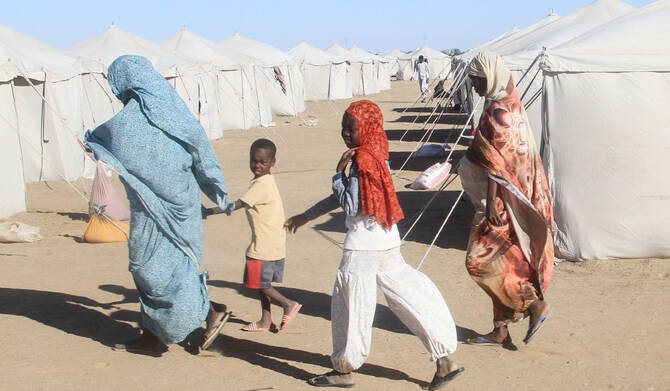
udanese who fled El-Fasher walk past tents at the Al-Afad camp for displaced people in the town of Al-Dabba, northern Sudan, on November 15, 2025. (AFP)
Short Url
Updated 18 November 2025
Follow

Pregnant women flee El-Fasher risking lives, babies

  • More than 140 pregnant women arrived at Al-Dabbah camps since El-Fasher’s fall last month, said Tasneem Al-Amin from the Sudan Doctors Network, a group of medical professionals tracking the war

CAIRO: A few weeks before the fall of her hometown to Sudan’s paramilitary group, Nadra Mohamed Ahmed, seven months pregnant at the time, trekked for nearly 40 km across unsafe roads, along with her two children, until she found safe transportation to a shelter across the country.
“By the time I arrived here, I had lost a lot of blood,” said Ahmed from her tent at the overcrowded displacement camp in the town of Al-Dabbah in northern Sudan. “I was admitted to the ICU where I spent a few days and had a blood transfusion.”
Ahmed arrived in the camp fleeing from El-Fasher in West Darfur, two months before the city was seized by the paramilitary Rapid Support Forces, or RSF, which have been battling Sudan’s army for more than two years.
More than 140 pregnant women arrived at Al-Dabbah camps since El-Fasher’s fall last month, said Tasneem Al-Amin from the Sudan Doctors Network, a group of medical professionals tracking the war. Many of these women arrive suffering severe complications, especially hemorrhaging, which sometimes culminate in a miscarriage, she said in a text message.
Carrying her four-year-old daughter on her back and holding her six-year-old son’s hand, Ahmed made part of her 14-day-long journey on foot without her husband, who had gone missing shortly before her escape. 


Iran offers concessions on nuclear program

Updated 7 sec ago
Follow

Iran offers concessions on nuclear program

  • Atomic energy chief says it will dilute enriched uranium if US eases sanctions

TEHRAN: Iran offered on Monday to dilute its highly enriched uranium if the US lifts sanctions.

Mohammad Eslami, head of the country’s Atomic Energy Organization, did not specify whether this included all sanctions on Iran or only those imposed by the US.

The new move follows talks on the issue in Oman last week that both sides described as positive and constructive.

Diluting uranium means mixing it with blend material to reduce the enrichment level, so that the final product does not exceed a given enrichment threshold.
Before US and Israeli strikes on its nuclear facilities in June last year, Iran had been enriching uranium to 60 percent, far exceeding the 3.67 percent limit allowed under the now-defunct nuclear agreement with world powers in 2015.
According to the UN’s nuclear watchdog, Iran is the only state without nuclear weapons that is enriching uranium to 60 percent.
The whereabouts of more than 400 kg of highly enriched uranium that Iran possessed before the war is also unknown. UN inspectors last recorded its location on June 10. Such a stockpile could allow Iran to build more than nine nuclear bombs if enrichment reached 90 percent.
Supreme leader Ayatollah Ali Khamenei urged Iranians on Monday to resist foreign pressure.
“National power is less about missiles and aircraft and more about the will and resolve of the people,” Khamenei said. “Show it again and frustrate the enemy.”
Nevertheless, despite this defiance, Iran has signaled it could come to some kind of deal to dial back its nuclear program and avoid further conflict with Washington.