

Pakistan overhauls rooftop solar policy, cuts rates for excess power sold to grid

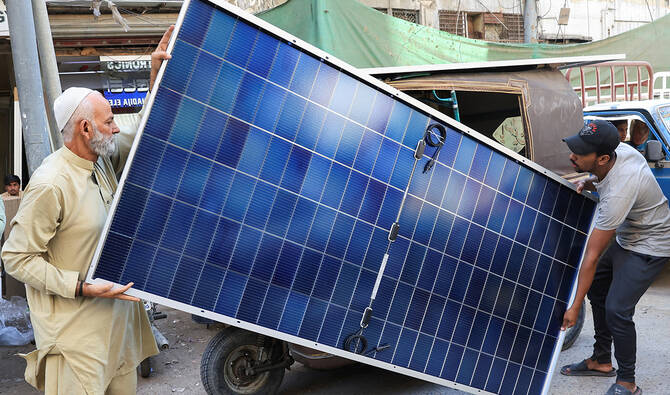
Men load solar panels on a rickshaw (tuk tuk) at a market, in Karachi, Pakistan March 26, 2025. (Reuters/File)
Short Url
Updated 10 February 2026
Follow

Pakistan overhauls rooftop solar policy, cuts rates for excess power sold to grid

  • Policy change comes amid rapid rooftop solar uptake and mounting energy sector losses
  • Lower rates for excess solar power shift benefits toward utilities, away from households

ISLAMABAD: Pakistan has sharply reduced the rate at which households and businesses are paid for excess electricity generated from rooftop solar systems, a move that lowers returns for consumers but is expected to ease financial pressure on state-run power utilities, according to new regulations notified this week.

The change shifts Pakistan from a net metering regime, under which solar users offset their electricity bills at the same rate they pay for grid power, to a net billing framework that separates buying and selling prices. Consumers will continue to pay full tariffs for electricity drawn from the grid while receiving a lower, market-linked rate for excess power they export.

Under new regulations notified by the National Electric Power Regulatory Authority (NEPRA) on Feb. 9, 2026, consumers exporting surplus electricity to the grid will no longer be compensated at retail tariffs.

“The power purchase price for electricity supplied by a prosumer to the distribution company shall be the national average energy purchase price,” the regulator said in the notification.

Pakistan has seen an unprecedented boom in rooftop solar over the past three years as households and businesses turned to private generation to escape record electricity prices, frequent outages and inflation-driven energy costs. 

Solar power grew from 4 percent of the energy mix in 2021 to over 14 percent–25 percent in 2024-2025, official figures show. Driven by skyrocketing grid tariffs, Pakistan became one of the world’s top new solar adopters, importing roughly 22 gigawatts (GW) of solar panels in 2024 alone. Industry data shows tens of thousands of new solar connections have been added annually, significantly reducing demand from the grid during daylight hours.

Power distribution companies, however, have warned that net metering was eroding revenues, worsening losses and shifting costs onto non-solar consumers, a growing concern in a sector already weighed down by billions of dollars in circular debt.

The revised framework seeks to rebalance incentives while still allowing consumers to generate their own electricity, officials say.

The new regulations apply to distributed generation systems using solar, wind or biogas technology with installed capacity of up to one megawatt. Installed capacity may not exceed a consumer’s sanctioned load, and utilities may restrict new connections if injections exceed 80 percent of a local transformer’s rated capacity.

Projects above 250 kilowatts will require technical studies before approval. All new agreements will be signed for five years and renewed under the updated rules.

Existing net-metered consumers will remain on their current contracts until expiry, after which they will transition to the new billing system.

NEPRA said the policy aims to balance renewable energy adoption with grid stability and financial sustainability as Pakistan tries to reform a power sector marked by chronic losses, rising subsidies and persistent fiscal pressure.


Pakistan says petroleum stocks at ‘comfortable levels’ despite Middle East crisis

Updated 9 sec ago
Follow

Pakistan says petroleum stocks at ‘comfortable levels’ despite Middle East crisis

  • US-Israeli strikes on Iran and Tehran’s counterattacks in Gulf have disrupted global supplies, with oil surging past $119 a barrel
  • Pakistan’s government assures it is undertaking continuous planning to safeguard domestic energy security, economic stability

KARACHI: Pakistan has “comfortable levels” of petroleum stocks and the supply chains are functioning smoothly, the finance ministry said on Monday, amid an ongoing Middle East conflict that has disrupted global fuel supplies.

Global fuel supply chains have been affected by disruptions in the Strait of Hormuz, a strategic waterway between Iran and Oman and a key transit route, that has been blocked by Tehran amid ongoing United States-Israeli strikes on Iran and its counter attacks against several Gulf states.

Oil prices surged more than 25 percent past globally on Monday to $119.50 a barrel, the highest levels since mid-2022, as some major producers cut supplies and fears of prolonged shipping disruptions gripped the market due to the expanding US-Israeli war with Iran.

Finance Minister Muhammad Aurangzeb on Tuesday presided a meeting of the Cabinet Committee to Monitor Petrol Prices to review developments in the energy sector and assess national preparedness measures in light of the evolving regional situation.

“The Committee deliberated on the evolving regional and global energy situation and undertook a detailed review of petroleum product stock positions across the country,” the finance ministry said.

“The Committee noted with satisfaction that petroleum product stocks remain at comfortable levels and supply chains are functioning smoothly, with multiple cargoes and import arrangements in place to ensure continuity of supply in the coming weeks.”

The statement came days after the intensifying conflict in Middle East and subsequent disruptions last week forced Pakistan to increase petrol and diesel prices by Rs55 ($0.20) per liter.

Separately, the Federation of Pakistan Chambers of Commerce and Industry (FPCCI) has urged the government to declare an “energy emergency” and implement reliable contingency measures to insulate Pakistan’s fragile economic recovery and its exports from the severe fallout of the ongoing conflict in the Middle East.

Officials also briefed participants of Monday’s meeting on recent trends in global crude and refined petroleum product prices, which have witnessed significant volatility due to geopolitical developments in the region.

“The Committee reviewed international market indicators, including benchmark crude movements and refined product price trends, and assessed possible scenarios for global energy markets,” the finance ministry said.

“It was noted that the Government is closely monitoring international price developments and undertaking continuous scenario planning to safeguard domestic energy security and economic stability.”