

Pakistan public debt falls by over $4.86 billion in first quarterly decline since 2019

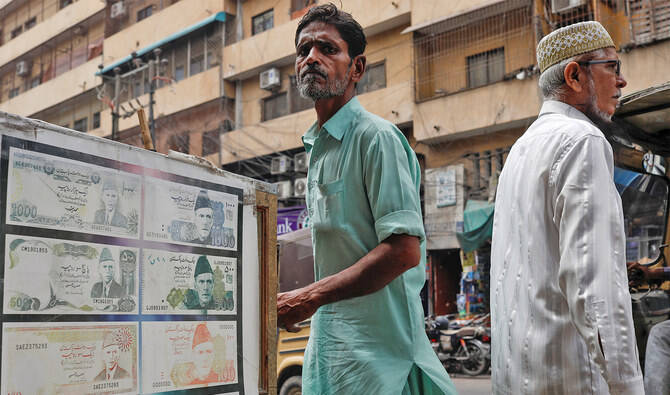
People walk past a sidewalk money exchange showcase, which is decorated with pictures of currency notes, in Karachi, Pakistan on September 12, 2023. (REUTERS/File)
Short Url
Updated 17 November 2025
Follow

Pakistan public debt falls by over $4.86 billion in first quarterly decline since 2019

  • Pakistan’s public debt has remained a central focus of economic policymaking, driven by persistent deficits and repeated borrowing cycles
  • The decline stems from disciplined fiscal management, deployment of surplus funds to repay expensive debt ahead of schedule, official says

ISLAMABAD: Pakistan’s public debt fell by more than Rs1,371 billion ($4.86 million) from July till Sept. this year in a first such decline since 2019, the country’s Finance Adviser Khurram Schehzad said on Monday, adding that this is also the largest drop in public debt.

Pakistan’s public debt has remained a central focus of economic policymaking in recent years, driven by persistent fiscal deficits, heavy interest obligations, and repeated external borrowing cycles.

The country’s debt stock had been on a steady upward trajectory due to currency depreciation, high domestic interest rates, and large financing needs tied to energy sector arrears, subsidies, and external repayments.

Multilateral lenders have repeatedly cautioned that without sustained fiscal discipline and structural reforms, the debt burden would continue to strain Pakistan’s macroeconomic stability.

“Pakistan’s total public debt has fallen from Rs80,518 billion (June 2025) to Rs79,146 billion (September 2025) — a decline of over Rs1,371 billion ($4.86 billion),” Schehzad said on X.

“[This is] first quarterly decline in 69 months (since Dec 2019), marking a notable shift in debt dynamics,” he said, “[and] largest quarterly reduction ever in both absolute value and percentage decline (QoQ).”

The development comes amid some signs of macroeconomic stability in the country, which is navigating a long path to economic recovery under a $7 billion International Monetary Fund (IMF) program.

It also comes months after officials said the country had retired Rs2,600 billion ($9.2 billion) debt to central and commercial banks in less than one year.

The decline stemmed from disciplined fiscal management and the strategic deployment of surplus funds to repay expensive debt ahead of schedule, according to the finance adviser.

It will help lower future borrowing needs, reduce refinancing and rollover risks along with strengthening medium-term financial stability.

“[It] sends a signal of improving policy credibility and investor confidence,” he said. “Over time, lower debt servicing can free fiscal space for development, social protection and growth-enhancing priorities.”


Pakistan bowler Tariq and his unusual delivery courts controversy at the T20 World Cup

Updated 7 sec ago
Follow

Pakistan bowler Tariq and his unusual delivery courts controversy at the T20 World Cup

  • The 28-year-old offspinner’s unconventional bowling action has already mesmerized some of the big names in shortest format of game
  • It has seen Tariq taking three wickets against an inexperienced the US in Sri Lanka this week in what was his first T20 World Cup game

ISLAMABAD: With a momentary pause in his delivery and his statue-like pose at the crease, Pakistan spin bowler Usman Tariq has created plenty of attention at cricket’s Twenty20 World Cup.
Just enough, it seems, to throw off opposing batters.

With it has come a fair share of controversy — that his pause-and sling style of bowling is an illegal delivery, or in cricket parlance, chucking. He’s already been reported twice, but cleared, by Pakistani cricket authorities.

The 28-year-old offspinner’s unconventional bowling action has already mesmerized some of the big names in shortest format of the game and has seen him taking three wickets against an inexperienced United States in Sri Lanka this week in what was his first T20 World Cup game.

As is often the case in cricket, the reasons for Tariq’s potential illegal delivery are complicated.

First there is the so-called “15-degree debate” — that bowlers cannot exceed the ICC’s 15-degree elbow flex limit, which is nearly impossible for on-field umpires to judge accurately in real time.

Another talking point has been the pause in Tariq’s delivery stride. Some critics, including former India cricketer Shreevats Goswami, compare it to a soccer penalty run-up that would be ruled illegal if the shooter stops midway.

BAFFLING THE BATTERS

Batters like Cameron Green of Australia and South African Dewald Brevis are a few notable players that were flummoxed by Tariq’s bowling action.

Power-hitter Brevis fell to Tariq’s only second ball in T20 international cricket in November. Green shook his head in disbelief and mocked Tariq’s bowling action close to the boundary line — but later apologized — when he walked back after slicing a wide delivery straight to the cover fielder during Pakistan’s 3-0 sweep of Australia at Lahore.

Tariq’s rise in T20 cricket has also seen him taking a hat-trick at Rawalpindi when he took 4-18 against Zimbabwe during the tri-series in November. He has taken 11 wickets off his 88 balls in only four T20 internationals.

It was no surprise when selectors included Tariq in the 15-man T20 World Cup squad, knowing that pitches in Sri Lanka would suit slow bowlers more than pacemen.

Tariq’s journey to top-level cricket wasn’t a smooth one. He was twice reported for suspect bowling action during country’s premier domestic T20 tournament — the Pakistan Super League — over the last two seasons, but on both occasions he was cleared after testing at the

National Cricket Academy in Lahore.

“I have two elbows in my arm,” Tariq said. “My arm bends naturally. I have got this tested and cleared. Everyone feels I bend my arm and all that. My bent arm is a biological issue.”

Tariq has also featured in the Caribbean Premier League and with his deceptive bowling action he was the tournament’s second-highest wicket taker for champions Trinbago Knight Riders.


LONG PAUSE A PROBLEM

“The batters are struggling to read Tariq because of the long pause the moment he steps on the bowling crease,” former Pakistan captain Sarfaraz Ahmed, who has played with Tariq in the PSL’s Quetta Gladiators, told The Associated Press.

“The long pause disturbs all the concentration of batters and when he bowls a fastish (delivery, after a long pause), or even a slow ball, it leaves the batters clueless.”

Less than three months ago, Tariq said he had dreamed about playing against archrival India. And after Pakistan withdrew its boycott of Sunday’s game in the T20 World Cup, Tariq’s dream could come true if Pakistan uses five spinners against India.

“I wish there’s a match against India and I can win the game for Pakistan single-handedly,” Tariq said then. “My coaches have injected this thing in me that ‘you have to win matches single-handedly’.”

On Sunday against India, Tariq could do just that.