

Lahore’s toxic smog takes toll on fruit vendors struggling to ‘make ends meet’ 

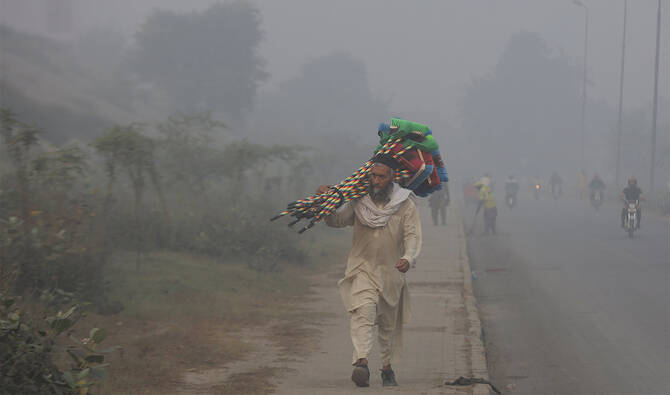
A man walks carrying a bunch of cleaning brushes on his shoulder while selling them along a road amid smog and air pollution in the morning, in Lahore, Pakistan, on October 30, 2025. (REUTERS/File)
Short Url
Updated 17 November 2025
Follow

Lahore’s toxic smog takes toll on fruit vendors struggling to ‘make ends meet’ 

  • Swiss monitoring agency IQAir frequently ranks Lahore among world’s most polluted cities 
  • Air pollutants, vehicle emissions, agricultural fires worsen Lahore’s smog every year in winter

LAHORE: Dense toxic smog blanketed Pakistan’s second biggest city Lahore on Saturday (November 15), with air quality hitting “hazardous” levels and posing a health threat to the city’s millions, particularly those working outdoors and exposed, data from the Swiss group IQAir showed.

Lahore recorded an Air Quality Index (AQI) of 344 at 8 am local time (0300 GMT), making it world’s second most polluted city after the Indian capital Delhi among the list of polluted major cities.

Fruit vendors, who ply their trade outdoors by buying fruits at wholesale markets and then selling them on carts and roadside stalls, say they are especially vulnerable to health problems caused by the smog, and struggle to make ends meet if they can’t work due to sickness.

“I went to the (wholesale) fruit market as early as 7 in the morning to buy fruit. Yes, smog is affecting throats, causes cold, cough and irritation to eyes. I fell ill two, three times and stayed home. But it is necessary to come here to run the business to make ends meet, even if one is sick,” said one fruit vendor, Mohammad Amir.

Khalid Mehmood, an elderly fruit vendor, told Reuters, “at times we fall ill and we are unable to make ends meet. It brings poverty to our families.”

Each winter, plain areas of Punjab province — of which Lahore is the capital — are gripped by thick smog as cold, heavy air traps pollutants from construction dust, vehicle emissions, and agricultural fires. While the provincial government has previously deployed measures such as anti-smog guns, these offer only temporary relief, leaving vulnerable populations exposed.


Pakistan, global crypto exchange discuss modernizing digital payments, creating job prospects 

Updated 05 December 2025
Follow

Pakistan, global crypto exchange discuss modernizing digital payments, creating job prospects 

  • Pakistani officials, Binance team discuss coordination between Islamabad, local banks and global exchanges
  • Pakistan has attempted to tap into growing crypto market to curb illicit transactions, improve oversight

ISLAMABAD: Pakistan’s finance officials and the team of a global cryptocurrency exchange on Friday held discussions aimed at modernizing the country’s digital payments system and building local talent pipelines to meet rising demand for blockchain and Web3 skills, the finance ministry said.

The development took place during a high-level meeting between Finance Minister Muhammad Aurangzeb, Pakistan Virtual Assets Regulatory Authority (PVARA) Chairman Bilal bin Saqib, domestic bank presidents and a Binance team led by Global CEO Richard Teng. The meeting was held to advance work on Pakistan’s National Digital Asset Framework, a regulatory setup to govern Pakistan’s digital assets.

Pakistan has been moving to regulate its fast-growing crypto and digital assets market by bringing virtual asset service providers (VASPs) under a formal licensing regime. Officials say the push is aimed at curbing illicit transactions, improving oversight, and encouraging innovation in blockchain-based financial services.

“Participants reviewed opportunities to modernize Pakistan’s digital payments landscape, noting that blockchain-based systems could significantly reduce costs from the country’s $38 billion annual remittance flows,” the finance ministry said in a statement. 

“Discussions also emphasized building local talent pipelines to meet rising global demand for blockchain and Web3 skills, creating high-value employment prospects for Pakistani youth.”

Blockchain is a type of digital database that is shared, transparent and tamper-resistant. Instead of being stored on one computer, the data is kept on a distributed network of computers, making it very hard to alter or hack.

Web3 refers to the next generation of the Internet built using blockchain, focusing on giving users more control over their data, identity and digital assets rather than big tech companies controlling it.

Participants of the meeting also discussed sovereign debt tokenization, which is the process of converting a country’s debt such as government bonds, into digital tokens on a blockchain, the ministry said. 

Aurangzeb called for close coordination between the government, domestic banks and global exchanges to modernize Pakistan’s payment landscape.

Participants of the meeting also discussed considering a “time-bound amnesty” to encourage users to move assets onto regulated platforms, stressing the need for stronger verifications and a risk-mitigation system.

Pakistan has attempted in recent months to tap into the country’s growing crypto market, crack down on money laundering and terror financing, and promote responsible innovation — a move analysts say could bring an estimated $25 billion in virtual assets into the tax net.

In September, Islamabad invited international crypto exchanges and other VASPs to apply for licenses to operate in the country, a step aimed at formalizing and regulating its fast-growing digital market.