

EU bows to pressure on loosening AI, privacy rules

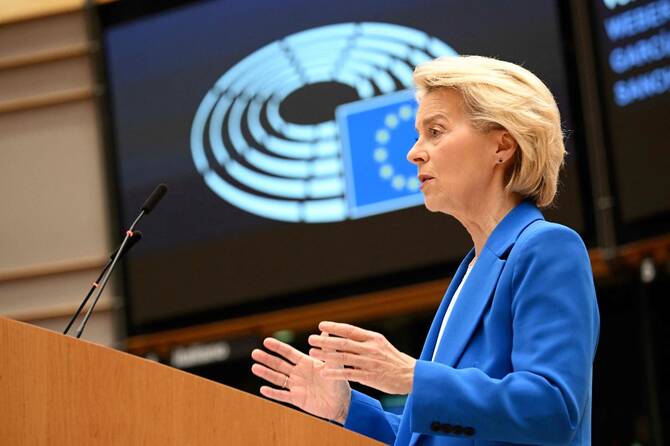
European Commission President Ursula von der Leyen delivers her speech during a debate on the new 2028-2034 Multi-annual Financial Framework at the European Parliament in Brussels, Belgium. (AFP)
Short Url
Updated 15 November 2025
Follow

EU bows to pressure on loosening AI, privacy rules

  • Brussels denies that pressure from the US administration influenced its push to “simplify” the bloc’s digital rules, which have drawn the wrath of President Donald Trump and American tech giants

BRUSSELS: The European Union is set next week to kickstart a rollback of landmark rules on artificial intelligence and data protection that face powerful pushback on both sides of the Atlantic.
Part of a bid to slash red tape for European businesses struggling against US and Chinese rivals, the move is drawing accusations that Brussels is putting competitiveness ahead of citizens’ privacy and protection.
Brussels denies that pressure from the US administration influenced its push to “simplify” the bloc’s digital rules, which have drawn the wrath of President Donald Trump and American tech giants.
But the European Commission says it has heard the concerns of EU firms and wants to make it easier for them to access users’ data for AI development — a move critics attack as a threat to privacy.
One planned change could unite many Europeans in relief however: the EU wants to get rid of those pesky cookie banners seeking users’ consent for tracking on websites.
According to EU officials and draft documents seen by AFP, which could change before the November 19 announcement, the European Commission will propose:
-- a one-year pause in the implementation of parts of its AI law
-- overhauling its flagship data protection rules, which privacy defenders say will make it easier for US Big Tech to “suck up Europeans’ personal data.”
The bloc’s cornerstone General Data Protection Regulation (GDPR) enshrined users’ privacy from 2018 and influenced standards around the world.
The EU says it is only proposing technical changes to streamline the rules, but rights activists and EU lawmakers paint a different picture.

- ‘Biggest rollback’ -

The EU executive proposes to narrow the definition of personal data, and allow companies to process such data to train AI models “for purposes of a legitimate interest,” a draft document shows.
Reaction to the leaks has been swift — and strong.
“Unless the European Commission changes course, this would be the biggest rollback of digital fundamental rights in EU history,” 127 groups, including civil society organizations and trade unions, wrote in a letter on Thursday.
Online privacy activist Max Schrems warned the proposals “would be a massive downgrading of Europeans’ privacy” if they stay the same.
An EU official told AFP that Brussels is also expected to propose a one-year delay on implementing many provisions on high-risk AI, for example, models that can pose dangers to safety, health or citizens’ fundamental rights.
Instead of taking effect next year, they would apply from 2027.
This move comes after heavy pressure from European businesses and US Big Tech.
Dozens of Europe’s biggest companies, including France’s Airbus and Germany’s Lufthansa and Mercedes-Benz, called for a pause in July on the AI law which they warn risks stifling innovation.

- More battles ahead -

Commission president Ursula von der Leyen faces a battle ahead as the changes will need the approval of both the EU parliament and member states.
Her conservative camp’s main coalition allies have raised the alarm, with the socialists saying they oppose any delay to the AI law, and the centrists warning they would stand firm against any changes that undermine privacy.
Noyb, a campaign group founded by Schrems, published a scathing takedown of the EU’s plans for the GDPR and what they entail.
The EU has pushed back against claims that Brussels will reduce privacy.
“I can confirm 100 percent that the objective... is not to lower the high privacy standards we have for our citizens,” EU spokesman for digital affairs, Thomas Regnier, said.
But there are fears that more changes to digital rules are on the way.

- Simplification, not deregulation -

The proposals are part of the EU executive’s so-called simplification packages to remove what they describe as administrative burdens.
Brussels rejects any influence from Trump — despite sustained pressure since the first weeks of the new US administration, when Vice President JD Vance railed against the “excessive regulation” of AI.
This “started before the mandate of the president of the US,” chief commission spokeswoman Paula Pinho said this week.
Calls for changes to AI and data rules have been growing louder in Europe.
A major report last year by Italian ex-premier Mario Draghi also warned that data rules could hamper European businesses’ AI innovation.


House Republicans barely defeat Venezuela war powers resolution to check Trump’s military actions

Updated 23 January 2026
Follow

House Republicans barely defeat Venezuela war powers resolution to check Trump’s military actions

WASHINGTON: The House rejected a Democratic-backed resolution Thursday that would have prevented President Donald Trump from sending US military forces to Venezuela after a tied vote on the legislation fell just short of the majority needed for passage.
The tied vote was the latest sign of Republican House Speaker Mike Johnson’s tenuous hold on the majority, as well as some of the growing pushback in the GOP-controlled Congress to Trump’s aggressions in the Western Hemisphere. A Senate vote on a similar resolution was also tied last week until Vice President JD Vance broke the deadlock.
To defeat the resolution Thursday, Republican leaders had to hold the vote open for more than 20 minutes while Republican Rep. Wesley Hunt, who had been out of Washington all week campaigning for a Senate seat in Texas, rushed back to Capitol Hill to cast the decisive vote.
On the House floor, Democrats responded with shouts that Republican leaders were violating the chamber’s procedural rules. Two Republicans — Reps. Don Bacon of Nebraska and Thomas Massie of Kentucky — voted with all Democrats for the legislation.
The war powers resolution would have directed Trump to remove US troops from Venezuela. The Trump administration told senators last week that there are no US troops on the ground in the South American nation and committed to getting congressional approval before launching major military operations there.
But Democrats argued that the resolution is necessary after the US raid to capture Venezuelan leader Nicolás Maduro and since Trump has stated plans to control the country’s oil industry for years to come.
The response to Trump’s foreign policy
Thursday’s vote was the latest test in Congress of how much leeway Republicans will give a president who campaigned on removing the US from foreign entanglements but has increasingly reached for military options to impose his will in the Western Hemisphere. So far, almost all Republicans have declined to put checks on Trump through the war powers votes.
Rep. Brian Mast, the Republican chair of the House Armed Services Committee, accused Democrats of bringing the war powers resolution to a vote out of “spite” for Trump.
“It’s about the fact that you don’t want President Trump to arrest Maduro, and you will condemn him no matter what he does, even though he brought Maduro to justice with possibly the most successful law enforcement operation in history,” Mast added.
Still, Democrats stridently argued that Congress needs to assert its role in determining when the president can use wartime powers. They have been able to force a series of votes in both the House and Senate as Trump, in recent months, ramped up his campaign against Maduro and set his sights on other conflicts overseas.
“Donald Trump is reducing the United States to a regional bully with fewer allies and more enemies,” Rep. Gregory Meeks, the top Democrat on the House Foreign Affairs Committee, said during a floor debate. “This isn’t making America great again. It’s making us isolated and weak.”
Last week, Senate Republicans were only able to narrowly dismiss the Venezuela war powers resolution after the Trump administration persuaded two Republicans to back away from their earlier support. As part of that effort, Secretary of State Marco Rubio committed to a briefing next week before the Senate Foreign Relations Committee.
Yet Trump’s insistence that the US will possess Greenland over the objections of Denmark, a NATO ally, has alarmed some Republicans on Capitol Hill. They have mounted some of the most outspoken objections to almost anything the president has done since taking office.
Trump this week backed away from military and tariff threats against European allies as he announced that his administration was working with NATO on a “framework of a future deal” on Arctic security.
But Bacon still expressed frustration with Trump’s aggressive foreign policy and voted for the war powers resolution even though it only applies to Venezuela.
“I’m tired of all the threats,” he said.
Trump’s recent military actions — and threats to do more — have reignited a decades-old debate in Congress over the War Powers Act, a law passed in the early 1970s by lawmakers looking to claw back their authority over military actions.
The war powers debate
The War Powers Resolution was passed in the Vietnam War era as the US sent troops to conflicts throughout Asia. It attempted to force presidents to work with Congress to deploy troops if there hasn’t already been a formal declaration of war.
Under the legislation, lawmakers can also force votes on legislation that directs the president to remove US forces from hostilities.
Presidents have long tested the limits of those parameters, and Democrats argue that Trump in his second term has pushed those limits farther than ever.
The Trump administration left Congress in the dark ahead of the surprise raid to capture Maduro. It has also used an evolving set of legal justifications to blow up alleged drug boats and seize sanctioned oil tankers near Venezuela.
Democrats question who gets to benefit from Venezuelan oil licenses
As the Trump administration oversees the sale of Venezuela’s petroleum worldwide, Senate Democrats are also questioning who is benefiting from the contracts.
In one of the first transactions, the US granted Vitol, the world’s largest independent oil broker, a license worth roughly $250 million. A senior partner at Vitol, John Addison, gave roughly $6 million to Trump-aligned political action committees during the presidential election, according to donation records compiled by OpenSecrets.
“Congress and the American people deserve full transparency regarding any financial commitments, promises, deals, or other arrangements related to Venezuela that could favor donors to the President’s campaign and political operation,” 13 Democratic senators wrote to White House Chief of Staff Susie Wiles Thursday in a letter led by Democratic Sen. Adam Schiff of California.
The White House has said it is safeguarding the South American country’s oil for the benefit of both the people of Venezuela and the US