

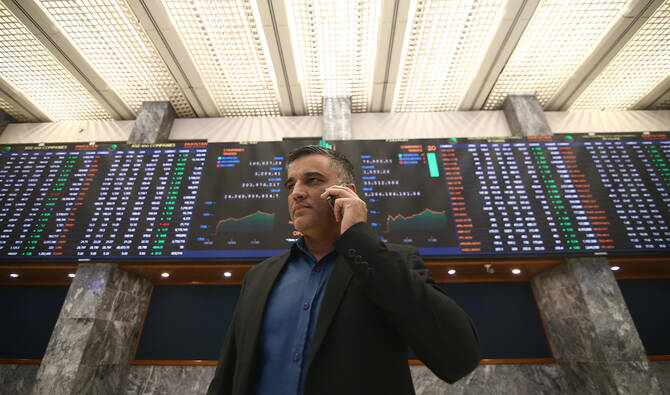

KARACHI: As Pakistan’s economy steadies, stock investors are increasingly gravitating toward Shariah-compliant equities, with Pakistan Stock Exchange (PSX) data showing these counters outperforming conventional stocks since early October and now accounting for more than half of the daily trading value.
Investors on Friday traded Rs35 billion ($125 million) worth of shares, of which Rs23 billion ($80 million) came from Shariah-compliant counters.
“Around 65 percent of today’s equity value traded was in Shariah compliant stocks,” PSX said in a statement.
Pakistan’s market has been on a strong upward run, with the benchmark KSE-100 Index climbing 41 percent to 161,935 points since January.
The Karachi Meezan Index (KMI-30), launched in 2008 to track Shariah-compliant equities, has risen 30 percent so far this year and gained another 0.8 percent on Friday to close at 231,590 points.
“The broader Pakistan Shariah index has demonstrated remarkable strength and resilience, closely mirroring the sustained bullish momentum observed across the PSX,” said Amreen Soorani, head of research at Al Meezan Investments Management Limited, Pakistan’s largest Shariah-compliant mutual fund managing Rs638 billion ($2.3 billion) in assets.
“This exceptional performance is a direct result of recent macroeconomic stabilization and impactful policy reforms,” she told Arab News.
Pakistan’s economic outlook has brightened as the current administration has pulled inflation down to 6.2 percent in October, while the central bank expects the current account deficit to widen by up to one percent this fiscal year.
Foreign exchange reserves are projected to reach $18 billion by June 2026.
“We maintain an optimistic outlook for the Shariah equity index, projecting sustained growth driven by robust corporate profitability and attractive dividend yields, all underpinned by strong structural and macroeconomic tailwinds,” Soorani added.
She said regulatory steps, including the listing of government sukuk on the stock exchange, were also “actively diversifying investment offerings and enhancing market liquidity in the Shariah space.”
INCREASING EXPOSURE
These trends are drawing in individual investors such as Saniya Bilal Doni, who is already invested in Shariah-compliant stocks and now plans to boost her holdings.
“My portfolio has benefited from the recent PSX rally, and I am considering increasing my exposure given the positive market outlook,” said Doni, 33, a Chartered Financial Analyst by qualification.
For her, she said, the appeal of these stocks extends beyond performance.
“The Shariah-compliant stocks align with my ethical and faith-based principles, and historically, Shariah-compliant companies in Pakistan tend to have stronger balance sheets, lower leverage and more disciplined governance, which naturally reduces risk,” she continued.
Doni did not disclose the size of her portfolio but said she prefers long-term, dividend-focused investments in “well performing” banking, real estate, fertilizer and technology stocks.
“In Pakistan, many retail and institutional investors already gravitate toward Shariah-compliant names,” said Leena Abid, an analyst at Karachi-based brokerage Arif Habib Limited.
She noted that the KMI-30 Index posted a 71 percent return last year and has already delivered 29 percent gains this year.
“Looking ahead, if the current momentum continues, supported by improving macros and earnings growth, the KMI-30 could end another year with gains,” she told Arab News.


