World Diabetes Day: Saudi Health Endowment Fund launches Insulin Pump Support Program

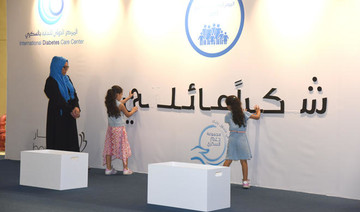
Saudi Health Endowment Fund marks World Diabetes Day with launch of Insulin Pump Support Program. (File Photo)
Short Url
Updated 14 November 2025
Follow

World Diabetes Day: Saudi Health Endowment Fund launches Insulin Pump Support Program

  • Dedicated to supporting children with Type 1 diabetes, it aims to improve quality of life and care
  • Princess Sara bint Mashhour, wife of crown prince, donates SR10m to fund

RIYADH: The Saudi Health Endowment Fund marked World Diabetes Day, observed annually on Nov. 14, by announcing the launch of a new fund dedicated to supporting children with Type 1 diabetes across the Kingdom, aiming to significantly improve their quality of life and care by facilitating access to modern insulin pumps.
In its initial phase, the fund aims to support 600 children annually by providing advanced insulin pumps, which represent one of the latest treatment options for controlling blood sugar and reducing the need for daily injections.
This intervention is expected to improve children’s physical and psychological well-being, while reducing the risk of complications as well as the health care burden on families and medical facilities.
The Health Endowment Fund called upon donors and community organizations to contribute.
Princess Sara bint Mashhour, the wife of Crown Prince Mohammed bin Salman,
made a generous donation of SR10 million ($2.7 million) to the fund.
Health Minister and Chairman of the Board of Directors of the Health Endowment Fund Fahad Al-Jalajel thanked Princess Sara for her generous donation and commended her role in supporting humanitarian initiatives, which reflect the values of Saudi society and the spirit of solidarity.
Dr. Anwar Khursheed, a senior family medicine physician at the National Guard Hospital in Riyadh, told Arab News: “As we mark World Diabetes Day, the launch of the Health Endowment Fund’s dedicated initiative for children with Type 1 diabetes is a transformative step for the Kingdom. This will greatly enhance the quality of life of young patients by accelerating access to modern insulin pumps, reducing complications, and empowering families with reliable, state-of-the-art care.
“As a long-standing physician in Saudi Arabia, I see this as a visionary investment in health care for future generations. It reflects the Kingdom’s commitment to compassionate, innovative health care and aligns perfectly with the health care goals in Saudi Vision 2030,” added Khursheed, who is also vice president of the Saudi Indian Healthcare Forum.
The new initiative is an extension of the Health Endowment Fund’s broader efforts to help vulnerable groups through specialized programs and collaboration with the health and non-profit sectors.
These efforts have already resulted in the provision of health services to over 3,000 beneficiaries across the Kingdom, bolstered by donations exceeding SR72 million in 2024 alone, underscoring strong community confidence and sustained humanitarian impact.
World Diabetes Day is the world’s largest diabetes awareness campaign, reaching a global audience of over 1 billion people in over 160 countries. Observed every year on Nov. 14, the birthday of Sir Frederick Banting, who co-discovered insulin with Charles Best in 1922, it was created in 1991 by the International Diabetes Federation and the World Health Organization and became an official UN International Day in 2006.
Diabetes and well-being are the themes for World Diabetes Day 2025.


Threat to Kingdom’s security is ‘red line’ that will be ‘addressed and neutralized,’ Saudi envoy says

Updated 14 January 2026
Follow

Threat to Kingdom’s security is ‘red line’ that will be ‘addressed and neutralized,’ Saudi envoy says

  • Abdulaziz Alwasil tells UN Security Council the situation in southern Yemen is ‘a just cause with social and historic dimensions’ that can only be resolved through dialogue
  • Recent military activity in the south was unilateral, resulting in an escalation that harms the interests of Yemeni people and undermines efforts to address issues in the south, he said

NEW YORK CITY: Any attempt to threaten Saudi Arabia’s national security is a “red line” and will be met with decisive action, the Kingdom’s ambassador to the UN told the Security Council on Wednesday.

Speaking during a meeting of the council to discuss Yemen, Abdulaziz Alwasil said the situation in the south of the country is “a just cause with social and historic dimensions” that can only be resolved through dialogue.

“We stress that any attempt to threaten our national security is a red line, and we will not hesitate to take the necessary actions and steps to address it and neutralize it,” he added.

Alwasil reaffirmed Saudi Arabia’s support for Yemeni President Rashad Al-Alimi, the Presidential Leadership Council, and the Yemeni government in their efforts to achieve security, stability, development and peace while preserving national unity.

He said military activity by Southern Transitional Council forces in Hadramout and Al-Mahra on Dec. 2, 2025, was unilateral, did not have the approval of the Presidential Leadership Council, and was not carried out in coordination with the Coalition to Restore Legitimacy in Yemen.

It had resulted in an unjustified escalation that harmed the interests of the Yemeni people, undermined efforts to address the issues in the south, and ran counter to the coalition’s objectives, Alwasil added.

The Kingdom, working with its coalition partners, the Presidential Leadership Council and the Yemeni government, had moved to contain the situation by dispatching a military force to coordinate arrangements with the Southern Transitional Council in Aden, he said.

The aim was to ensure the return of the southern council’s forces to their previous positions outside of Hadramout and Al-Mahra, and the handover of camps to legitimate government forces and local authorities in line with agreed procedures, Alwasil added.

He expressed regret over the military operations that took place in Hadramout and Al-Mahra, close to Saudi Arabia’s southern border, which he said posed a direct threat to the Kingdom’s national security, as well as the security of Yemen and regional stability. Such steps were extremely dangerous, he added, and contradicted the principles on which the Coalition to Restore Legitimacy in Yemen had been founded.

Alwasil welcomed a prisoner and detainee exchange agreement signed in Muscat on Dec. 23, which he described as an important humanitarian measure to alleviate suffering and build confidence.

He praised Oman for hosting and sponsoring the consultations and supporting negotiations, and commended the efforts of UN’s special envoy for Yemen, Hans Grundberg, the International Committee of the Red Cross and all others that has played a part.

Regarding the political efforts to resolve the crisis, Alwasil said Saudi Arabia welcomed President Al-Alimi’s call for an inclusive conference in Riyadh to bring together all stakeholders to discuss just solutions to the situation in southern Yemen.

Preparations for the conference have begun, he added, in cooperation with the Yemeni government and southern representatives, reflecting the close ties between the two countries and their shared interests in stabilizing Yemen.

He urged all southern stakeholders to participate actively and constructively in the talks, to help find comprehensive and just solutions that meet the legitimate aspirations of the people of southern Yemen.

Alwasil called on all Yemeni forces and stakeholders to cooperate and intensify their efforts to reach a lasting political settlement that would ensure security and stability.

He described the southern issue as “a just cause with social and historic dimensions,” adding that “the only way to address it is through dialogue that leads to a comprehensive political solution” based on nationally and internationally agreed terms of reference.