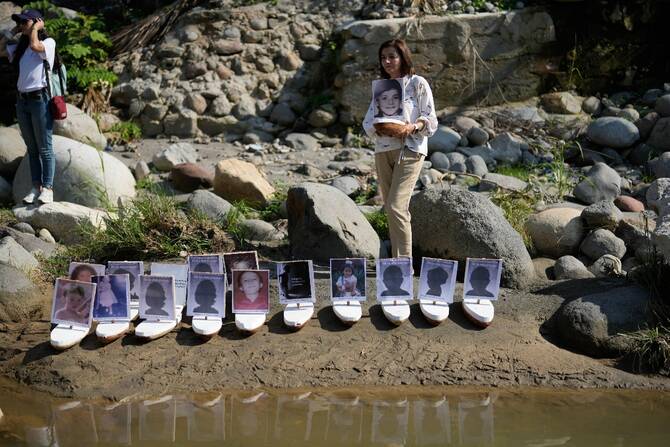
ARMERO: Martha Lucía López released the boat into the river alongside hundreds of others with the faces of missing children, in one last attempt to find her son, or rather, to pray that he would find her.
Her son, Sergio Melendro, was one of hundreds of children reported missing when a volcanic eruption devastated the Colombian town Armero on Nov. 13, 1985, and whose whereabouts remains unknown.
“The only option we have is for them, the people who adopted them, to tell the true story and for them (the children) to come to us,” the 67-year-old said.
Approximately 25,000 perished when the Nevado del Ruiz volcano erupted, making it the deadliest natural disaster in Colombia’s recent history and leaving the town in central-western Colombia uninhabited. The ensuing chaos led many children to be separated from their families, who keep searching for them 40 years later.
Losing Sergio
On the night of the eruption, López and her husband heard strange noises and left the house to see if something was wrong. She had heard on the news that the volcano was erupting, but left Sergio, 5 years old at the time, sleeping at home because she thought they were far enough away.
But soon the lava melted the volcano’s snow-capped peak and merged with the riverbeds, generating an avalanche that rushed down the mountains. The river overcame López and her husband, overturning their car and causing them to take refuge in a tree and then house.
Their house was destroyed, and she never saw Sergio again.
Years later, López learned her family had shared Sergio’s name in an ad on TV, and received information that he was at the Colombian Institute of Family Welfare (ICBF), the agency responsible for protecting children in the country.
López says that her sister tried to find him at the institute’s headquarters in Bogotá. “They never let her in… they asked her to bring clothes and photos proving she was family, nothing more.”
Years later, a friend of López’s told her that in New Orleans, a man approached her and said that his brother had adopted a child who was a victim of the Armero tragedy.
“He showed her a photo… Sergio’s eyes were unmistakable,” she says, referring to their blue color. However, they were never able to contact him again.
What happened to the children
Some children were taken by the ICBF, others were sent to nearby villages and others were never seen again, according to organizations tracking the issue and Ancizar Giraldo, who was 12 years old when the volcano erupted.
Giraldo spent almost four years at a social center funded with international donations until his mother found him using the photographs released by the ICBF.
The Armando Armero Foundation, a civil society organization, has documented 580 missing children, 71 of whom were reportedly adopted. So far, they have found four of them alive after collecting DNA samples.
“There is no single modus operandi. You can’t just say, ‘the children were stolen solely by the ICBF,’ there are many ways. Civilians even went to Armero right after the tragedy and saw children, took them home, and welcomed them with affection,” said the foundation’s director Francisco González. Others were sent to other parts of Colombia and beyond, he said.
Forty years ago, without the same access to information as today, families searched in person at shelters and ICBF offices.
Adriana Velásquez, deputy director general of the ICBF, explained to the AP that after the tragedy they received at least 170 children from Armero, according to the records they have found. She stated that they are investigating how many were given up for adoption, since at that time it was a decision made by the courts.
For many years, the families’ hopes rested on the ICBF’s “red book,” named for its red cover, which contains records of some of the children from Armero. This book was declassified in October, but is not a complete record of all the children reported missing or disappeared, Velásquez noted.
Despite the challenges, after four decades, families refuse to abandon their search.
“It’s been 40 years of hope,” said Benjamín Herrera, father of Óscar Fernando, who was 14 months old at the time of the tragedy. “And we will wait as long as it takes.”


![]()

Parents search for children missing since a volcanic eruption in Colombia 40 years ago
Short Url
https://arab.news/nwx64
Parents search for children missing since a volcanic eruption in Colombia 40 years ago
- Some children were taken by the ICBF, others were sent to nearby villages and others were never seen again, according to organizations tracking the issue


Latest updates


Recommended


© 2026 SAUDI RESEARCH & PUBLISHING COMPANY, All Rights Reserved And subject to Terms of Use Agreement.