ISLAMABAD: Senior lawyer Aslam Ghumman’s heart skipped a beat when television channels broke the news of a blast in Islamabad’s G-11 sector. His son, Zubair Ghumman, had gone to that area only minutes earlier.
Twelve people were killed and 36 wounded when a deadly suicide explosion took place outside a district court complex in Islamabad’s G-11 sector.
Pakistan has suffered an uptick in militant violence in recent months in its western provinces bordering Afghanistan. Islamabad blames the attacks on militants based in Afghanistan, a charge Kabul denies.
The suicide bombing on Tuesday was the deadliest attack in Islamabad in years. And just as his father feared, Zubair was among the 12 who perished in the blast.
“I called him… he didn’t pick up,” Ghumman recalled, his voice breaking. “Then a friend answered and told me, ‘He’s injured. We’re taking him to PIMS [Pakistan Institute of Medical Sciences] hospital.’”
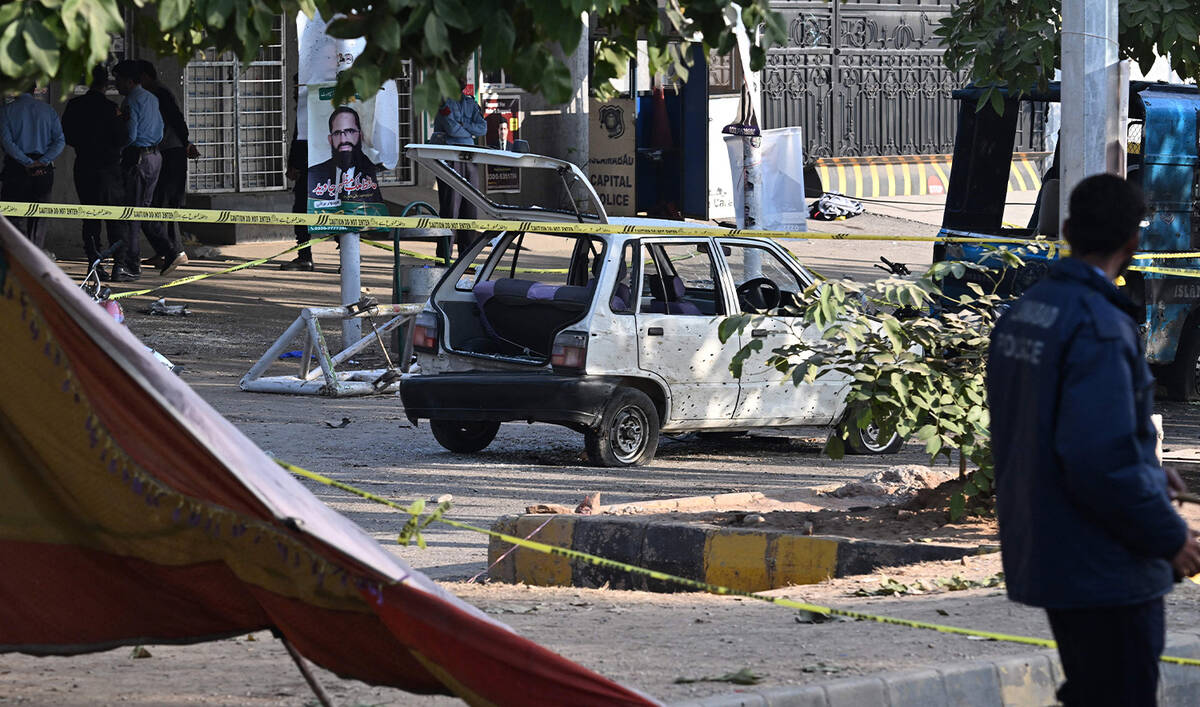
Police officials inspect the cordoned-off site, a day after the suicide bombing, in Islamabad on November 12, 2025. (AFP)
Ghumman frantically reached the hospital only to find out that his son had passed away.
His son, Zubair, had recently enrolled as an advocate of Pakistan’s top court.
‘LAST GOOD DEED’
According to Ghumman, his son was not supposed to be at the G-11 district court that morning. He was to attend the hearing of a case at family court near old high court building in the G-10 sector.
An elderly couple with their daughter saw Zubair there and asked him for directions to G-11. Instead of pointing the way, he offered to drive them there.
Ghumman said his son reached the main gate of the district court and told the couple “this is G-11.”
“They went inside. He was turning back toward the car when the blast took place,” an emotional Ghumman said.
“That was his last good deed,” he continued. “Allah helped him leave this world while doing good.”
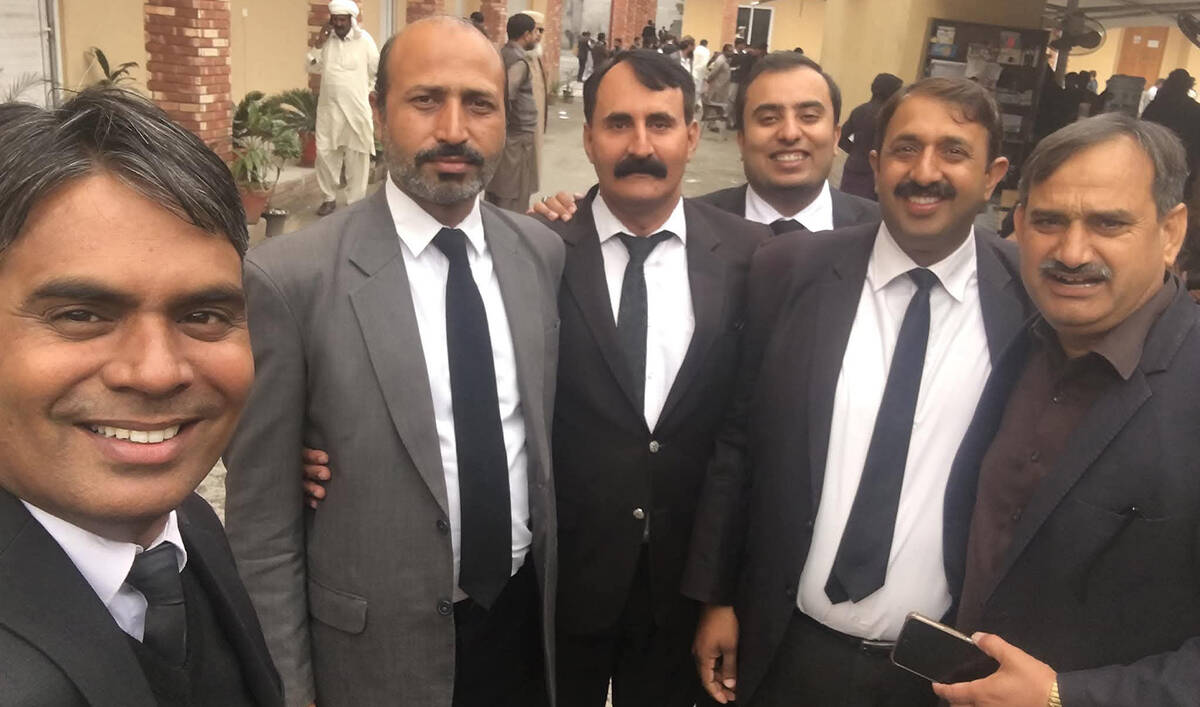
The picture, shared on November 12, 2025, shows lawyer Zubair Ghumman (second left), who was killed in a suicide blast outside a district court complex in Islamabad’s G-11 sector on November 11, 2025, standing with his friends. (Aslam Ghumman’s friend)
A fellow lawyer, Hafiz Ahmed Rasheed, described Zubair as an “asset to the legal fraternity.”
“He was very sociable, professional and very hardworking when it came to his profession,” Rasheed said.
“He was very friendly with his friends. He was a humble person.”

Yahya Zubair (C) son of deceased lawyer, mourns during his father's funeral in Islamabad on November 12, 2025, a day after suicide bombing. (AFP)
CHAOS EVERYWHERE
Assistant Sub-Inspector Muhammad Irshad, who was in a police car patrolling near the district court when the blast took place, recalled the explosion and the chaos that followed.
“A blast suddenly took place. I don’t know what happened after that,” Irshad said while undergoing treatment at PIMS hospital. “There was chaos.”
Head Constable Muhammad Imran, who was driving the patrol car, also survived the blast. He is also undergoing treatment at PIMS.
“Our morale is high. By the grace of God, we will fight,” Imran said. “We are not afraid of such [violent] elements.”
Meanwhile, Ghumman’s grief slowly turned to anger. He questioned how “terrorists” who kill innocents believe they will go to paradise through such actions.
“They kill innocent people. What can be more unjust than this?” he wondered.
“The killing of one person is like killing the entire humanity,” he added, referring to a Qur’anic verse upholding the sanctity of human life.