

Siege of Sarajevo drew wealthy foreigners to shoot at civilians, say Italian prosectors 

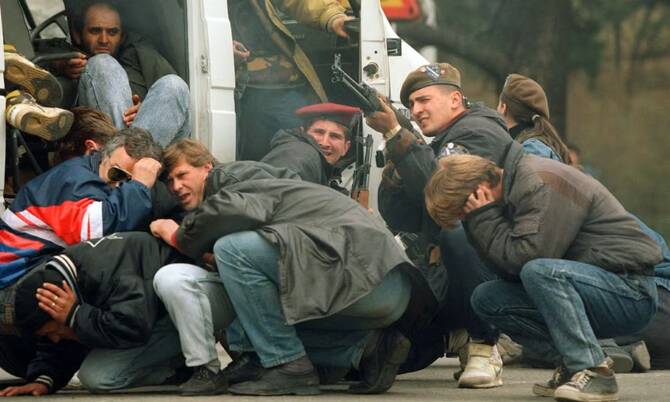
A Bosnian soldier returns fire in downtown Sarajevo as he and civilians come under fire from Serbian snipers, April 1992. (AFP)
Short Url
Updated 12 November 2025
Follow

Siege of Sarajevo drew wealthy foreigners to shoot at civilians, say Italian prosectors 

  • Journalist says he has identified people involved with ‘tourist shooters’ who paid hundreds of thousands of dollars to kill people
  • Specialist Italian police unit investigating claims after case filed by former mayor of Sarajevo

LONDON: Allegations that wealthy foreigners paid to shoot civilians during the siege of Sarajevo are being investigated by Italian prosecutors.

The claims, made by investigative journalist Ezio Gavazzeni, add that people from the US, UK, Russia and elsewhere paid Serbian forces the equivalent of up to €100,000 ($115,900) to fire at inhabitants of the Bosnian city in the 1990s.

It was supposedly organized by troops loyal to Radovan Karadzic, who was later convicted of genocide.

Gavazzeni told La Repubblica: “(There was) a price tag for these killings; children cost more, then men, preferably in uniform and armed, women, and finally old people, who could be killed for free.”

He added: “They departed Trieste (in northeast Italy) for a manhunt. And then they came home and continued their normal lives. They were respectable in the opinion of those who knew them.”

Gavazzeni continued: “There were Germans, French, English … people from all Western countries who paid large sums of money to be taken there to shoot civilians.”

“There were no political or religious motivations. They were rich people who went there for fun and personal satisfaction. We are talking about people who love guns who perhaps go to shooting ranges or on safari in Africa.”

Italian prosecutors are working with the specialist Carabinieri anti-terror and organized crime unit, the Raggruppamento Operativo Speciale, to identify those possibly involved in Italy after a case was filed by the former mayor of Sarajevo, Benjamina Karic.

She told Italy’s ANSA news agency: “An entire team of tireless people are fighting to have this complaint heard.”

Gavazzeni said that he had spoken to a Bosnian intelligence officer who claimed to have knowledge of the macabre practice from a captured Serbian soldier, and that he had also identified a number of Italians involved.

Nicola Brigida, a lawyer working with Gavazzeni, told the Guardian: “The evidence accumulated after a long investigation is well substantiated and could lead to serious investigation to identify the culprits. There is also the report from the former Sarajevo mayor.”

It is not the first time such allegations have been made. In 2007 a former US marine, John Jordan, told the International Criminal Tribunal for the former Yugoslavia that he knew of “tourist shooters” who came to Sarajevo “to take pot shots at civilians for their own gratification.”

He noted that one man had turned up with a rifle “more suited to wild boar than to urban combat.”

The city, surrounded by hills to use as vantage points, became notorious for sniper shootings during the siege, which was the longest of any city in modern European history, and saw about 11,500 people killed.

Italian intelligence agency SISMI also said during the tribunal that “weekend snipers” had taken part in killings in Sarajevo during the siege. At least one case, involving Russian nationalist Eduard Limonov, is known to have taken place, after he was filmed in 1992 firing at the city alongside Karadzic.

British journalist Tim Judah, who was based in the area, told the Telegraph: “It is possible that there were people willing to pay to do this. But I don’t think the numbers would have been very large.”

A spokesperson for the Bosnian consulate in Milan said: “We are impatient to discover the truth about such a cruel matter in order to close a chapter of history. I am in possession of certain information I will be sharing with the investigators.”


Pakistanis fleeing Iran describe strikes shaking ground under their feet

Updated 58 min 43 sec ago
Follow

Pakistanis fleeing Iran describe strikes shaking ground under their feet

  • Nearly 1,000 students, businessmen and pilgrims have fled Iran since the war started out of a total 35,000 Pakistanis in the country

QUETTA: Pakistanis fleeing Iran described explosions and missile strikes across Tehran shaking the ground under ​their feet and engulfing buildings in fire and smoke in a city emptied of many of its residents. The conflict has widened sharply, with a US submarine sinking an Iranian warship off Sri Lanka on Wednesday and NATO air defenses destroying an Iranian missile fired toward Turkiye.
Governments have been scrambling to evacuate stranded citizens, with most of the region’s airspace closed due to the risk of missiles hitting passenger planes.
“I was in the classroom when a powerful explosion rocked our university building,” Hareem ‌Zahra, 23, a ‌student at the Tehran University of Engineering, told ​Reuters ‌after ⁠crossing Pakistan’s land ​border with ⁠Iran.
“We saw thick smoke coming from many buildings on fire,” she said, adding Tehran was under attack until the moment she left.

TEHRAN LOOKED DESERTED
Nearly 1,000 students, businessmen and pilgrims have fled Iran since the war started out of a total 35,000 Pakistanis in the country, Mudassir Tipu, Pakistan’s ambassador to Tehran, said.
“There are now serious challenges. As you know there is no Internet in most parts of Iran,” he said. Iran ⁠has retaliated with a barrage of ballistic missiles targeting Israel and ‌Washington’s allies in the Gulf, including Qatar, Kuwait, ‌the UAE, and Saudi Arabia, following US and Israeli ​air strikes that killed Supreme Leader ‌Ayatollah Ali Khamenei on Saturday.
Tehran has looked deserted since the conflict began, said Nadir ‌Abbas, 25, a student of Persian literature at a university in the Iranian capital.
“I saw a drone hit a basketball court where six girl players lost their lives.”
Reuters could not verify his account.

DESTRUCTION EVERYWHERE

Islamabad is walking a diplomatic tightrope as it attempts to maintain warming ‌ties with Washington while expressing solidarity with Iran.
Pakistan is home to the second-largest Shiite population in the world after Iran and ⁠being drawn into ⁠the conflict could lead to instability at home as well as complications evacuating its citizens.
“The first attack happened right next to my hospital,” said Sakhi Aun Mohammad, a student at Tehran University of Medical Sciences. After he reached the border, an Iranian friend called to check if he was safe, saying: “’Thank God, you have gone to Pakistan, all of you are safe, but your hostel has been attacked’.” A Pakistani diplomat who is still in Tehran said attacks took place every four or five hours, adding one missile struck a building next to his office. “At times you will feel as if something exploded right at your feet,” he said. “The last time ​I got out was at night. ​Buildings had collapsed, some others were on fire. There is destruction everywhere.”
He added: “It is almost like a ghost town.”