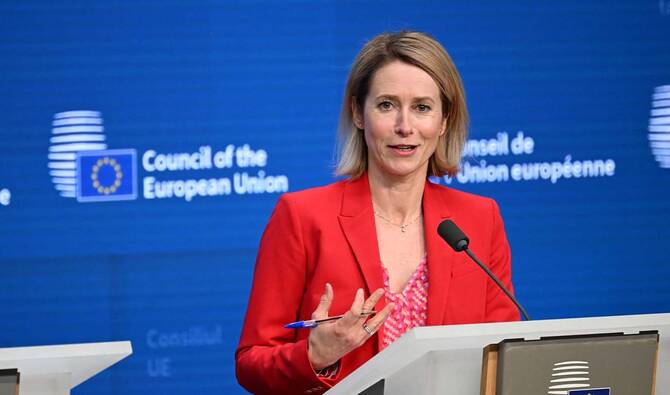

ISLAMABAD: The European Union’s (EU) High Representative for Foreign Affairs Kaja Kallas will arrive in Islamabad tomorrow, Monday, to take part in the EU-Pakistan Strategic Dialogue to review bilateral ties and cooperation, the intergovernmental body said this week.
Kallas will co-chair the 8th EU-Pakistan Strategic Dialogue in Islamabad along with Deputy Prime Minister and Foreign Minister Ishaq Dar, the European External Action Service (EEAS), the EU’s diplomatic service, said in a statement on Saturday.
The Strategic Dialogue is the highest level of institutionalized interaction between the two sides, during which they review cooperation across all sectors under the Pakistan-EU Strategic Engagement Plan 2019.
“On 1 June, the High Representative/Vice President (HR/VP) Kaja Kallas will travel to Islamabad, Pakistan, for a bilateral visit and the 8th EU-Pakistan Strategic Dialogue,” the EEAS said.
It said Kallas will meet President Asif Ali Zardari, Prime Minister Shehbaz Sharif and Chief of Defense Forces Field Marshal Asim Munir during her visit.
It said the eighth round of the dialogue will provide an opportunity for both sides to discuss bilateral relations under the Strategic Engagement Plan, signed in June 2019.
Kallas will hold a joint press conference with Dar at 12:30 p.m. local time, the statement said.
“During the visit, the HRVP will also meet with representatives of think thanks and academia,” the statement added.
Pakistan attaches special importance to the EU, with it being one of its largest trading partners for Islamabad, accounting for more than 30 percent of exports under the GSP Plus scheme.
The GSP Plus scheme grants countries’ exports duty-free access to the European market in exchange for voluntarily agreeing to implement 27 international core conventions, including those on human and civil rights. Pakistan is one of the beneficiaries of the scheme.
The seventh round of the Strategic Dialogue between the two sides was held in November last year when Kallas visited Islamabad. Both sides stressed the importance of further deepening trade and investment ties, including through the EU’s GSP Plus arrangement, to drive sustainable growth, export diversification, job creation and mutually beneficial economic opportunity.