

Pakistan takes part in Jeddah Hajj Conference, vows better facilities for pilgrims

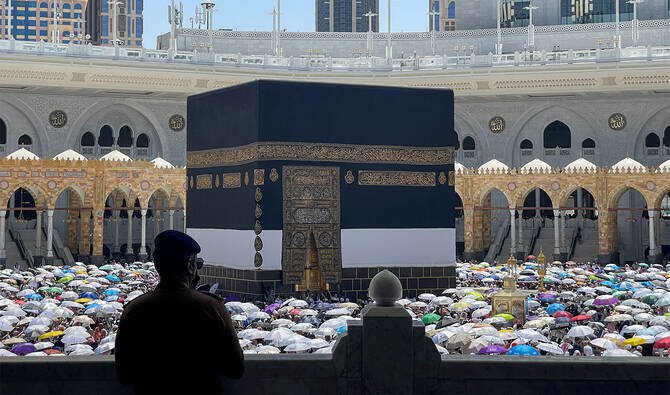
A policeman looks as Muslims perform the farewell Tawaf ritual around the Kaaba at the Grand Mosque in the holy city of Mecca, Saudi Arabia, on June 8, 2025. (REUTERS/File)
Short Url
Updated 12 November 2025
Follow

Pakistan takes part in Jeddah Hajj Conference, vows better facilities for pilgrims

  • Pakistan’s religious affairs secretary meets Saudi minister for Hajj and Umrah in Jeddah 
  • Pakistan has been allocated a quota of 179,210 pilgrims for next year’s pilgrimage 

ISLAMABAD: A Pakistani government delegation took part in the ongoing annual Hajj Conference and Exhibition in Jeddah on Wednesday, the religious affairs ministry said, vowing to provide better facilities for pilgrims during next year’s pilgrimage. 

The Pakistani delegation was led by Dr. Syed Atta-ur-Rehman, federal secretary for religious affairs, who met Saudi Arabia’s Minister of Hajj and Umrah Tawfiq Bin Fawzan Al-Rabiah during the fifth Hajj Conference and Exhibition in Jeddah. 

The conference is being held from Nov. 9-12 under the theme ‘From Makkah to the World’ and will feature more than 80 sessions and 60 workshops, with participants including academics, researchers, and representatives of Hajj affairs offices and diplomatic missions. 

“A detailed discussion was held with the Saudi Minister of Hajj and Umrah on various matters related to preparations for the upcoming Hajj,” the religious affairs ministry said in a statement. 

“During the meeting, both sides reaffirmed their commitment to providing even better facilities for pilgrims during Hajj 2026,” it added. 

Pakistan and Saudi Arabia signed the Hajj 2026 agreement last Sunday. Pakistan has been allocated a quota of 179,210 pilgrims for next year’s Hajj out of which around 118,000 seats have been allocated to the government scheme and the rest to private tour operators.

Under Pakistan’s Hajj scheme, the estimated cost of the government package ranges from Rs1,150,000 to Rs1,250,000 [$4,049.93 to $4,236], subject to final agreements with service providers.

Applicants paid an initial installment of Rs500,000 ($1,764) or Rs550,000 ($1,941), depending on the selected package, in August, while the remaining amount will be collected in November.



Pakistan, global crypto exchange discuss modernizing digital payments, creating job prospects 

Updated 05 December 2025
Follow

Pakistan, global crypto exchange discuss modernizing digital payments, creating job prospects 

  • Pakistani officials, Binance team discuss coordination between Islamabad, local banks and global exchanges
  • Pakistan has attempted to tap into growing crypto market to curb illicit transactions, improve oversight

ISLAMABAD: Pakistan’s finance officials and the team of a global cryptocurrency exchange on Friday held discussions aimed at modernizing the country’s digital payments system and building local talent pipelines to meet rising demand for blockchain and Web3 skills, the finance ministry said.

The development took place during a high-level meeting between Finance Minister Muhammad Aurangzeb, Pakistan Virtual Assets Regulatory Authority (PVARA) Chairman Bilal bin Saqib, domestic bank presidents and a Binance team led by Global CEO Richard Teng. The meeting was held to advance work on Pakistan’s National Digital Asset Framework, a regulatory setup to govern Pakistan’s digital assets.

Pakistan has been moving to regulate its fast-growing crypto and digital assets market by bringing virtual asset service providers (VASPs) under a formal licensing regime. Officials say the push is aimed at curbing illicit transactions, improving oversight, and encouraging innovation in blockchain-based financial services.

“Participants reviewed opportunities to modernize Pakistan’s digital payments landscape, noting that blockchain-based systems could significantly reduce costs from the country’s $38 billion annual remittance flows,” the finance ministry said in a statement. 

“Discussions also emphasized building local talent pipelines to meet rising global demand for blockchain and Web3 skills, creating high-value employment prospects for Pakistani youth.”

Blockchain is a type of digital database that is shared, transparent and tamper-resistant. Instead of being stored on one computer, the data is kept on a distributed network of computers, making it very hard to alter or hack.

Web3 refers to the next generation of the Internet built using blockchain, focusing on giving users more control over their data, identity and digital assets rather than big tech companies controlling it.

Participants of the meeting also discussed sovereign debt tokenization, which is the process of converting a country’s debt such as government bonds, into digital tokens on a blockchain, the ministry said. 

Aurangzeb called for close coordination between the government, domestic banks and global exchanges to modernize Pakistan’s payment landscape.

Participants of the meeting also discussed considering a “time-bound amnesty” to encourage users to move assets onto regulated platforms, stressing the need for stronger verifications and a risk-mitigation system.

Pakistan has attempted in recent months to tap into the country’s growing crypto market, crack down on money laundering and terror financing, and promote responsible innovation — a move analysts say could bring an estimated $25 billion in virtual assets into the tax net.

In September, Islamabad invited international crypto exchanges and other VASPs to apply for licenses to operate in the country, a step aimed at formalizing and regulating its fast-growing digital market.