UK health minister denies plotting against PM Starmer

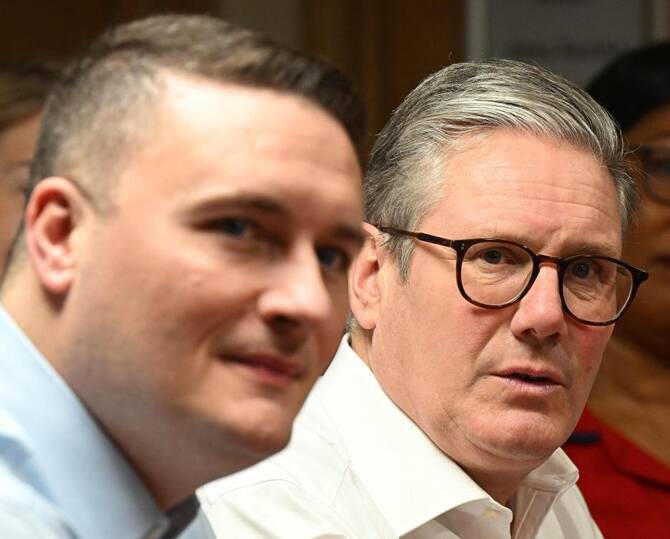
UK health minister Wes Streeting, left, was forced to repeatedly deny he planned to oust Prime Minister Keir Starmer. (AFP)
Short Url
Updated 12 November 2025
Follow

UK health minister denies plotting against PM Starmer

  • Health chief Wes Streeting has long been seen as a potential replacement for Keir Starmer
  • The government’s poll ratings have nosedived since Starmer won power in July last year

LONDON: The UK health minister was on Wednesday forced to repeatedly deny he planned to oust Prime Minister Keir Starmer, hours after sources said the premier would fight off any leadership challenge, despite plummeting poll ratings.
“I’m not going in to demand the prime minister’s resignation,” Wes Streeting told Sky News. “I support the prime minister. I have done since he was elected leader of the Labour Party.”
The 42-year-old has long been seen as a potential replacement for Starmer.
His denial, repeated to other broadcasters, follow anonymous briefings by Starmer allies who on Sunday told journalists he would fight any attempt to replace him.
“Keir knows he is already fighting a leadership contest. When it comes, he won’t resign. He will fight it,” one supporter was quoted as saying by The Times daily.
The government’s poll ratings have nosedived since Starmer won power in July last year.
Despite securing a landslide election victory, his government has struggled on issues such as economic growth and immigration.
Brexit figurehead Nigel Farage’s Reform UK party has been leading by double-digit margins in many national polls for much of this year.
The next general election is not expected until 2029 but the government faces an important test at local elections in May 2026.
A challenge for the leadership of the Labour Party would require the support of 20 percent of the party’s MPs, which currently means 80 nominations would be needed.


Activist Peter Tatchell arrested over ‘globalize the intifada’ placard

Updated 4 sec ago
Follow

Activist Peter Tatchell arrested over ‘globalize the intifada’ placard

  • Arrest in London during Saturday protest an ‘attack on free speech,’ his foundation says
  • Intifada ‘does not mean violence and is not antisemitic,’ veteran campaigner claims

LONDON: Prominent activist Peter Tatchell was arrested at a pro-Palestine march in central London, The Independent reported.

According to his foundation, the 74-year-old was arrested for holding a placard that said: “Globalize the intifada: Nonviolent resistance. End Israel’s occupation of Gaza & West Bank.”

The Peter Tatchell Foundation said in a statement that the activist labeled his Saturday arrest as an “attack on free speech.”

It added: “The police claimed the word intifada is unlawful. The word intifada is not a crime in law. The police are engaged in overreach by making it an arrestable offense.

“This is part of a dangerous trend to increasingly restrict and criminalize peaceful protests.”

Tatchell described the word “intifada,” an Arab term, as meaning “uprising, rebellion or resistance against Israel’s occupation of the West Bank and Gaza.

“It does not mean violence and is not antisemitic. It is against the Israeli regime and its war crimes, not against Jewish people.”

According to his foundation, Tatchell was transported to Sutton police station to be detained following his arrest.

In December last year, London’s Metropolitan Police said that pro-Palestine protesters chanting “globalize the intifada” would face arrest, attributing the new rules to a “changing context” in the wake of the Bondi Beach attack in Australia.

“Officers policing the Palestine Coalition protest have arrested a 74-year-old man on suspicion of a public order offense. He was seen carrying a sign including the words ‘globalize the intifada’,” the Metropolitan Police said on X.

According to a witness, Tatchell had been marching near police officers with the placard for about a mile when the group came across a counterprotest.

He was then stopped and “manhandled by 10 officers,” said Jacky Summerfield, who accompanied Tatchell at the protest.

“I was shoved back behind a cordon of officers and unable to speak to him after that,” she said.

“I couldn’t get any closer to hear anything more than that; it was for Section 5 (of the Public Order Act).

“There had been no issue until that. He was walking near the police officers. Nobody had said or done anything.”