Pakistan urged to shift climate finance to local level as weather risks intensify

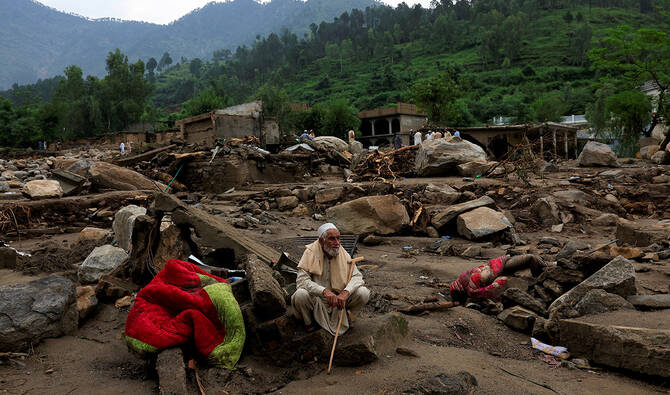
Nasir Khan, 81, sits amid the remains of damaged houses following a storm that caused heavy rains and flooding, in Bayshonai Kalay, Buner district, Khyber Pakhtunkhwa province, Pakistan, August 17, 2025. (Reuters/File)
Short Url
Updated 31 January 2026
Follow

Pakistan urged to shift climate finance to local level as weather risks intensify

  • Khurram Schehzad says climate governance must be brought closer to vulnerable communities
  • Pakistan faces mounting climate shocks despite contributing less than 1% to global emissions

KARACHI: Pakistan needs to move climate finance closer to local governments to protect communities from increasingly severe weather shocks, a senior government adviser said on Saturday, as policymakers warned that centralized approaches were failing to reach those most exposed.

Pakistan has been facing increasingly erratic weather patterns, including frequent heatwaves, unprecedented rains, storms, cyclones, floods and droughts.

The country has stepped up efforts to strengthen national climate resilience following devastating floods in 2022 and 2025 that displaced millions, destroyed infrastructure and farmland and caused multibillion-dollar economic losses.

Khurram Schehzad, adviser to the finance minister, emphasized the importance of decentralizing climate action by examining the role of local governments in climate finance during a panel discussion held at the Institute of Business Administration in Karachi.

“There is an urgent need to shift climate governance and climate finance closer to the communities most exposed to climate risks,” he said, according to a statement circulated after the discussion.

“While global climate discourse often focuses on pledges and frameworks, climate resilience is ultimately built through execution, access to finance and delivery at the local level,” he added.

The discussion focused on how cities and districts could be empowered to design and bankroll locally grounded adaptation projects and bridge gaps between national climate commitments and on-the-ground delivery.

Panelists said Pakistan’s climate response must move beyond strategy documents toward practical financing mechanisms that enable households, farmers, small businesses and local administrations to invest in resilience.

Schehzad highlighted several pathways, including climate-smart agricultural lending for smallholders, energy transition finance for households and micro-enterprises, affordable climate-resilient housing, results-based financing instruments and risk-sharing frameworks to de-risk private investment.

Participants also pointed to structural challenges, including planning bottlenecks and limited fiscal space at the local level, calling for reforms to simplify approval processes for small-scale adaptation projects.


Bangladesh requests Pakistan to play T20 World Cup match against India on Feb. 15

Updated 8 sec ago
Follow

Bangladesh requests Pakistan to play T20 World Cup match against India on Feb. 15

  • Islamabad announced boycotting the Feb. 15 match in Colombo to protest the ICC’s exclusion of Bangladesh from the T20 World Cup
  • ’We are deeply moved by Pakistan’s efforts to go above and beyond in supporting Bangladesh during this period,’ the BCB chief says

ISLAMABAD: The Bangladesh Cricket Board (BCB) on Monday formally requested Pakistan to play its scheduled T20 World Cup match against arch-rival India on Feb. 15, following Islamabad’s decision to boycott the high-profile fixture.

Islamabad announced boycotting the Feb. 15 Pakistan-India match in Colombo to protest the International Cricket Council’s (ICC) exclusion of Bangladesh from the T20 World Cup, following Dhaka’s decision to not play matches in India owing to security fears.

On Sunday, ICC Deputy Chairman Imran Khwaja arrived in Lahore for talks with PCB officials and BCB President Aminul Islam as the sport’s governing body strived to save the high-stakes T20 World Cup encounter.

In a statement, the BCB thanked the PCB, ICC and all others for their positive roles in trying to “overcome recent challenges,” particularly thanking PCB Chairman Mohsin Naqvi and Pakistani cricket fans for demonstrating “exemplary sportsmanship and solidarity.”

“We are deeply moved by Pakistan’s efforts to go above and beyond in supporting Bangladesh during this period. Long may our brotherhood flourish,” BCB President Islam said in a statement.

“Following my short visit to Pakistan yesterday and given the forthcoming outcomes of our discussions, I request Pakistan to play the ICC T20 World Cup game on 15 February against India for the benefit of the entire cricket ecosystem.”

The dispute stemmed from the ICC’s decision to replace Bangladesh with Scotland last month after Bangladesh refused to play tournament matches in India. Dhaka’s decision followed the removal of Mustafizur Rahman from the Indian Premier League (IPL). He was bought for $1 million by the IPL’s Kolkata Knight Riders, but on Jan. 3 the Board of Control for Cricket in India (BCCI) ordered Kolkata to release Mustafizur without a public explanation but amid regional tensions.

Pakistani cricket authorities subsequently announced boycotting the match against India at R. Premadasa Stadium in Colombo on Feb. 15. An India-Pakistan fixture is the sport’s most lucrative asset, generating a massive share of global broadcasting and sponsorship revenue.

The PCB has remained defiant amid reports of potential sanctions. On Saturday, it rejected claims by Indian media that it had initiated a dialogue with the ICC to find a way out of the standoff.

The standoff highlights the growing friction within the sport’s governance, with Pakistan accusing India’s cricket board of influencing the ICC’s decisions. India generates the largest share of cricket’s commercial revenue and hence enjoys considerable influence over the sport. Critics argue that this financial contribution translates into decisive leverage within the ICC.

A large part of that revenue comes from the Indian Premier League (IPL), the sport’s most lucrative T20 cricket competition, which is run by the Board of Control for Cricket in India (BCCI). Between 2024 and 2027, the IPL is projected to earn $1.15 billion, nearly 39 percent of the ICC’s total annual revenue, according to international media reports.