Morocco deploys army to help evacuate thousands after floods

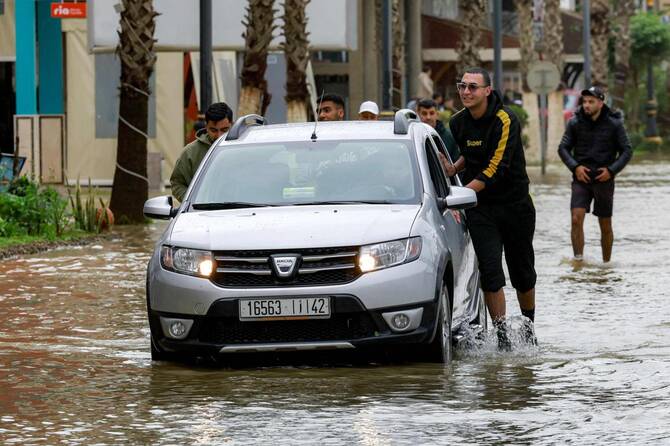
Men push a vehicle moving along an inundated road in Morocco’s northwestern city of Ksar el-Kebir on Jan. 29, 2026, as several neighborhoods flooded in the city due to a rise in the water level of the Loukkos river following recent heavy rainfall. (AFP)
Short Url
Updated 31 January 2026
Follow

Morocco deploys army to help evacuate thousands after floods

  • More than 20,000 people had been moved ⁠to shelter and camps by Saturday
  • Authorities set up sandbags and temporary barriers in flood-prone districts as waters began to recede

RABAT: Morocco has deployed army rescue units to help with the evacuation of thousands of people after floods triggered by torrential rains and rising river levels hit parts of the country’s northwest, state TV reported on Saturday.
Weeks of heavy rainfall, combined with water releases from a nearly full dam nearby, increased water levels in the ⁠Loukous River and flooded several neighborhoods in the city of Ksar Kbir, about 190 km (118 miles) north of the capital Rabat, a national flood follow-up committee said.
More than 20,000 people had been moved ⁠to shelter and camps by Saturday, official media reported.
Authorities set up sandbags and temporary barriers in flood-prone districts as waters began to recede.
Schools in Ksar Kbir have been ordered to remain closed until February 7 as a precaution.
In the nearby province of Sidi Kacem, the Sebou River’s rising levels prompted evacuations ⁠from several villages as authorities raised vigilance levels.
The abundant rainfall ended a seven-year drought that drove the country to invest heavily in desalination plants.
The average dam-filling rate has risen to 60 percent, with several major reservoirs reaching full capacity, according to official data.
Last month, 37 people were killed in flash floods in the Atlantic coastal city of Safi, south of Rabat.


Turkiye’s foreign minister says the US and Iran showing flexibility on nuclear deal, FT reports

Updated 4 sec ago
Follow

Turkiye’s foreign minister says the US and Iran showing flexibility on nuclear deal, FT reports

  • Hakan Fidan: “It is positive that the Americans appear willing to tolerate Iranian enrichment within clearly set boundaries”
  • Washington has until now demanded Iran relinquish its stockpile of uranium enriched to up to 60 percent fissile purity
The United States and Iran are showing flexibility on a nuclear deal, with Washington appearing “willing” to tolerate some nuclear enrichment, Turkish Foreign Minister Hakan Fidan told the Financial Times in an interview published Thursday.
“It is positive that the Americans appear willing to tolerate Iranian enrichment within clearly set boundaries,” Fidan, who has been involved in talks with both Washington and Tehran, told the FT.
“The Iranians now recognize ‌that they ‌need to reach a deal with the ‌Americans, ⁠and the Americans ⁠understand that the Iranians have certain limits. It’s pointless to try to force them.”
Washington has until now demanded Iran relinquish its stockpile of uranium enriched to up to 60 percent fissile purity, a small step away from the 90 percent that is considered weapons grade.
Iranian ⁠President Masoud Pezeshkian has said Iran would continue ‌to demand the ‌lifting of financial sanctions and insist on its nuclear rights including ‌enrichment.
Fidan told the FT he believed Tehran “genuinely ‌wants to reach a real agreement” and would accept restrictions on enrichment levels and a strict inspection regime, as it did in the 2015 agreement with the US and others. US ‌and Iranian diplomats held talks through Omani mediators in Oman last week in ⁠an effort ⁠to revive diplomacy, after President Donald Trump positioned a naval flotilla in the region, raising fears of new military action. Trump on Tuesday said he was considering sending a second aircraft carrier to the Middle East, even as Washington and Tehran prepared to resume negotiations.
The Turkish foreign minister, however, cautioned that broadening the Iran-US talks to ballistic missiles would bring “nothing but another war.”
The US State Department and the White House did not respond to a request for comment outside regular business hours.