

Afghanistan’s economy buckles as millions return from Pakistan and Iran, UNDP warns

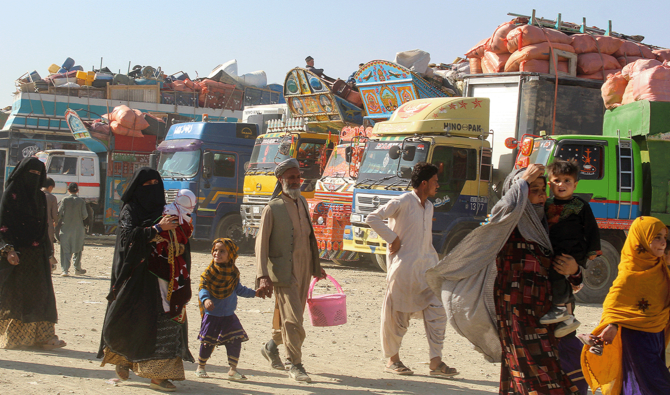
Afghan refugees arrive near the Pakistan-Afghanistan border in Chaman on October 30, 2025, ahead of their departure for Afghanistan. (AFP/File)
Short Url
Updated 12 November 2025
Follow

Afghanistan’s economy buckles as millions return from Pakistan and Iran, UNDP warns

  • Nine in 10 Afghan families are skipping meals, selling belongings or taking on debt to survive
  • Overlapping shocks from mass returns and natural disasters have deepened Afghanistan’s crisis

KARACHI: Afghanistan’s economic recovery is buckling as nine in 10 households are forced to skip meals, sell belongings or take on debt to survive, the United Nations said on Wednesday, warning that mass returns are exacerbating the country’s worst crisis since the Taliban returned to power.

A United Nations Development Program report said nearly one in 10 overseas Afghans has been forced back home, with more than 4.5 million returnees since 2023, mainly from Iran and Pakistan, swelling the population by 10 percent. On top of that, earthquakes, floods and drought have destroyed 8,000 homes and strained public services “beyond their limits.”

QUAKES, FLOODS AND HUNGER

A survey of more than 48,000 households found that more than half of Afghanistan’s returnees have skipped medical care to buy food and 45 percent rely on open springs or unprotected wells for water.

Nearly 90 percent of returning Afghan families are in debt, owing $373 to $900, up to five times the average monthly income of $100 and nearly half of annual per-capita gross domestic product, the UNDP said.

In areas with high numbers of returnees, one teacher serves 70 to 100 students, 30 percent of children work and joblessness among returnees reaches 95 percent. The average monthly income is 6,623 Afghanis ($99.76), while rents have tripled.

|The UNDP warned that without urgent support to strengthen livelihoods and services in high-return areas, overlapping crises of poverty, exclusion and migration will deepen.

It said sustaining aid is critical as donor pledges have plunged since 2021, covering only a fraction of the $3.1 billion that the UN sought for Afghanistan this year.

The Taliban government appealed for international humanitarian assistance after a deadly quake struck eastern Afghanistan in September and it has formally protested Pakistan’s mass expulsion of Afghan nationals, saying it is “deeply concerned” about their treatment.

The Ministry of Refugees and Repatriation, the Ministry of Labor and Social Affairs and a government spokesperson did not immediately respond to requests for comment.

WOMEN BEAR THE BRUNT

Participation by women in Afghanistan’s labor force has fallen to 6 percent, one of the lowest globally, and restrictions on movement have made it nearly impossible for women who head households to access jobs, education or health care.

Kanni Wignaraja, UN assistant secretary-general and UNDP regional director for Asia and the Pacific, said, “In some provinces one in four households depend on women as the main breadwinner, so when women are prevented from working, families, communities, the country lose out.”

Households headed by women, accounting for as many as 26 percent of returnee families in some districts, face the highest risk of food insecurity and secondary displacement.

The UNDP urged Taliban authorities to allocate more resources and called on donors to lift restrictions on female aid staff.

“Cutting women out of frontline aid work means cutting off vital services for those who need them most,” Wignaraja said.


Pakistan, Muslim countries reject Israel’s plan to expel Palestinians from Gaza

Updated 4 sec ago
Follow

Pakistan, Muslim countries reject Israel’s plan to expel Palestinians from Gaza

  • Israel has announced plans to open the Rafah crossing with Egypt for Gaza residents fleeing the enclave
  • Muslim nations seek implementation of Trump’s peace plan, establishment of independent Palestinian state

ISLAMABAD: Pakistan, together with seven other Arab and Muslim countries, on Friday rejected Israel’s attempt to expel Palestinians by opening the Rafah border crossing with Egypt solely for fleeing Gaza residents, and called for adherence to the peace plan proposed by US President Donald Trump’s administration.

Trump’s Gaza plan calls on Israel to allow humanitarian aid into the territory and keep the Rafah crossing open from both sides.

However, Israel has continued to restrict aid flows, and its military said on Wednesday the crossing would open in the coming days “exclusively for the exit of residents from the Gaza Strip to Egypt.”

“The Foreign Ministers of the Islamic Republic of Pakistan, the Arab Republic of Egypt, the Hashemite Kingdom of Jordan, the United Arab Emirates, the Republic of Indonesia, the Republic of Türkiye, the Kingdom of Saudi Arabia, and the State of Qatar express their deep concern regarding the Israeli statements concerning the opening of the Rafah Crossing in one direction, with the aim of transferring residents of the Gaza Strip into the Arab Republic of Egypt,” said the joint statement circulated in Pakistan by the foreign office.

“The Ministers underscore their absolute rejection of any attempts to expel the Palestinian people from their land and stress the necessity of the full adherence to the plan proposed by US President Donald Trump, including its provisions on keeping the Rafah Crossing open in both directions, ensuring the freedom of movement for the population, and refraining from compelling any resident of the Gaza Strip to leave,” it continued.

The statement appreciated the US president’s commitment to establishing peace in the region and emphasized the importance of implementing his plan “without delay or obstruction” to help consolidate regional stability.

“The Ministers underscore the need to fully sustain the ceasefire, alleviate civilian suffering, ensure the unrestricted entry of humanitarian assistance into the Gaza Strip, initiate early recovery and reconstruction efforts, and create the conditions necessary for the Palestinian Authority to resume its responsibilities in the Gaza Strip,” the statement added.

They reaffirmed their countries’ readiness to work with the United States and all concerned regional and international actors to achieve “a just, comprehensive, and sustainable peace in accordance with international legitimacy and the two-state solution,” including the establishment of an independent Palestinian state on the pre-1967 lines with East Jerusalem as its capital.

Pakistan’s foreign office circulated the statement after Deputy Prime Minister Ishaq Dar held a telephone conversation with Saudi Foreign Minister Prince Faisal bin Farhan to discuss regional developments, particularly Gaza.

Dar condemned Israel’s plan to partially reopen the Rafah crossing only for fleeing Gaza residents, calling it a “clear violation” of the region’s peace plan.