

US airlines cancel 1,200 flights Tuesday as shutdown continues

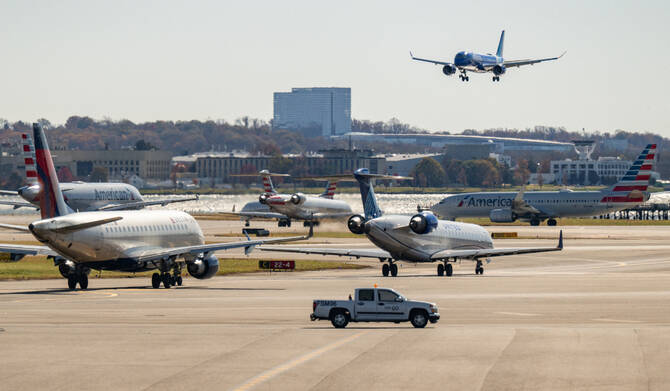
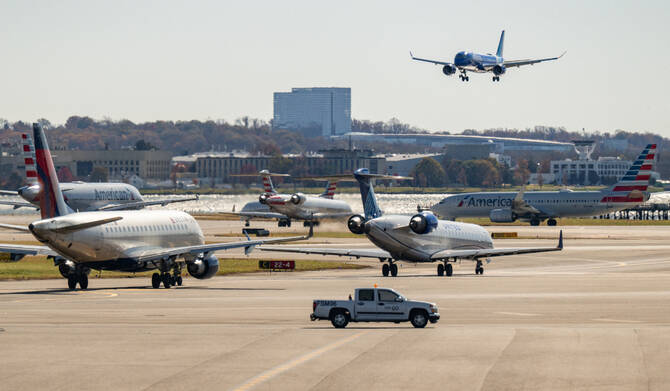
A plane approaches Ronald Reagan Washington National Airport, more than a month into the ongoing U.S. government shutdown, in Arlington, Virginia, U.S., November 11, 2025. (REUTERS)
Short Url
Updated 12 November 2025
Follow

US airlines cancel 1,200 flights Tuesday as shutdown continues

  • After airlines canceled 2,400 flights and delayed 9,600 on Monday, airlines delayed just 1,700 on Tuesday, the best performance for the industry in recent days

WASHINGTON: Airlines canceled 1,200 flights on Tuesday as air traffic control staffing improved significantly ahead of an expected end to a record-setting government shutdown as soon as Wednesday.
After airlines canceled 2,400 flights and delayed 9,600 on Monday, airlines delayed just 1,700 on Tuesday, the best performance for the industry in recent days.
Last week, the Federal Aviation Administration instructed airlines to cut 4 percent of daily flights starting on Friday, November 7, at 40 major airports because of air traffic control staffing issues. Reductions in flights rose to 6 percent on Tuesday.

HIGHLIGHTS

• Airlines delayed 1,700 flights on Tuesday, down from previous days

• Air traffic control shortages have improved

• FAA is about 3,500 controllers short of targeted staffing levels

Flight reductions were set to hit 8 percent on Thursday and 10 percent on Friday, November 14. Airlines and the FAA are in discussions about when and how the cuts will be reduced and eventually eliminated as a record-setting 42-day government shutdown nears an end.
On Monday, President Donald Trump threatened to dock the pay of any controller who did not return to work and would welcome the resignations of workers who were not diligent in showing up for work.
Some airlines are holding off on cutting 8 percent of flights for Thursday. United Airlines said Tuesday it has cut about 5 percent of Thursday flights.
Several options are being discussed for how the FAA might end or shrink the flight cuts, sources told Reuters.
Air traffic control staffing shortages improved dramatically on Tuesday after more than two dozen issues on Monday. Transportation Secretary Sean Duffy said just four staffing issues were reported Tuesday, down from 81 Saturday.
Duffy said at a press conference at Chicago O’Hare that he will reduce flight cuts as safety allows.
“When that data changes, we’re going to start taking that down from 6 percent, maybe we’ll go to four, two, and get back to normal air travel,” Duffy said. “It depends on controllers coming back to work.”
On Monday night, the Senate voted to approve legislation to end the shutdown and fund the government through January 30. The House is set to take it up on Wednesday. Duffy said that if the House did not approve the bill that flight disruptions could skyrocket this weekend and some major airlines might not keep flying. “That’s how serious this is,” Duffy said.
Air traffic absences have led to tens of thousands of flight cancelations and delays since October 1 when the shutdown began. Over the weekend, 1.2 million passengers were delayed or had their flight cancelations due to air traffic controller absences.
The shutdown, the longest in US history, has forced 13,000 air traffic controllers and 50,000 Transportation Security Administration agents to work without pay.
The FAA is about 3,500 air traffic controllers short of targeted staffing levels. Many had been working mandatory overtime and six-day weeks even before the shutdown. 


Hong Kong election turnout in focus amid anger over deadly fire

Updated 5 sec ago
Follow

Hong Kong election turnout in focus amid anger over deadly fire

  • Security tight as city holds legislative elections
  • Residents angry over blaze that killed at least 159

HONG KONG: Hong Kong’s citizens were voting on Sunday in an election where the focus is on turnout, with residents grieving and traumatized after the city’s worst fire in nearly 80 years and the authorities scrambling to avoid a broader public backlash.
Security was tight in the northern district of Tai Po, close to the border with mainland China, where the fire engulfed seven towers. The city is holding elections for the Legislative Council, in which only candidates vetted as “patriots” by the China-backed Hong Kong government may run.
Residents are angry over the blaze that killed at least 159 people and took nearly two days to extinguish after it broke out on November 26. The authorities say substandard building materials used in renovating a high-rise housing estate were responsible for fueling the fire.
Eager to contain the public dismay, authorities have launched criminal and corruption investigations into the blaze, and roughly 100 police patrolled the area around Wang Fuk Court, the site of the fire, early on Sunday.
A resident in his late 70s named Cheng, who lives near the charred buildings, said he would not vote.
“I’m very upset by the great fire,” he said during a morning walk. “This is a result of a flawed government ... There is not a healthy system now and I won’t vote to support those pro-establishment politicians who failed us.”
Cheng declined to give his full name, saying he feared authorities would target those who criticize the government.
At a memorial site near the burned-out residential development, a sign said authorities plan to clear the area after the election concludes close to midnight, suggesting government anxiety over public anger.
Beijing’s national security office in Hong Kong has said it would crack down on any “anti-China” protest in the wake of the fire and warned against using the disaster to “disrupt Hong Kong.”
China’s national security office in Hong Kong warned senior editors with a number of foreign media outlets at a meeting in the city on Saturday not to spread “false information” or “smear” government efforts to deal with the fire.
The blaze is a major test of Beijing’s grip on the former British colony, which it has transformed under a national security law after mass pro-democracy protests in 2019.
An election overhaul in 2021 also mandated that only pro-Beijing “patriots” could run for the global financial hub’s 90-seat legislature and, analysts say, further reduced the space for meaningful democratic participation.
Publicly inciting a vote boycott was criminalized as part of the sweeping changes that effectively squeezed out pro-democracy voices in Hong Kong. Pro-democracy voters, who traditionally made up about 60 percent of Hong Kong’s electorate, have since shunned elections.
The number of registered voters for Sunday’s polls — 4.13 million — has dropped for the fourth consecutive year since 2021, when a peak of 4.47 million people were registered.
Seven people had been arrested as of Thursday for inciting others not to vote, the city’s anti-corruption body said.
Hong Kong and Chinese officials have stepped up calls for people to vote.
“We absolutely need all voters to come out and vote today, because every vote represents our push for reform, our protection of the victims of  disaster, and a representation of our will to unite and move forward together,” Hong Kong leader John Lee said after casting his vote.
Hong Kong’s national security office urged residents on Thursday to “actively participate in voting,” saying it was critical in supporting reconstruction efforts by the government after the fire.
“Every voter is a stakeholder in the homeland of Hong Kong,” the office said in a statement. “If you truly love Hong Kong, you will vote sincerely.”
The last Legislative Council elections in 2021 recorded the lowest voter turnout — 30.2 percent — since Britain returned Hong Kong to Chinese rule in 1997.
