

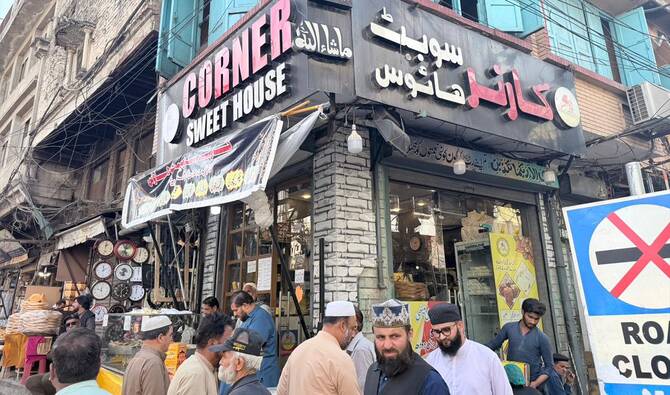

RAWALPINDI: Tucked into the narrow lanes of Rawalpindi’s old Urdu Bazar, a modest sweet shop draws steady crowds each year as Eid approaches, its counters filling with trays of traditional confections prepared much as they were over seven decades ago.
For many in this Pakistani city, Corner Sweet House is not just a place to buy desserts but a fixture of Eid celebrations, where families return year after year to continue a tradition rooted in memory, migration and shared rituals.
Founded in 1947, the year Pakistan was created after the partition of British India, the shop has served customers for nearly eight decades, becoming part of the city’s social fabric as generations mark festivals with boxes of sweets.
“I used to come here since childhood,” said Naveed Kanwal, a 62-year-old social worker and trade union leader.
“For Eid, they would start decorating the shop after the 21st of Ramadan, with stacks of sweets everywhere,” he added.
Kanwal recalled a time when Rawalpindi was smaller and centered around Raja Bazar, where the shop still stands.
“When Eid came, this was the place that spread happiness,” he said. “People would gift boxes of sweets to each other. Corner Sweet had a big name.”
Today, despite the rise of modern bakeries and changing consumer habits, Corner Sweet House has held on to its traditional recipes.
Pistachio barfi remains a bestseller, while ras malai draws customers during warmer months. The owners say they maintain consistency by sourcing fresh milk, khoya and ghee daily from cities such as Sargodha and Faisalabad.
“On Eid, the distribution of sweets is a famous tradition,” said Khalid Mehmood, the 63-year-old owner. “Thank God, we still get a very good response.”
The shop has also built a loyal following among prominent residents, including veteran politician Sheikh Rashid Ahmad, who lives nearby.
A FAMILY LEGACY
For the owners, the shop represents a family story that has spanned generations.
“This shop was established in 1947,” Mehmood said. “It’s not just a shop, it’s the story of my entire family. My grandfather, my father, my uncle, my brother, all of them worked here. Now it’s the fourth generation.”
Mehmood said his grandfather, Mohammad Hasan, migrated from Ludhiana in Indian Punjab in 1947 and initially set up a milk and yogurt stall that later evolved into a full-fledged sweet shop run by his son, Farzand Ali.
The business remained within the family, though Mehmood’s uncle branched out in 1974 to open a separate outlet, The Sweet Palace, on Murree Road.
Customers say the shop’s appeal lies not only in taste but in continuity.
“I have been coming here for about 35 to 38 years … The special thing is their standard and cleanliness. They also help people in need who come here,” said Sheikh Abdul Qadeer while buying sweets.
For Kauser Ali, the connection spans generations:
“My grandfather used to buy sweets from here, then my father then me and now my children are buying from this shop.”
Another regular, Sheikh Shabbir, said the tradition continues with each celebration.
“They have really good sweets,” he said. “We’ve been coming here for 35 or 40 years. Whenever there is a special day, we buy from here.”


