

UN Tourism: Riyadh Declaration charts future of industry with AI, sustainability at core

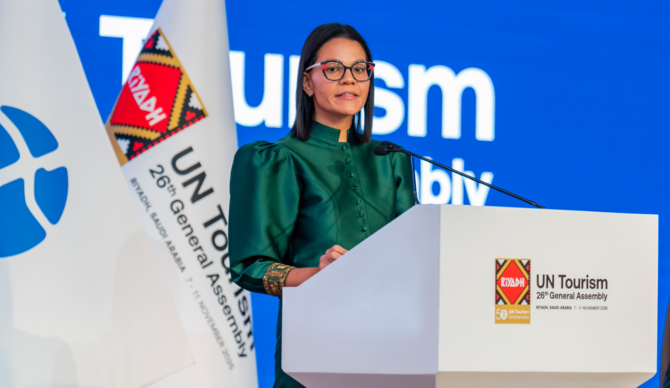
UN Tourism Executive Director Natalia Bayona led a press conference after the Riyadh Declaration was released. X/@UNWTO
Short Url
Updated 10 November 2025
Follow

UN Tourism: Riyadh Declaration charts future of industry with AI, sustainability at core

  • Member states unite to address environmental pressures, talent gaps, and digital innovation in tourism

RIYADH: Countries worldwide have committed to advancing a more sustainable tourism sector that embraces digital transformation and addresses workforce challenges.

The Riyadh Declaration on the Future of Tourism was unveiled during the UN Tourism 26th General Assembly, hosted in Saudi Arabia.

The declaration emphasizes that ministers “acknowledge that the global tourism sector is at a turning point in how people travel, how destinations evolve, and how communities thrive.” It also recognizes that rapid technological advancements — including artificial intelligence and other emerging technologies — are reshaping the global tourism landscape.

The document outlines 11 pledges, starting with a commitment for all member states to “act immediately to advance and accelerate progress towards a more sustainable tourism sector that balances environmental stewardship, economic vitality, and social well-being.”

It also encourages countries to “advance and promote the responsible adoption of digital transformation and innovation in the tourism sector by incentivizing investment in digital infrastructure, taking into account different levels of infrastructural development.”

Other pledges focus on strengthening the sector’s resilience, including advancing risk assessments, investing in “adaptive infrastructure and systems,” and fostering rapid response and recovery mechanisms.

Highlighting the importance of collaborative efforts, one goal calls on member states to “address workforce shortages and skills gaps by encouraging investments in tourism education and training, and sharing knowledge among all member states.”

Cultural preservation is also addressed, with countries urged to “promote culturally respectful and socially inclusive tourism by engaging authentically with local communities, safeguarding cultural heritage, and protecting the social fabric of host societies, while preserving cultural identity.”

The declaration notes that adopting new technologies will have “profound and multifaceted effects on the future of tourism,” and identifies sustainability, environmental pressures, accessibility, and digital innovation gaps as key areas of concern. It also highlights challenges such as exposure to crises, workforce shortages, talent mismatches, social integration, unbalanced visitor flows, and infrastructure limitations.

Public safety and the equitable distribution of tourism benefits are also raised as priorities.

At a press conference announcing the declaration, UN Tourism Executive Director Natalia Bayona said the General Assembly aimed “to set a clear vision for the future with tourism as a driver of peace, prosperity, innovation and sustainability for all.”

She added: “This is the biggest General Assembly that we have done in the history of the organization, more than 150 delegations, 90 ministers, 70 ambassadors, 17 deputy ministers of vice-ministers. Our affiliate members, the private sector, more than 120 companies from the private sector.”

Beyond setting pledges, the declaration directs UN Tourism Secretary-General Shaikha Al-Nowais to develop a “strategic roadmap” on the future of tourism, to be presented to the Executive Council within a year.

It also calls on Al-Nowais to implement the AI Impact on Tourism Report and Recommendation Guide and create a global maturity framework or index for AI in tourism. This tool will help countries assess readiness, identify gaps, unlock opportunities, and ensure the responsible and safe adoption of AI in the sector.

Member states requested UN Tourism to track AI adoption globally and develop recommendations for improvement. This report is expected at the Executive Council’s first ordinary session in 2027.

Also speaking at the press conference, Saudi Arabia’s Minister of Tourism Ahmed Al-Khateeb described the Riyadh Declaration as a “roadmap,” highlighting the commitment of member states and the secretary-general to its implementation.

“All decisions during the event were taken in a positive atmosphere, underscoring the Kingdom’s coordination abilities,” he said.


NDF mobilizes $16.2bn annually to power Vision 2030, fund’s governor tells Arab News

Updated 6 sec ago
Follow

NDF mobilizes $16.2bn annually to power Vision 2030, fund’s governor tells Arab News

RIYADH: The Momentum 2025 conference on the future of development finance underscores the National Development Fund’s role as a central enabler of Saudi Arabia’s development according to its governor.

Speaking to Arab News on the first day of the three-day conference in Riyadh, NDF’s Stephen Groff said the forum aims to enhance cooperation among local development funds, banks, and international development finance institutions, while fostering stronger partnerships with public and private sector leaders to ensure the optimal deployment of resources in support of Vision 2030.

He emphasized the NDF’s focus on stimulating investment in non-oil sectors and supporting entrepreneurs and SMEs through innovative financing and guarantee tools.

Groff said: “The purpose of this conference is to highlight the work that is being done by the NDF and its ecosystem of 12 affiliated funds and banks to support the Saudi economic diversification in line with Saudi Vision 2030, as well as to support the growth of jobs and opportunities for all Saudis.”

On the NDF’s role within the broader development ecosystem, he added: “Well, the objective of the NDF, more broadly is to support the economic objectives of Vision 2030, by helping in economic diversification, helping in the growth of new sectors, de-risk private investment into these newer sectors, so that we can ensure that there is sufficient amount of capital coming in, to support the diversification, and ensure that the kind of growth that we are seeing in the country is sustainable and resilient over time.”

The governor said the growth in Saudi Arabia’s non-oil sector in the past eight to nine years has been in part due to the kinds of investments that the NDF makes through its ecosystem of funds and banks and supporting entrepreneurs, SMEs, which has a large focus in Vision 2030.

Groff highlighted that the fund now measures its performance based on developmental impact, including the number of jobs created, the volume of financing directed to the private sector, and the growth rate of non-oil sector contributions.

“I think the kinds of job opportunities that we are seeing in the country today are significant. We are seeing massive growth in the tourism sector with terrific opportunities for investors in the sector,” he said.

Over the past seven years, the NDF has mobilized resources exceeding SR60 billion ($16.2 billion) annually to support the development ecosystem without requiring additional government funding.

Groff said that when NDF started, there were six funds that existed in the ecosystem at that point, and many of them had been around for up to 60 years and had capital allocated to them. 

“We consolidated that capital to the equivalent of about SR430 billion. And we used that capital to seed the work that was being done by those individuals, six original funds. But we also used it to set up six new funds. So the new funds that we have established are focused on the tourism sector, the import export bank, the SME bank, the Cultural Development Fund, and the Events Investment Fund,” he said.

“All of these new areas of the economy, we used that existing capital to set that up, and all of that together, in an annual disbursement amount of about SR60 billion, is being disbursed annually by this ecosystem of funds. Now, we haven’t received any additional capital from the central government to support those efforts,” he added.

“And that’s fine because we haven’t needed it. We have been able to function. But now we are embarking on a journey of eventually securitizing some of our portfolio, issuing bonds in the international markets. That will allow us to leverage that capital base and make even more efficient and effective use of that capital base to support the economic diversification,” said the governor.