

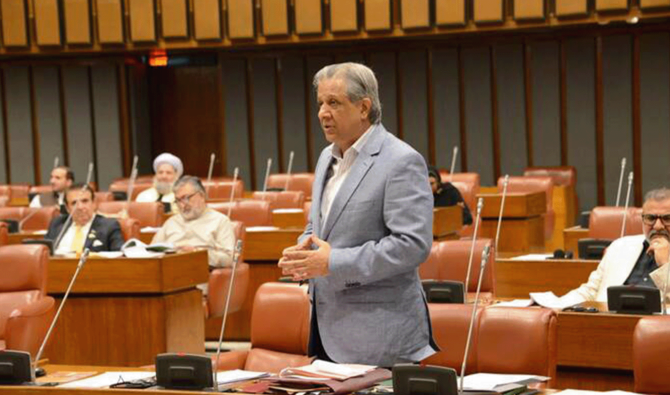

ISLAMABAD: The Pakistani government on Saturday tabled the proposed 27th constitutional amendment in the Senate, which was referred to the standing committees on law and justice.
The government requested the suspension of the question hour and other house business before Law Minister Azam Nazeer Tarar tabled the bill in the upper house of Pakistan parliament, following its approval by the federal cabinet.
Senate Chairman Yousuf Raza Gillani then referred it to the Senate committee on law and justice for review, directing the committee to invite chairman and members of the National Assembly committee on law and justice to participate in its proceedings and share input.
Speaking to reporters in Islamabad, Law Minister Tarar said the meeting of the federal cabinet, presided over by Prime Minister Shehbaz Sharif through a video link from Baku, discussed key changes under the proposed 27th constitutional amendment.
“The things which have been agreed on, after consultations... there has been a consensus over the establishment of a constitutional court,” Tarar said. “Now the proposal for a separate federal constitution court will be referred to parliament in the form of a bill, and as I said, parliament will decide on it after a debate.”
According to political leaders, the amendment proposes creating a new constitutional court, restoring executive magistrates, revising the distribution of federal revenue among provinces under the National Finance Commission (NFC) and making changes to how senior judges and military leadership appointments are structured within the constitution.
The government had been holding consultations with parties in the governing alliance, including the Pakistan Peoples Party (PPP), the Muttahida Qaumi Movement (MQM) and the Pakistan Muslim League-Quaid (PML-Q), in a bid to secure the two-thirds parliamentary majority required for constitutional changes.
It has been proposed in the bill that the transfer of judges be handled by the Judicial Commission of Pakistan and provincial cabinet threshold of 11 percent be increased to 13 percent for smaller provinces like Khyber Pakhtunkhwa and Balochistan, according to the law minister.
Speaking about Article 243, which concerns the structure of the armed forces’ command, Tarar said the recent Pakistan-India war had taught a lot of lessons, including the fact that the contours of war have changed.
“So regarding this, appointments and their processes, which were in the Army Act but could not be discussed at the time of the 1973 Constitution, one of which is the role of the field marshal... it has been deemed necessary to discuss this,” he said.
“It has been suggested that the titles you give to national heroes, this is also a ceremonial title alongside being a rank, so it has been suggested that this should remain with them for lifetime... As far as their command is concerned, it will continue to be regulated as per the law.”
Tarar’s statement came hours after the PPP, a key coalition partner, said it supported amending Article 243, establishing a constitutional court and managing judges’ transfers.
The most contentious element of the draft amendment involves potential revisions to the National Finance Commission (NFC), which determines how federal tax revenue is shared among provinces.
The PPP, which spearheaded the 18th amendment in 2010 to expand provincial autonomy, has consistently opposed any measures that would dilute the financial or administrative powers of the federating units.
“NFC allocations can increase for provinces but cannot be reduced,” PPP Chairman Bilawal Bhutto-Zardari said at a news conference late Friday, stressing that the constitutional protection of provincial financial rights “cannot be compromised.”
The Pakistan Tehreek-e-Insaf (PTI), the main opposition party led by former PM Imran Khan, has vowed to oppose the 27th amendment and demanded full disclosure of the draft before it reaches parliament.
State Minister for Law Aqeel Malik said the approval of the 27th constitutional amendment by the federal cabinet marks a “significant step toward strengthening the supremacy of parliament.”
“This amendment not only symbolizes the strengthening of democratic institutions but also fulfills the long-cherished vision of establishing a constitutional court,” he said.
“This development represents a positive and historic milestone toward promoting constitutional balance, transparent accountability, and institutional harmony across the country.”
In Pakistan, constitutional amendments have historically been used to reshape the balance of power between the legislature, judiciary and provinces.
The proposed 27th amendment follows the 26th amendment passed in October 2024, which gave parliament a role in appointing the chief justice and created a new panel of senior judges to hear constitutional cases, measures critics said weakened judicial independence.
Pakistan’s constitution, adopted in 1973, has been amended more than two dozen times, often reflecting shifts in authority among civilian governments and the military. Provisions governing the NFC award are among the most politically sensitive because they underpin the country’s federal structure and provincial autonomy.


