

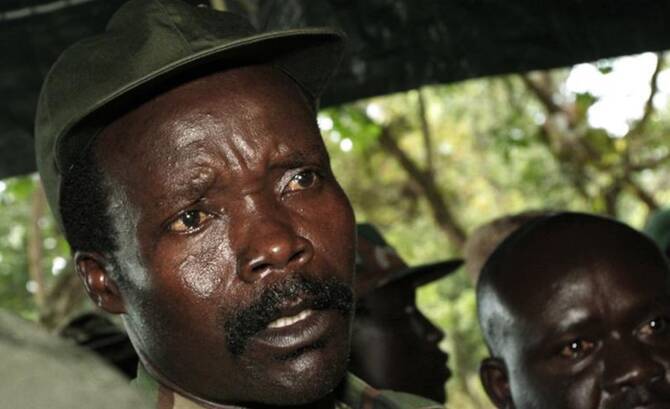
ICC confirms charges against Ugandan warlord Kony

The International Criminal Court Thursday confirmed all 39 charges of war crimes and crimes against humanity allegedly committed by fugitive Uganda warlord Joseph Kony, including murder, enslavement, rape, and torture. (X/@channelafrica1)
Short Url
Updated 06 November 2025
Follow

ICC confirms charges against Ugandan warlord Kony

  • Under ICC procedure, a trial would normally follow the confirmation of charges
  • Judges said there were reasonable grounds to believe Kony was responsible for 29 charges as an “indirect co-perpetrator“

THE HAGUE: The International Criminal Court Thursday confirmed all 39 charges of war crimes and crimes against humanity allegedly committed by fugitive Uganda warlord Joseph Kony, including murder, enslavement, rape, and torture.
The leader of the Lord’s Resistance Army spearheaded a campaign of terror across northern Uganda between July 2002 and December 2005.
Under ICC procedure, a trial would normally follow the confirmation of charges. However, the court does not allow trials in absentia, and Kony has not been seen in public since 2006.
Judges said there were reasonable grounds to believe Kony was responsible for 29 charges as an “indirect co-perpetrator.”
This related to LRA attacks on a school and camps for internally displaced people and included murder, torture, forced marriage, forced pregnancy, rape, and conscripting children younger than 15.
The ICC also said Kony had a case to answer as a direct perpetrator in 10 cases related to two victims forced to be his “wives.”
These charges included enslavement, forced marriage, rape, forced pregnancy, and sexual slavery.
A former Catholic altar boy, Kony headed the feared LRA, whose insurgency against the Ugandan government saw more than 100,000 people killed and 60,000 children abducted, according to the United Nations.
His stated aim was to establish a nation based on the Bible’s 10 commandments but those who escaped told gruesome tales of the group’s brutality, being forced to hack or even bite others to death, eat human remains, and drink blood.
His last-known appearance was in 2006, when he told a Western journalist he was “not a terrorist” and that stories of LRA brutality were “propaganda.”
It is not known whether he is even still alive.

- ‘Tools of war’ -

In September, the ICC held a three-day “confirmation of charges” hearing in The Hague on the Kony case — the first-ever to be held without the suspect present.
His defense lawyer Peter Haynes argued during the hearing that the case should be frozen, as Kony had no way of challenging evidence in his absence.
The ICC judges rejected this request, they said in Thursday’s statement.
A lawyer for the victims, Sarah Pellet, laid out searing testimony of some of the atrocities suffered at the hands of the LRA.
The victims “had no choice when they were forced to watch killings. They had no choice when they were made to kill. They had no choice when their bodies were turned into tools of war,” Pellet told the court.
The court said neither party could appeal the decision until Kony had been informed — almost certainly a moot point.
The ICC prosecutor’s office said that confirming the charges was “a crucial step in holding Kony accountable for the grave crimes attributed to him.”
The office said it had an “unwavering commitment to pursuing justice for the victims of the crimes of the LRA and affected communities in northern Uganda.”
Several victims told AFP in Uganda that the confirmation of charges could not diminish the harm caused.
“ICC confirming Joseph Kony’s atrocities against us was expected, but is it erasing the suffering we suffered?,” said Angel Stella Lalam, a Kony victim who now heads the War Victims and Networking Organization based in Gulu city, the epicenter of the armed insurgency.
Lalam told AFP by phone that she was abducted as a child and only returned to her family more than a decade later.
“The confirmation of charges is cosmetic and does not address the suffering of the victims, especially when he is not in the dock and still at large,” she added.
Alex Okello, 56, a local leader in Pabbo, north of Gulu, said he wanted to see Kony actually face justice.
“The confirmation of charges against Kony is good but it’s not making us comfortable because he has not been arrested and he can kill more people,” Okello added.

‘I wanted to die’: survivors recount Mozambique flood terror

Updated 5 sec ago
Follow

‘I wanted to die’: survivors recount Mozambique flood terror

  • The southern African country’s latest bout of flooding has claimed nearly 140 lives since October 1
  • Around 100,000 people are sheltering in one of 99 temporary accommodation centers
MANHICA, Mozambique: Erica Raimundo Mimbir delivered her first baby on a school desk, the only dry place she found after days marooned in her flooded home in southern Mozambique.
“I wanted to die because of the labor pains and the conditions,” the 17-year-old said in a village in the province of Maputo.
Evacuated by boat the next day, Mimbir took shelter with relatives, among some 650,000 Mozambicans the United Nations says have been affected by torrential rains since December.
“I don’t think I’ll return home because I’ve never experienced anything like this,” Mimbir said, recounting that the high waters meant she could not sleep lying down but leaning against a wall.
“It was very painful,” she said, holding her baby, Rosita, who was born on January 19 premature and weighing 1.5 kilograms.
The child was named after Rosita Salvador, whose mother gave birth in a tree that she climbed to escape devastating flooding in Mozambique in 2000.
Salvador, who died this month after a long illness, became a symbol of resilience in a disaster that killed 800 people.
The southern African country’s latest bout of flooding has claimed nearly 140 lives since October 1, according to the National Disasters Management Institute.
Around 100,000 people are sheltering in one of 99 temporary accommodation centers, says the UN’s humanitarian coordination office (OCHA).
‘Heart not at peace’
In the province’s 3 de Fevereiro village in Manhica district, a low-slung school has been turned into one such emergency shelter.
About 500 people sleep on mats in its 11 classrooms, their clothes draped over blackboards and window bars as they take stock of what the floods swept away and how close many came to losing their lives.
Among them is Elsa Paulino, a 36-year-old mother of five who became cut off from her home after taking her two youngest children to a funeral outside her village.
By the time she returned, the road had vanished under rising water. “The car I was traveling in almost overturned because of the fury of the waters,” she said.
Her other three children were still at home. “I was desperate.”
Paulino eventually managed to arrange for them to be evacuated by bus to relatives in neighboring Gaza province, also badly affected by the floods.
But washed-out roads mean her children have still not been able to join her. “Right now I know my children are safe but my mother’s heart isn’t at peace,” she said.
Across the region, floods have ripped through critical infrastructure — roads, bridges, power lines and water systems. They have slowed aid deliveries and isolated entire communities.
The N1 highway linking Maputo to the north remains cut. About 325,000 head of livestock have died and 285,000 hectares (704,250 acres) of farmland have been damaged, according to OCHA.
The latest flooding is among the worst Mozambique has seen in years, with officials warning the death toll could rise as more heavy rains loom and a nationwide red alert remains in force.
For Salvador Maengane, a 67-year-old farmer sheltering in 3 de Fevereiro, the losses are total.
“All my farmland was flooded,” he said. He was due to harvest maize and vegetables in March and sugarcane in May.
“Everything was lost and I have nothing to sell. All my family’s livelihood is gone,” he said, his thin frame hunched with exhaustion.
Maengane, who farms five hectares in Xinavane, further north, said that in previous rainy seasons he could still salvage part of his crop.
“This is the first time I have seen a tragedy of this magnitude,” he said.