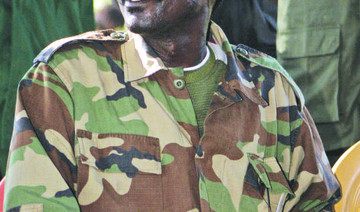
THE HAGUE: Prosecutors at the International Criminal Court began presenting evidence Tuesday to support their charges against fugitive Ugandan rebel leader Joseph Kony at the global court’s first ever in absentia hearing, alleging that he inflicted horrors on Ugandan society that still echo two decades later.
Kony is facing 39 counts of war crimes and crimes against humanity as the fugitive leader of the Lord’s Resistance Army, or LRA, which terrorized northern Uganda for decades.
“The social and cultural fabric of Northern Uganda has been torn apart, and it is still struggling to rebuild itself,” deputy prosecutor Mame Mandiaye Niang said in his opening statements.
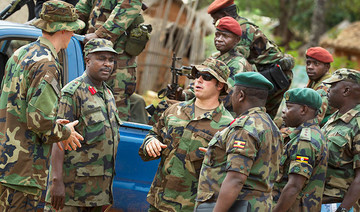
The LRA began its attacks in Uganda in the 1980s, when Kony sought to overthrow the government. After being pushed out of Uganda, the militia went on to attack villages in Congo, Central African Republic and South Sudan. It was notorious for using child soldiers, mutilating civilians and enslaving women.
Niang said that victims were still “scarred in their body and spirit.”
As part of his presentation to a panel of three black-robed judges, Niang showed multiple graphic videos of the destruction the prosecution says was wrought by the LRA, including a clip from a Uganda police video depicting a body being removed from the rubble of a burned out building.
The court’s so-called confirmation of charges hearing comes two decades after it issued an arrest warrant for Kony.
The ICC hearing is not a trial, but allows prosecutors to outline their case in court. After weighing the evidence, judges can rule on whether or not to confirm the charges against Kony, but he cannot be tried unless he is in ICC custody.
Court-appointed counsel for Kony argued the proceedings violate their client’s fair trial rights and should not have been held at all.
“The empty chair impacted the preparation of the defense,” lawyer Peter Haynes said, pointing to the courtroom seat where Kony would be if he was present.
The hearing has been seen as a test case for the court moving forward with other cases where the likelihood of having a suspect detained is considered remote, such as Israeli Prime Minister Benjamin Netanyahu or Russian President Vladimir Putin.
“Everything that happens at the ICC is precedent for the next case,” Michael Scharf, an international law professor at Case Western Reserve University, told The Associated Press.
Scharf added that while the whereabouts of Netanyahu and Putin are known, Kony has eluded US special forces and remained at large despite a $5 million reward. He also noted that the warrants for Netanyahu and Putin were issued in recent years, whereas Kony has been wanted since 2005.
Kony was thrust into the global spotlight in 2012 when a video about his crimes went viral. Despite the attention and international efforts to capture him, he remains at large.
The ICC proceedings against Kony will be followed by many in Uganda, where survivors welcome the charges even as they regret the failure to catch him.
“He did many things bad,” said Odong Kajumba, who escaped the LRA after he was captured and forced to carry a sack of sugar to Uganda’s border with Sudan in 1996. If they can arrest Kony, he said, “I am very happy.”
Not everyone is happy with the proceedings moving forward.
”Why do you want to try a man you can’t get? They should first get him,” said Odonga Otto, a former lawmaker from northern Uganda. “It’s a mockery.” Trying Kony while he is in custody makes court proceedings “more real” for victims and survivors of his alleged crimes, he said.
Another LRA commander, Dominic Ongwen, was convicted in 2020 of 61 offenses including murders, rapes, forced marriages and recruiting child soldiers. Ongwen was himself abducted by the militia as a 9-year-old boy, transformed into a child soldier and later became a brutal commander in the rebel group.
Ongwen is currently serving his 25-year sentence in Norway.


![]()

ICC opens war crimes case against Ugandan rebel leader Joseph Kony

Short Url
https://arab.news/va2mu
ICC opens war crimes case against Ugandan rebel leader Joseph Kony
- Kony is facing 39 counts of war crimes and crimes against humanity
- “The social and cultural fabric of Northern Uganda has been torn apart and it is still struggling to rebuild itself,” deputy prosecutor Mame Mandiaye Niang said
Latest updates



Recommended


© 2026 SAUDI RESEARCH & PUBLISHING COMPANY, All Rights Reserved And subject to Terms of Use Agreement.