

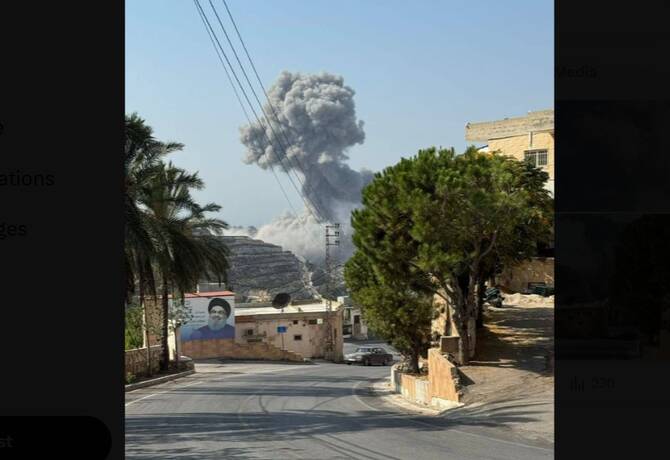
Israel steps up attacks on southern Lebanon, drops evacuation warnings

1 / 2
Israeli jets struck several towns in southern Lebanon on Thursday after urging residents to leave, marking an escalation in their near-daily strikes on the country. (X/@loquacious_lb)
2 / 2
Israeli jets struck several towns in southern Lebanon on Thursday after urging residents to leave, marking an escalation in their near-daily strikes on the country. (X/@loquacious_lb)
Short Url
Updated 07 November 2025
Follow

Israel steps up attacks on southern Lebanon, drops evacuation warnings

  • ‘Lebanon has not fired a single shot and has not violated ceasefire agreement,’ official source tells Arab News
  • Hezbollah issues letter warning that negotiating with Israeli would lead to ‘dangerous consequences’

BEIRUT: One person was killed and eight others were wounded on Thursday in an Israeli attack on southern Lebanon that included evacuation warnings ahead of strikes on what Israel described as Hezbollah military infrastructure in Tayr Debba, At-Taybah and Ayta Al-Jabal, south of the Litani River.

The escalation appears to mark a return to open conflict.

The warnings, followed by airstrikes, caused panic in populated villages, with people fleeing areas near the targeted locations.

Israeli army spokesman Avichai Adraee said the man killed and those wounded in an attack in the area between the towns of Abbasiya and Toura in the Tyre district, were “workers employed within Hezbollah infrastructure used to produce equipment for the reconstruction of facilities targeted and destroyed during the war.”

The strike marks the latest in a series of violations by Israel of the ceasefire agreement that has been in effect since Nov. 27. Since then, Israeli forces have carried out dozens of air and ground attacks deep inside Lebanon.

Israeli military reports, including the latest on Thursday, said that “Hezbollah has crossed Israel’s red line by possessing 20,000 missiles, the majority of which are short-range, contrary to previous estimates of 10,000.”

In a report issued on Wednesday, the Israeli army estimated that it had “assassinated about 20 Hezbollah members in the past month.”

These violations coincide with almost daily Israeli media reports about “preparations for a military intervention in Lebanon.”

Israeli Channel 12 reported on Thursday that the Israeli army is preparing for a new offensive in Lebanon aimed “at weakening Hezbollah, and that the goal of the intervention is to push the Lebanese government to sign a stable agreement with Israel.”

On Thursday, Hezbollah issued a letter addressed to the president, speaker of parliament, prime minister, and the Lebanese people, warning that negotiating with “the Israeli enemy … would lead to dangerous consequences,” and said it was prepared to resist.

“The legitimate right to defense does not fall under the category of a peace agreement or a war agreement. Rather, we are exercising our right to defend ourselves against an enemy that imposes war on our country, does not cease its aggression, and seeks to subjugate our state,” the statement added.

A day earlier President Joseph Aoun reiterated “Lebanon’s readiness to negotiate with Israel, approaching this path as a comprehensive national option, not a sectarian one.”

Hezbollah, which has refused to hand over its arms, said: “The issue of exclusive control of weapons is not to be discussed in response to a foreign demand or Israeli pressure, but within a national framework that establishes a comprehensive strategy for security, defense, and the protection of national sovereignty.”

Lebanese political parties have condemned Hezbollah’s statement.

An official Lebanese source told Arab News that “the Lebanese president’s insistence on conducting negotiations with Israel indicates that Lebanon does not want war, but rather prefers to pursue diplomacy.

“The US has not conveyed the Israeli response to the negotiation proposal, knowing that Lebanon will not engage in talks over the return of Lebanese prisoners held by Israel, since it is not holding any Israeli captives,” the source added.

“Lebanon will not negotiate over territory, as Israel continues to occupy positions along the border area. What is needed is an end to Israeli strikes.”

The source said that Israel’s threats could not be justified, adding that “no shots have been fired from Lebanon and there has been no violation of the ceasefire agreement. In fact, it is Israel that has breached the agreement, while Lebanon has refrained from responding to these violations.”

On Thursday afternoon, the Cabinet reviewed the Lebanese Army Command’s second report on its operations south of the Litani River.

The report is part of the army’s plan to place all weapons under the control of the Lebanese state.

Media reports said that the army has increased its presence in the area to 118 positions, while some other locations “cannot be disclosed either due to the Israeli occupation of those areas or ongoing attacks.”

The army report said that a number of weapons depots have been dismantled and tunnels that were discovered have been brought under control.

It highlighted four “massive facilities,” including one in Wadi Jilo in Tyre district that contained a large quantity of weapons and vehicles.

The report also presented an overview of “the risks faced by the army as a result of Israeli attacks targeting both its personnel and members of UNIFIL.”

UNIFIL spokesperson Candace Ardell said on Thursday that the interim force is working closely with the Lebanese Armed Forces, adding that its operations are essential to maintaining stability in the region.

Israeli Defense Minister Israel Katz on Sunday warned that the Lebanese capital Beirut would be targeted if Hezbollah launched any attack on northern Israel.

“Israel will respond to any threat, and US envoys have conveyed this message to the Lebanese government,” he said.

However, Katz said that “the US is exerting pressure on Lebanon to disarm Hezbollah, and Israel will give this effort a chance.”


Oman and Lebanon call for full Israeli withdrawal, urge end to attacks

Updated 58 min 46 sec ago
Follow

Oman and Lebanon call for full Israeli withdrawal, urge end to attacks

  • Joseph Aoun and Sultan Haitham bin Tariq make a joint call for an immediate halt to Israeli attacks on Lebanese territory
  • Reaffirmation of the unified Arab position on ending the Israeli occupation and establishing an independent Palestinian state based on the 1967 borders

BEIRUT: Lebanese President Joseph Aoun and his Omani counterpart Sultan Haitham bin Tariq on Wednesday made a joint call for an immediate halt to Israeli attacks on Lebanese territory and a full withdrawal from all occupied Arab lands, warning that continued violations pose a direct threat to regional stability.

The statement came during a high-level summit in Muscat, where both leaders voiced “serious concern over the ongoing Israeli aggression” and described the occupation as a “clear violation” of UN Security Council Resolution 1701 and other international resolutions.

The two sides also expressed support for international efforts to de-escalate tensions, stabilize the situation on the ground, facilitate the return of displaced persons, and advance post-conflict reconstruction.

Aoun led a Lebanese ministerial delegation to Oman that included Lebanon’s ministers of foreign affairs, interior, defense, health, and agriculture for talks with Omani officials.

The joint statement emphasized the strengthening of bilateral ties and expanding cooperation in key sectors including politics, the economy, investment, banking, tourism, transport, and logistics.

Both sides called for early preparations to hold the first session of the Omani-Lebanese Joint Committee, chaired by the two foreign ministers in Muscat, and to pursue new agreements and memorandums of understanding intended to enhance collaboration in trade, culture, and science. The statement also highlighted the need to boost private sector engagement in shared development opportunities.

The Omani side reaffirmed its full support for Lebanon’s sovereignty, independence, and territorial integrity, as well as for strengthening Lebanese state institutions, particularly the army and legitimate security forces, and backing the country’s ongoing economic, financial, and administrative reforms.

The two sides reaffirmed the unified Arab position on ending the Israeli occupation and establishing an independent Palestinian state based on the 1967 borders, with East Jerusalem as its capital. They also underscored the importance of strengthening Arab solidarity, respecting the sovereignty of states, and upholding the principles of good neighborliness and international law.

Aoun’s official visit to Oman took place within the context of Muscat’s established role as a regional and international mediator. During his meetings, Aoun praised Oman’s diplomatic standing and approach, describing it as “wise and responsible.”

He commended Oman’s foreign policy, grounded in dialogue, mediation, balance, and good neighborliness, saying it had earned the sultanate a “distinguished status and a pivotal role in promoting stability and resolving conflicts through peaceful means.”

Aoun said that, in Lebanon, “we hold this wise approach in high regard and deeply value the sultanate’s steadfast support for Lebanon in various international forums, as well as its support as we confront the challenges before us.”

For his part, Sultan Haitham bin Tariq reaffirmed Oman’s continued commitment to Lebanon’s stability and its close monitoring of the latest developments in the country.

He emphasized the deep-rooted relations between the two countries and the importance of strengthening bilateral cooperation and coordination. The sultan also praised the positive contributions of the Lebanese community in Oman.

On the sidelines of the visit, Lebanese Interior Minister Ahmed Al-Hajjar held a meeting with his Omani counterpart Hamoud bin Faisal Al-Busaidi at Al-Alam Palace in Muscat. They underlined the enhancement of joint cooperation, particularly in security and policing.

According to a joint statement, the discussions also covered Lebanon’s efforts to consolidate internal security and maintain stability.

Participating on the Omani side in the expanded talks were Al-Busaidi; Shihab bin Tarik Al-Said, deputy prime minister for defense affairs; Badr bin Hamad Al-Busaidi, foreign minister of Oman; Hamad bin Said Al-Aufi, head of the private office; Mahad bin Said Ba’owain, minister of labor and head of the honorary mission; Saud bin Hamoud Al-Habsi, minister of agricultural, fisheries and water resources; and Hilal bin Ali Al-Sabti, minister of health.