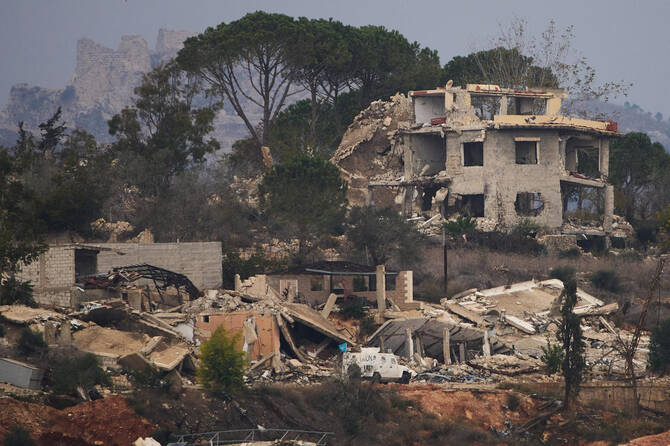
BEIRUT: Israel launched a series of strikes on southern Lebanon on Tuesday, Lebanese state media reported, with the Israeli army saying it hit a Hezbollah training center and other targets.
Despite a November 2024 ceasefire that was supposed to end more than a year of hostilities between Israel and the Iran-backed militant group, Israel has kept up strikes on Lebanon and maintains troops in five areas of the country’s south.
Lebanon’s state-run National News Agency (NNA) reported “a series of (Israeli) raids targeting the Iqlim Al-Tuffah region” near the towns of Azza, Rumin and Jbaa, about 40 kilometers (25 miles) north of the border with Israel.
“A number of houses were damaged” in JBaa, the NNA added.
The Israeli military said it had struck “infrastructure belonging to the Hezbollah terrorist organization in several areas in southern Lebanon.”
According to the military “a training and qualification compound used by Hezbollah’s Radwan Force” was hit, as were “military structures and a launch site belonging to Hezbollah.”
Israel says its continued attacks on Lebanon are to prevent the group from rearming
Under heavy US pressure and fears of expanded Israeli strikes, Lebanon’s government has committed to disarming Hezbollah, and the army is set to dismantle the group’s military infrastructure near the border by year’s end before tackling the rest of the country.
In a meeting with French envoy Jean-Yves Le Drian on Monday, Lebanese President Joseph Aoun rejected “accusations claiming that the Lebanese army is not fully carrying out its role south of the Litani River,” about 30 kilometers (20 miles) north of Israel.
Lebanon “supports any audit conducted by the ceasefire monitoring committee regarding the procedures implemented south of the Litani,” Aoun added.
The five-member committee, which includes Lebanon, Israel, France, the US and the UN peacekeeping force, is set to meet again with Lebanese and Israeli civilian representatives on December 19.


![]()

Israel army says struck Hezbollah sites in Lebanon
Short Url
https://arab.news/b3g2x
Israel army says struck Hezbollah sites in Lebanon
- The Israeli military said it had struck “infrastructure belonging to the Hezbollah terrorist organization”
- “A training and qualification compound used by Hezbollah’s Radwan Force” was hit

Latest updates


© 2026 SAUDI RESEARCH & PUBLISHING COMPANY, All Rights Reserved And subject to Terms of Use Agreement.