

Pakistan’s top military commander hails Saudi defense pact as ‘historic’ at scholars’ conference

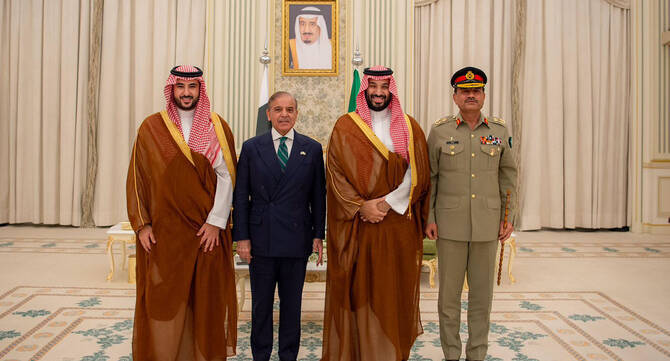
Pakistan army chief Field Marshal Syed Asim Munir (right), Saudi Crown Prince Mohammed bin Salman (2nd right), Prime Minister of Pakistan Shehbaz Sharif (2nd left) and the Saudi Minister of Defense pictured after signing of landmark defense pact in Riyadh on September 17, 2025. (PMO)
Short Url
Updated 21 December 2025
Follow

Pakistan’s top military commander hails Saudi defense pact as ‘historic’ at scholars’ conference

  • Asim Munir says Pakistan has a unique bond with the Kingdom, citing the ‘honor’ of helping safeguard the holy sites
  • He says only the state can declare jihad, urging religious scholars to counter extremist narratives and promote unity

ISLAMABAD: Chief of Defense Staff Field Marshal Asim Munir on Wednesday described the country’s joint security pact with Saudi Arabia as a “historic” milestone, telling a gathering of religious scholars that Pakistan and the kingdom share a deep strategic relationship.

Signed in September, the Strategic Mutual Defense Agreement has solidified decades of Saudi–Pakistan defense cooperation, covering intelligence-sharing, counterterrorism and regional stability.

The two nations have long coordinated on defense matters, with Pakistani military personnel deployed in the Kingdom.

“The defense agreement [with Saudi Arabia] is historic,” he said in an address to the conference in the federal capital.

The top military commander said Pakistan regarded its connection with the Kingdom as unique.

“Among all Muslim countries, Allah has given Pakistan the honor of helping safeguard the Haramain,” he continued, referring to the two holiest sites of Islam in Makkah and Madinah.

Munir used his speech to warn against extremism, saying that under the Islamic framework, only the state could declare jihad, a pointed reference to groups such as the Tehreek-e-Taliban Pakistan (TTP), which claims to act in the name of religion while carrying out attacks on civilians and security forces.

“When nations abandon knowledge and the pen, disorder takes hold,” he said, urging the religious scholars to help keep society unified and to “broaden the nation’s vision.”

Munir also criticized India, describing “terrorism” as “India’s habit, not Pakistan’s.”

His remarks came months after a four-day military confrontation in May, during which the two nuclear-armed neighbors exchanged artillery and missile fire and deployed drones and fighter jets.

India blamed Pakistan for a militant attack in Indian-administered Kashmir before launching a missile attack. Islamabad denied involvement and called for an international probe.

Pakistan claimed it had shot down six Indian fighter jets before a US-brokered ceasefire took effect.

“We do not hide when confronting the enemy,” Munir said. “We challenge openly.”


Rating firm S&P says it won’t rush Iran war downgrades, sees risks for countries like Pakistan

Updated 12 March 2026
Follow

Rating firm S&P says it won’t rush Iran war downgrades, sees risks for countries like Pakistan

  • Agency says it is monitoring indebted energy importers as higher oil prices strain finances
  • Gulf economies seen better placed to weather shock, though Bahrain flagged as vulnerable

LONDON: S&P Global ‌said it would not make any knee-jerk sovereign rating cuts following the outbreak of war in the ​Middle East, but warned on Thursday that soaring oil and gas prices were putting a number of already cash-strapped countries at risk.

The firm’s top analysts said in a webinar that the conflict, which has involved US and Israeli strikes ‌against Iran and Iranian ‌strikes against Israel, ​US ‌bases ⁠and Gulf ​states, ⁠was now moving from a low- to moderate-risk scenario.

Most Gulf countries had enough fiscal buffers, however, to weather the crisis for a while, with more lowly rated Bahrain the only clear exception.

Qatar’s banking sector could ⁠also struggle if there were significant ‌deposit outflows in ‌reaction to the conflict, although there ​was no evidence ‌of such strains at the moment, they ‌said.

“We don’t want to jump the gun and just say things are bad,” S&P’s head global sovereign analyst, Roberto Sifon-Arevalo, said.

The longer the crisis ‌was prolonged, though, “the more difficult it is going to be,” he ⁠added.

Sifon-Arevalo ⁠said Asia was the second-most exposed region, due to many of its countries being significant Gulf oil and gas importers.

India, Thailand and Indonesia have relatively lower reserves of oil, while the region also had already heavily indebted countries such as Pakistan, Bangladesh and Sri Lanka whose finances would be further hurt by rising energy prices.

“We ​are closely monitoring ​these (countries) to see how the credit stories evolve,” Sifon-Arevalo said.