

Observation mission says Tanzanian election did not comply with AU standards

1 / 5
People protest in the streets of Arusha, Tanzania, on Oct. 30, 2025. (AP Photo)
2 / 5
Protesters gather near burning buildings and barricades as clashes erupt in Dar es Salaam on October 29, 2025, during Tanzania's presidential elections. (AFP)
3 / 5
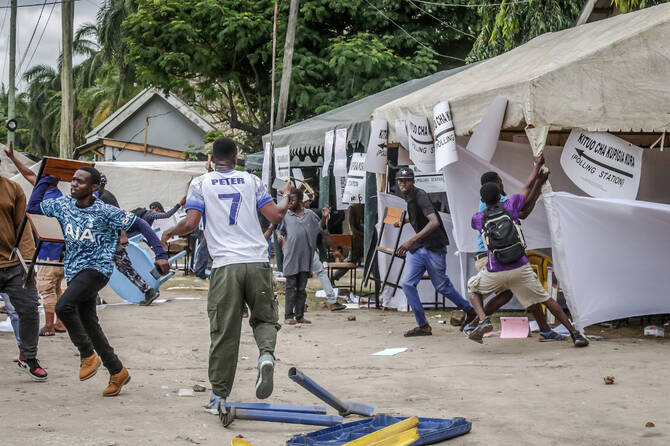
Protesters attack a polling station as clashes erupt in Dar es Salaam on October 29, 2025, during Tanzania’s presidential elections. (AFP)
4 / 5
Mourners gather for the funeral of someone who died during post-electoral violence in Arusha, Tanzania, Tuesday, Nov. 4, 2025. (AP Photo)
5 / 5
Short Url
Updated 06 November 2025
Follow

Observation mission says Tanzanian election did not comply with AU standards

  • President Samia Suluhu Hassan won the October 29 poll with 98 percent of the vote 
  • The opposition, which was barred from participating, branded the election a “sham”

NAIROBI, Kenya: African Union election observers said late Wednesday that the integrity of Tanzania’s recently concluded elections was “compromised,” citing incidents of “ballot stuffing at several polling stations.”
President Samia Suluhu Hassan won the October 29 poll with 98 percent of the vote, according to the electoral commission, but the opposition, which was barred from participating, branded the election a “sham.”
Violent protests broke out across the country on election day.
The government responded with a total Internet blackout and transport shutdown, and the opposition says hundreds were killed by security forces, though getting verified information remains difficult despite an easing of restrictions.


The AU Election Observation Mission said its observers witnessed voters being issued multiple ballots, with some allowed to cast their votes without their identities being verified against the registry.
“The 2025 Tanzania General Elections did not comply with AU principles, normative frameworks, and other international obligations and standards for democratic elections,” reads the initial report from the AU mission.
The mission said its observers were restricted from monitoring the vote count, noting that this “limited transparency.”
It added that in some polling stations observers “were asked to only observe voting for five minutes.”
The report also noted violent protests, gunfire, road closures, and tire burning in areas such as Dar es Salaam, Mbeya, Mwanza, Kagera, Dodoma, Kigoma, Tebora, Buhungwa, Singinda, among others.
The AU urged Tanzania to “prioritize electoral and political reforms to address the root causes of its democratic and electoral challenges.”
On Monday, African poll observers released an initial report saying Tanzanians had been unable to “express their democratic will” due to the barring of opposition candidates, censorship and intimidation, as well as signs of rigging on election day.


Blair dropped from Gaza ‘peace board’ after Arab objections

Updated 55 min 11 sec ago
Follow

Blair dropped from Gaza ‘peace board’ after Arab objections

  • Former UK PM was viewed with hostility over role in Iraq War
  • He reportedly met Netanyahu late last month to discuss plans

LONDON: Former UK Prime Minister Tony Blair has been withdrawn from the US-led Gaza “peace council” following objections by Arab and Muslim countries, The Guardian reported.

US President Donald Trump has said he would chair the council. Blair was long floated for a prominent role in the administration, but has now been quietly dropped, according to the Financial Times.

Blair had been lobbying for a position in the postwar council and oversaw a plan for Gaza from his Tony Blair Institute for Global Change that involved Jared Kushner, Trump’s son-in-law.

Supporters of the former British leader cited his role in the Good Friday Agreement, which ended decades of conflict and violence in Northern Ireland.

His detractors, however, highlighted his former position as representative of the Middle East Quartet, made up of the UN, EU, Russia and US, which aimed to bring about peace in the Middle East.

Furthermore, Blair’s involvement in the Iraq War is viewed with hostility across the Arab world.

After Trump revealed his 20-point plan to end the Israel-Hamas war in September, Blair was the only figure publicly named as taking a potential role in the postwar peace council.

The US president supported his appointment and labeled him a “very good man.”

A source told the Financial Times that Blair’s involvement was backed by the US and Israel.

“The Americans like him and the Israelis like him,” the person said.

The US plan for Gaza was criticized in some quarters for proposing a separate Gaza framework that did not include the West Bank, stoking fears that the occupied Palestinian territories would become separate polities indefinitely.

Trump said in October: “I’ve always liked Tony, but I want to find out that he’s an acceptable choice to everybody.”

Blair is reported to have held an unpublicized meeting with Israeli Prime Minister Benjamin Netanyahu late last month to discuss plans.

His office declined to comment to The Guardian, but an ally said the former prime minister would not be sitting on Gaza’s “board of peace.”