NAIROBI: Authorities in Tanzania faced mounting concern Tuesday over killings during crackdowns on protests surrounding last week’s election, with the largest opposition party alleging that security forces were secretly dumping bodies of hundreds killed in the violence.
Demonstrations spread across the East African country for several days after the Oct. 29 voting as mostly young people took to the streets to protest an election that foreign observers said failed to meet democratic standards because key opposition figures were barred.
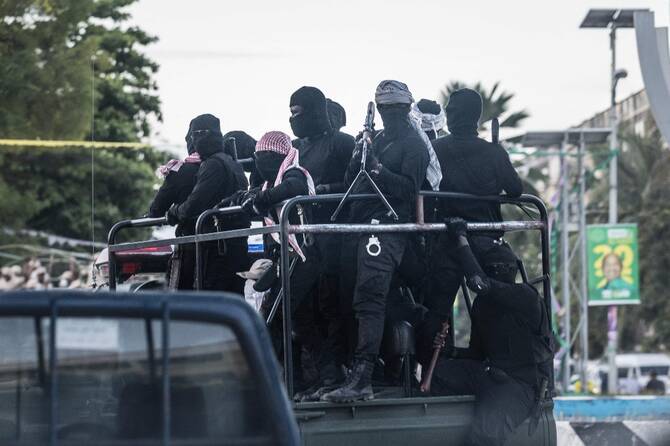
Authorities declared a nationwide curfew and security forces cracked down on protests by firing live bullets and tear gas canisters.
The main opposition party, Chadema, has claimed that more than 1,000 people were killed and said Tuesday that security forces were trying to hide the scale of the deaths by secretly disposing of the bodies. The authorities have not responded to the claims.
“Tanzanians’ hearts are bleeding right now. This is a new thing for Tanzanians,” Brenda Rupia, Chadema’s director of communications, said by phone from the commercial capital of Dar es Salaam.
President Samia Suluhu Hassan was declared the winner with more than 97 percent of the vote in a rare landslide victory for the region, but foreign observers said the turnout was low. It was her first election victory — she rose to the presidency automatically as vice president in 2021 after the sudden death of her predecessor, John Pombe Magufuli.
Hassan’s win has been criticized as not credible because her main rivals — Tundu Lissu of Chadema and Luhaga Mpina of ACT-Wazalendo — had been prevented from running. Lissu has been jailed for several months, facing treason allegations stemming from his call for electoral reforms. His deputy, John Heche, was also detained days before voting.
Human Rights Watch on Tuesday condemned the violent crackdown on protesters in a statement that urged Tanzanian authorities to “end the use of excessive and lethal force against protests, and take steps to ensure accountability” by security forces.
The group said various people in Tanzania had cited point-blank shootings by security forces.
The UK, Norway and Canada have cited what they said were credible reports of a large number of fatalities. And the Catholic Church says people died in their “hundreds,” although it was also unable to verify or confirm the exact numbers.
Tanganyika Law Society President Boniface Mwabukusi told The Associated Press that more than 1,000 people died based on accounts his group received and that it was in the process of compiling a report to be shared with international legal organizations.
“The killings were pre-planned to target regions that are known to be politically active, those that are critics of the ruling party. Following people to their homes and killing them amounts to a massacre,” Mwabukusi said.
Rupia, the top Chadema spokesperson, said at least 400 deaths have been reported by its leaders in the Tunduma area of Mbeya region. Other regions also have reported hundreds of victims, she said.
Asked if all the victims were getting funerals, she said that the security forces “are holding dead bodies” and that the remains of victims were being secretly dumped by the security forces to hide the scale of the killings.
Another Chadema official, Deogratius Munishi, said the party would not enter into any political pact with the government until there are electoral and judicial reforms to ensure justice is served. “We want to see those who shot Tanzanians being held accountable,” he said.
Tito Magoti, an independent human rights lawyer based in Dar es Salaam, said Tanzania is “in such crisis” as people look for missing relatives and others come to terms with the number of the dead, which he said is far greater than the figure cited by Chadema.
He said he received a message Tuesday from a citizen near the town of Arusha who reported seeing two army trucks coming from a hospital mortuary loaded with dead bodies. One was full and the other was half-full, he said.
He said he suspected authorities would bury the victims in a forest as part of a cover-up, and added that: “I don’t know know much hospitals are going to be complicit.”
Hassan, Tanzania’s first female leader, was inaugurated on Monday. She acknowledged in her speech that there had been loss of life and urged security agencies to ensure a return to normalcy.
Authorities have warned people not to share photos and videos that may cause panic as the Internet slowly returns after a six-day shutdown. Mobile phone users received a text message on Monday night saying that sharing images that could cause panic or demean human life would lead to “treason charges.”
The messages came shortly after the Internet was reconnected, when people began sharing unverified images of bodies they claimed were victims of the election protests.
A social media page that had been uploading videos and photos of purported election protest victims was pulled down on Monday evening, after attracting thousands of followers within a day.
On Tuesday, life was slowly returning to normal in Dar es Salaam and the administrative capital, Dodoma, with gas stations and grocery shops reopening and public transport resuming after days of closure.
The government spokesperson on Monday asked all public workers to return to work, effectively ending a work-from-home order that had been announced after the curfew imposed on Wednesday.


![]()

Tanzanian opposition claims security forces are secretly dumping bodies after election violence
Short Url
https://arab.news/p9kks
Tanzanian opposition claims security forces are secretly dumping bodies after election violence
- Human Rights Watch on Tuesday condemned the violent crackdown on protesters in a statement that urged Tanzanian authorities to “end the use of excessive and lethal force against protests, and take steps to ensure accountability” by security forces


Latest updates


© 2026 SAUDI RESEARCH & PUBLISHING COMPANY, All Rights Reserved And subject to Terms of Use Agreement.