Bangladesh offers reward for stolen guns before polls

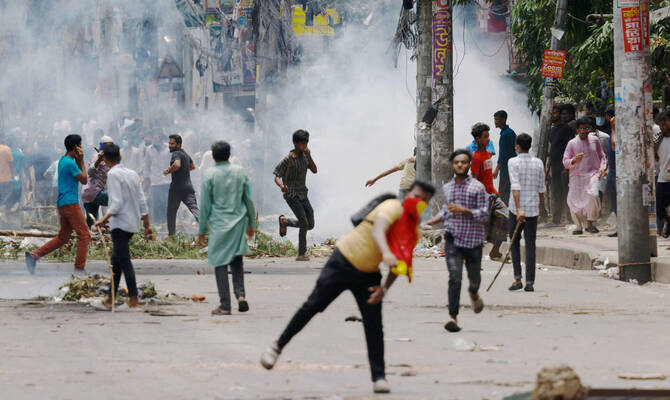
Protesters clash with Border Guard Bangladesh (BGB) and the police outside the state-owned Bangladesh Television as violence erupts across the country after anti-quota protests by students, in Dhaka, Bangladesh, July 19, 2024. (Reuters)
Short Url
Updated 05 November 2025
Follow

Bangladesh offers reward for stolen guns before polls

  • An estimated 6,000 firearms were stolen from police armories during the deadly August 2024 unrest that toppled the hard-linerule of then-prime minister Sheikh Hasina

DHAKA: Bangladesh announced on Wednesday cash rewards to surrender machine guns, rifles and pistols looted during an uprising last year, hoping to collect hundreds of weapons ahead of key elections.

An estimated 6,000 firearms were stolen from police armories during the deadly August 2024 unrest that toppled the hard-linerule of then-prime minister Sheikh Hasina.

More than 1,300 are still reported as missing, police spokesman AHM Shahadat Hossaine told AFP.

Police issued a list of rewards for their return, ranging from just over $4,000 for a light machine gun to $800 for an assault rifle, and $400 for a shotgun or pistol. Cash would also be paid for ammunition.

“Bangladesh Police guarantee full confidentiality,” Hossaine said, urging people to hand them in.

Bangladesh has been in political turmoil since Hasina fled into exile last year, and political parties are jostling for power ahead of polls slated for February 2026.

Dhaka-based rights group Odhikar says political violence since the uprising has killed nearly 300 people.

More than 150 others have been killed in mob violence, according to Odhikar.

Investigators meanwhile continue to probe a devastating fire that tore through the cargo complex of the country’s main international airport on October 18.

Bushra Islam, a senior official at Biman Bangladesh Airlines, told AFP that a team had found the smashed lock of a vault which had survived the fire — a strongroom used to store arms, as well as valuable items such as gold and diamonds.

Islam said it was not clear “how many arms have gone missing, if any.”

A senior police officer, speaking on condition of anonymity, said a team had inspected the vault after the fire.


Swedish intelligence warns of increased Middle East war fallout

Updated 5 sec ago
Follow

Swedish intelligence warns of increased Middle East war fallout

  • “The threat has increased primarily against American, Jewish, Israeli interests or opposition figures” Hallstrom told AFP
  • Hallstrom also said the war in the Middle East could have “considerable impact” on European security

STOCKHOLM: A top Swedish intelligence official on Thursday warned of increased threats against American and Israeli interests, as well as Iranian dissidents, in Sweden because of the war in the Middle East.
The Scandinavian country’s security, which had already deteriorated after Russia’s invasion of Ukraine, has worsened since the US-Israeli strikes on Iran on Saturday unleashed a new war, according to Fredrik Hallstrom, head of operations for the Swedish Security Service (Sapo).
“The threat has increased primarily against American, Jewish, Israeli interests or opposition figures, rather than toward Sweden as a nation or country,” Hallstrom told AFP.
“I’m talking about opposition figures with such influence that they could actually either be perceived as a serious threat to the Iranian regime, or in fact be one,” he explained.
Hallstrom also said the war in the Middle East could have “considerable impact” on European security.
Police have taken measures to increase security around potential targets, such as embassies, he said.
Sapo has previously pointed to Iran, China and Russia as the main threats to the country.
It has accused Iran in particular of recruiting members of Swedish criminal gangs to commit “acts of violence” against Israeli and other interests in Sweden — a claim Iran denied.
Other risks highlighted by Sapo include increased intelligence activities in Sweden, surveillance and actions targeting Iranian dissidents in exile, as well as the acquisition of equipment, research and know-how that could contribute to the development of nuclear weapons.
“We know that Iran uses cyberattacks and hacks phones and computers in order to monitor others,” Hallstrom said.
He added that this monitoring could be potentially used to get individuals “in Sweden to provide information about other people, by exerting pressure.”