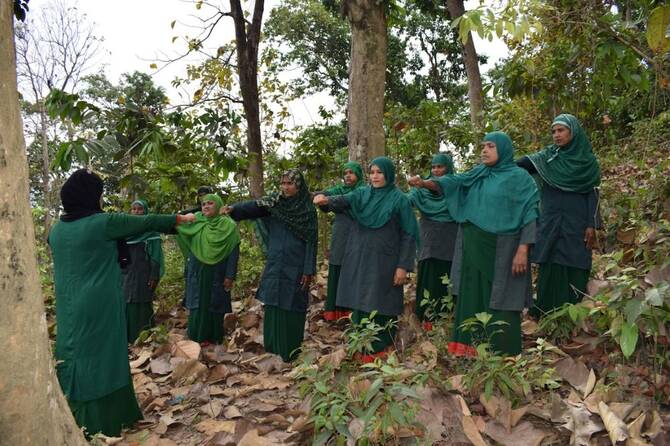
DHAKA: In the forest of southeastern Bangladesh, an all-women squad has been braving scorching heat and monsoon rains to ward off poachers and safeguard the fragile ecosystem of the country’s coast.
Consisting of 28 members, the Women’s Forest Patrol Team from Kerontoli village in Cox’s Bazar was launched in 2006 with the support of the Bangladesh Forest Department, USAID and non-governmental organization Nishirgo Network.
It was not easy in the beginning to form the group and encourage women to take part, but eventually, one of the village’s residents, Khurshida Begum, managed to assemble the team against the odds and initial prejudices.
She was only 16 at the time and has been leading the group ever since.
“As a child, I felt very sad watching people cut down trees for firewood or hunt wild animals. They didn’t understand the importance of protecting nature. Even the forest department’s vigilance wasn’t strong enough,” Begum told Arab News.
“I realized that preserving the forest is essential for our survival. It’s our duty to protect it since we live closest to it. This forest is our valuable natural resource. If we don’t preserve it, then who will?”
In the area under the Teknaf sub-district where she lives, significant forest loss has been occurring on the shoreline, mainly due to illegal logging, but also coastal erosion and rising sea levels, affecting both community welfare and wildlife.
“While guarding the forest, I’ve often encountered wild animals like elephant herds, deer, and large snakes. But they never harm us,” Begum said.
“Without forests, these wild animals would lose their safe habitat. The forests also protect us from floods and cyclones. The trees prevent the hills from landslides. If we hadn’t worked as forest guards, the forest in our area might have disappeared by now. Our tireless efforts have saved its trees.”
Every morning at 9 a.m., the women split into seven groups that patrol a different area.
Wearing green uniforms and boots, they carry sticks to protect themselves from snakes and other smaller animals, umbrellas to shield them from the sun and rain, and flutes to give a sound warning to other groups when they spot poachers.
Their honorarium is little, about $15 a month, but for their service, the Forest Department has leased to them a part of the community forest where trees can be harvested sustainably and where they can plant new saplings.
“This forest is our lifeline and a part and parcel of our life. It provides us with oxygen and protects us from cyclones and landslides. It also gives us shade during the scorching summer. With the opportunity of owning (a part of the) community forest, this forest has also become a source of earning for us,” said Nur Nahar Begum, another member of the squad.
“We can use the trees as pillars of our houses and make the roof with leaves. Our lives and livelihoods are very much dependent on the forest.”
She does not remember ever being afraid to venture into the woods and has been part of the team for the past two decades — a role she takes pride in and believes women are best suited for.
“This is my area and everyone from this locality knows me very well. Besides this, the forest authorities have been providing all-out support in our patrol work,” she said.
“Women are the best fit for the forest-guarding job compared with male guards. Women, Earth, and forest — all these hold the spirit of regeneration … We have a natural instinct to protect living beings.”