

Pakistan expects IMF board approval in early December after staff-level deal

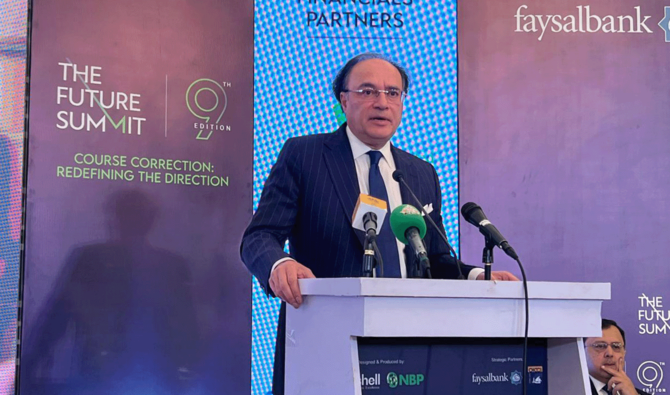
Pakistan's Finance Minister Muhammad Aurangzeb addressing the inaugural ceremony of The Future Summit in Karachi, Pakistan, on November 5, 2025. (Government of Pakistan)
Short Url
Updated 05 November 2025
Follow

Pakistan expects IMF board approval in early December after staff-level deal

  • Government aims to turn support from China, US and Gulf allies into trade, private-sector investment flows
  • Finance chief warns population growth and climate change pose existential threats to Pakistan’s progress

ISLAMABAD: Pakistan expects the International Monetary Fund’s (IMF) Executive Board to approve the country’s next loan tranche in early December after reaching a staff-level agreement in October, Finance Minister Muhammad Aurangzeb said on Wednesday.

Last month, the IMF announced it had reached the agreement with Pakistan for the second review of its 37-month Extended Fund Facility (EFF) and the first review of a 28-month Resilience and Sustainability Facility (RSF), a step that could unlock about $1.2 billion once approved by the Fund’s executive board.

Pakistan secured a $7 billion bailout from the IMF in September 2024 after months of negotiations to stabilize its struggling economy, rebuild reserves and attract foreign investment.

Since then, the IMF has said implementation has remained strong, with fiscal and monetary tightening restoring a measure of stability. The current-account balance recorded a surplus, inflation has eased and external buffers have improved.

“We are under the Fund program, so the second review went well and we had a staff-level agreement announced in Washington, and God willing it goes to the board in early December [for approval],” Aurangzeb said while speaking at The Future Summit in Karachi.

He said Pakistan was witnessing a “confluence of favorable factors,” combining macroeconomic stability with what he called “geopolitical tailwinds” from its traditional partners, including China, the United States and the Gulf Cooperation Council countries, particularly Saudi Arabia.

He said the government saw an opportunity to translate this diplomatic and financial support into trade and private-sector-led investment flows, highlighting that sustainable growth must be driven by business and productivity rather than aid.

The minister said corporate profitability had risen by 14 percent during the first nine months of the year, reflecting an underlying strength in Pakistan’s corporate sector.

He also cited a recent Overseas Investors Chamber of Commerce & Industry (OICCI) survey showing that 73 percent of CEOs now view Pakistan as a viable investment destination, up from 61 percent, describing it as a sign of improved investor sentiment.

The minister said Pakistan was now “moving in the right direction” but needed to “stay the course” on structural reforms while recognizing that some areas demanded urgent corrective action.

However, he also mentioned challenges that could jeopardize economic gains.

“These are two areas which I continue to call existential threats for Pakistan: population and climate change,” he said, calling for urgent course correction in both.

Aurangzeb said Pakistan must address rapid population growth and its climate vulnerabilities with the same urgency it has applied to fiscal reforms, noting that “no matter how much we grow, if our population continues to expand at 2.5 percent, we are not going to get where we want to be by 2047.”

He also maintained that technological and digital investments were becoming key drivers of growth and welcomed Google’s decision to open an office in Pakistan and establish the country as a technical and export hub, describing it as “great news.”

“The ball is in our court to provide that ecosystem, to provide that digital infrastructure on the basis of which we can take AI-led growth forward,” he said.


UN experts slam Pakistan lawyer convictions

Updated 5 sec ago
Follow

UN experts slam Pakistan lawyer convictions

  • Imaan Mazari, husband Hadi Ali Chattha were sentenced to 10 years last month for “anti-state” social media posts
  • Five UN special rapporteurs say couple jailed for exercising rights guaranteed by international human rights law

GENEVA, Switzerland: Five UN special rapporteurs on Wednesday condemned the conviction and lengthy jail sentences imposed on a prominent rights activist and her fellow lawyer husband in Pakistan over “anti-state” social media posts.

Imaan Mazari, a 32-year-old lawyer and vocal critic of Pakistan’s military, “disseminated highly offensive” content on X, according to an Islamabad court.

She and her husband Hadi Ali Chattha were jailed on January 25, with a court statement saying they “will have to remain in jail for 10 years.”

The UN experts said they had been jailed for “simply exercising rights guaranteed by international human rights law.”

“Lawyers, like other individuals, are entitled to freedom of expression. The exercise of this right should never be conflated with criminal conduct, especially not terrorism,” they said in a joint statement.

“Doing so risks undermining and criminalizing the work of lawyers and human rights defenders across Pakistan and has a chilling effect on civil society in the country.”

Mazari shot to prominence tackling some of Pakistan’s most sensitive topics while defending ethnic minorities, journalists facing defamation charges and clients branded blasphemers.

As a pro bono lawyer, Mazari has worked on some of the most sensitive cases in Pakistan, including the enforced disappearances of ethnic Balochs, as well as defending the community’s top activist, Mahrang Baloch.

Mazari and her husband have been the subject of multiple prosecutions in the past, but have never previously been convicted of wrongdoing.

“This pattern of prosecutions suggests an arbitrary use of the legal system as an instrument of harassment and intimidation in order to punish them for their work advocating for victims of alleged human rights violations,” the UN experts said.

“States must ensure lawyers are not subject to prosecution for any professional action, and that lawyers are not identified with their clients.”

The statement’s signatories included the special rapporteurs on human rights defenders, the independence of judges, freedom of opinion, freedom of association and on protecting rights while countering terrorism.

UN special rapporteurs are independent experts mandated by the UN Human Rights Council to report their findings. They do not speak in the name of the United Nations itself.

The UN experts have put their concerns to Islamabad.