

‘Hundreds dead’ in Tanzania post-election violence, says opposition

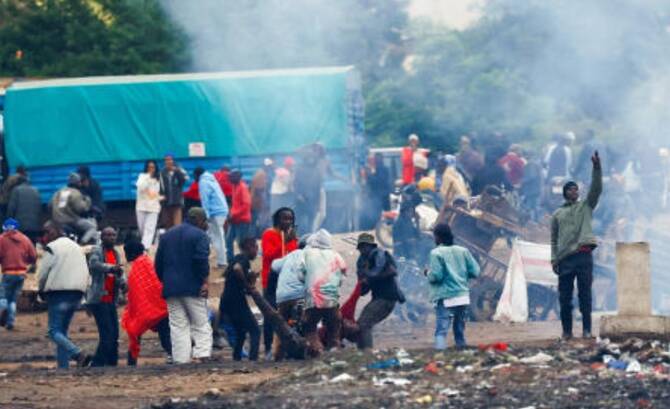
Demonstrators carry a dead man killed during a protest a day after a general election marred by violent demonstrations over the exclusion of two leading opposition candidates at the Namanga One-Post Border crossing point between Kenya and Tanzania, as seen from Namanga, Kenya Oct. 30, 2025. (Reuters)
Short Url
Updated 31 October 2025
Follow

‘Hundreds dead’ in Tanzania post-election violence, says opposition

  • The main opposition party, Chadema, said clashes continued between protesters and security forces in the commercial hub on Friday
  • “As we speak the figure for deaths in Dar (es Salaam) is around 350 and for Mwanza it is 200-plus,” Chadema spokesman said

NAIROBI: Around 700 people have been killed in three days of election protests in Tanzania, the main opposition party said Friday, with protesters still on the streets in the midst of an Internet blackout.
President Samia Suluhu Hassan had sought to cement her position and silence critics in her party with an emphatic win in Wednesday’s election, in which her main challengers were either jailed or barred from standing.
But the vote descended into chaos as crowds took to the streets of Dar es Salaam and other cities, tearing down her posters and attacking police and polling stations, leading to an Internet shutdown and curfew.
With foreign journalists largely banned from covering the election and a communications blackout entering its third day, information from the ground has been scarce.
The main opposition party, Chadema, said clashes continued between protesters and security forces in the commercial hub on Friday.
“As we speak the figure for deaths in Dar (es Salaam) is around 350 and for Mwanza it is 200-plus. Added to figures from other places around the country, the overall figure is around 700,” Chadema spokesman John Kitoka told AFP.
“The death toll could be much higher,” he warned, saying killings could be happening during the nighttime curfew.
A security source told AFP they were hearing reports of more than 500 dead, “maybe 700-800 in the whole country.”
“We are talking hundreds of deaths,” a diplomatic source told AFP.
The United Nations said “credible reports” indicated 10 dead, in the first information released by an international body, while Amnesty International said it had information of at least 100 killed.
Multiple hospitals and health clinics were too afraid to talk directly to AFP.
Hassan had yet to comment on the unrest and local news sites had not been updated since Wednesday.
The only official statement came from army chief Jacob Mkunda late Thursday who called the protesters “criminals.”
In Zanzibar, a tourist hotspot with its own semi-autonomous government, a spokesman for Hassan’s Revolution Party (Chama Cha Mapinduzi: CCM) said the Internet would return when the situation calmed.
“The government knows why they have shut the Internet. There are people who have tried creating tension in Dar es Salaam and they have destroyed a lot of things,” spokesman Hamis Mbeto told reporters.

- Zanzibar ‘robbed’ -

In Zanzibar, the CCM had already been declared winner of the local vote on Thursday.
The opposition party, ACT-Wazalendo, rejected the result, saying: “They have robbed the people of Zanzibar of their voice... The only solution to deliver justice is through a fresh election.”
A senior party official told AFP that ballot boxes had been stuffed, people allowed to vote multiple times without ID and their election observers kicked out of counting rooms.
At a meeting place for opposition supporters on Zanzibar, there was dismay and fear.
“There has never been a credible election since 1995,” said a 70-year-old man, referring to Tanzania’s first multi-party vote.
None of those interviewed gave their names.
“We are afraid of speaking because they might come to our houses and pick us up,” said one.

- Crackdown -

Hassan has faced opposition from parts of the army and allies of her iron-fisted predecessor, John Magufuli, since she took over upon his death in 2021, analysts say.
They said she wanted an emphatic victory to cement her position, and the authorities banned the main opposition party, Chadema, and put its leader on trial for treason.
In the run-up to the vote, rights groups condemned a “wave of terror” in the east African nation, including a string of high-profile abductions that escalated in the final days.
Much public anger has been directed at Hassan’s son, Abdul Halim Hafidh Ameir, accused of overseeing the crackdown.
ACT-Wazalendo was allowed to contest the local election in Zanzibar, but its candidate was barred from competing against Hassan on the mainland.


Nobel laureate Machado says US helped her leave Venezuela, vows return

Updated 6 sec ago
Follow

Nobel laureate Machado says US helped her leave Venezuela, vows return

  • Machado emerged on a hotel balcony in Oslo to cheering supporters early Thursday
  • “We did get support from the United States government to get here,” Machado said

OSLO: Nobel Peace laureate Maria Corina Machado said on Thursday that the United States helped her get to Norway from hiding in Venezuela, expressing support for US military action against her country and vowing to return home.
Machado, who vanished in January after challenging the rule of President Nicolas Maduro, emerged on a hotel balcony in Oslo to cheering supporters early Thursday after several days of confusion over her whereabouts.
“We did get support from the United States government to get here,” Machado told a press conference when asked by AFP about whether Washington had helped.
The Wall Street Journal reported that she wore a wig and a disguise on the high-risk journey, leaving her hide-out in a Caracas suburb on Monday for a coastal fishing village, where she took a fishing skiff across the Caribbean Sea to Curacao.
The newspaper said the US military was informed to avoid the boat being targeted by airstrikes. Once on the island, she took a private jet to Oslo early on Wednesday.
Machado thanked those who “risked their lives” to get her to Norway but it was not immediately clear how or when she will return to Venezuela, which has said it would consider her a fugitive if she left.
“Of course, the risk of going back, perhaps it’s higher, but it’s always worthwhile. And I’ll be back in Venezuela, I have no doubt,” she added.
Machado has been hailed for her fight for democracy but also criticized for aligning herself with US President Donald Trump, to whom she has dedicated her Nobel, and for inviting foreign intervention in her country.

- Military build-up -

The United States has launched a military build-up in the Caribbean in recent weeks and deadly strikes on what Washington says are drug-smuggling boats.
“I believe every country has the right to defend themselves,” Machado told reporters Thursday.
“I believe that President Trump’s actions have been decisive to reach the point where we are right now, in which the regime is weaker than ever, because the regime previously thought that they could do anything,” she continued.
Late Wednesday, Trump said the United States had seized a “very large” oil tanker near Venezuela, which Caracas denounced as “blatant theft.”
Maduro maintains that US operations are aimed at toppling his government and seizing Venezuela’s oil reserves.
Machado first appeared on a balcony of the Grand Hotel in the middle of the night, waving and blowing kisses to supporters chanting “libertad” (“freedom“) below.
On the ground, she climbed over metal barriers to get closer to her supporters, many of whom hugged her and presented her with rosaries.
She said she has missed much of her children’s lives while hiding, including graduations and weddings.

- ‘ Political risk’ -

Machado won the Peace Prize for “her struggle to achieve a just and peaceful transition from dictatorship to democracy.”
She has accused Maduro of stealing Venezuela’s July 2024 election, from which she was banned — a claim backed by much of the international community.
She last appeared in public on January 9 in Caracas, where she protested Maduro’s inauguration for his third term.
The decision to leave Venezuela and join the Nobel festivities in Oslo comes at both personal and political risk.
“She risks being arrested if she returns even if the authorities have shown more restraint with her than with many others, because arresting her would have a very strong symbolic value,” said Benedicte Bull, a professor specializing in Latin America at the University of Oslo.
While Machado is the ” undisputed” leader of the opposition, “if she were to stay away in exile for a long time, I think that would change and she would gradually lose political influence,” Bull said.
In her acceptance speech read by one of her daughters Wednesday, Machado denounced kidnappings and torture under Maduro’s tenure, calling them “crimes against humanity” and “state terrorism, deployed to bury the will of the people.”