

Indian Sikh pilgrims enter Pakistan, first major crossing since May conflict

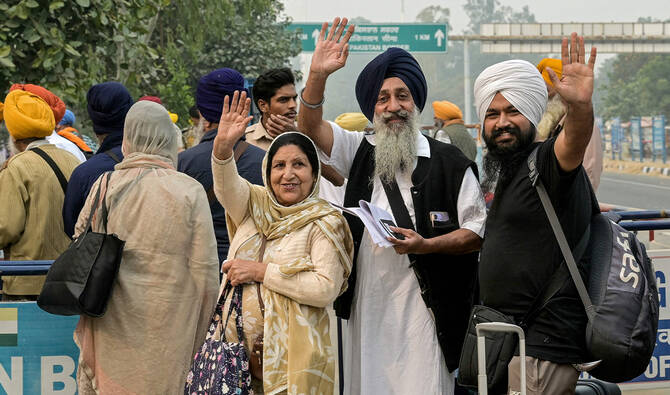
Indian Sikh pilgrims wave as they head to Pakistan through the India-Pakistan Wagah border in Wagah on November 4, 2025. (AFP)
Short Url
Updated 04 November 2025
Follow

Indian Sikh pilgrims enter Pakistan, first major crossing since May conflict

  • More than 2,100 pilgrims granted visas to mark Guru Nanak’s birth anniversary in Pakistan
  • Pilgrims to visit sacred Sikh sites in Nankana Sahib and Kartarpur during 10-day celebrations

WAGAH BORDER: Pakistan on Tuesday welcomed dozens of Sikh pilgrims from India, AFP journalists saw, in the first major crossing since deadly clashes in May closed the land border between the nuclear-armed neighbors.

More than 2,100 pilgrims were granted visas to attend a 10-day festival marking 556th birth anniversary of Guru Nanak, founder of the Sikh faith, Pakistan’s High Commission in New Delhi said last week.

Tensions remain high between Islamabad and New Delhi after the worst fighting since 1999 took place in May, with more than 70 people killed in missile, drone and artillery exchanges.

The Wagah-Attari border — the only active land crossing between the two countries — was closed to general traffic following the violence.

Pilgrims queued up on the Indian side of the border on Tuesday morning, some carrying their luggage on their heads, as the Indian Border Security Force looked on.

AFP journalists on the Pakistani side of the Wagah-Attari border saw dozens of them entering Pakistan.

They were received by Pakistani officials who presented them with flowers and showered them with rose petals.

Indian media reported around 1,700 were due to cross into Pakistan, although there was no immediate official confirmation from Indian authorities.

The pilgrims will gather on Wednesday at Nankana Sahib, Guru Nanak’s birthplace about 80 kilometers (50 miles) west of Lahore by road, and later visit other sacred sites in Pakistan, including Kartarpur, where the guru is buried.

Pakistan’s High Commission had said last week its decision was consistent with efforts to promote “inter-religious and inter-cultural harmony and understanding.”

Indian newspapers reported Saturday that the government would allow “selected” groups to travel to Pakistan.

The Kartarpur Corridor, a visa-free route that opened in 2019 that allows Indian Sikhs to visit the temple without crossing the main border, remains closed since the conflict.

The four-day clashes between the arch-rivals broke out in May after New Delhi accused Islamabad of backing an attack targeting tourists in Indian-administered Kashmir on April 22, claims Pakistan denied.

Sikhism is a monotheistic religion born in the 15th century in Punjab, a region spanning parts of what is now India and Pakistan.

The frontier between the two countries was a colonial creation drawn at the violent end of British rule in 1947, which sliced the subcontinent into Hindu-majority India and Muslim-majority Pakistan.

While most Sikhs migrated to India during partition, some of their most revered places of worship ended up in Pakistan, including the shrines in Nankana Sahib and Kartarpur.


Pakistan’s army chief to get expanded powers under proposed reform

Updated 6 sec ago
Follow

Pakistan’s army chief to get expanded powers under proposed reform

  • Asim Munir, President Trump’s ‘favorite field marshal,’ to be head of all military forces, a new position
  • Constitutional cases to be taken away from Supreme Court, opposition raps changes as undemocratic

ISLAMABAD: Pakistan’s powerful army chief will be given an expanded role and the remit of the Supreme Court will be curbed under constitutional changes passed by the upper house of parliament this week, a move the opposition says will undermine democracy.

Pakistan, historically coup-prone, is seeing its longest period of elected government. But in recent years, after civilians have sought to assert more authority in governance, the military has taken tighter hold of the levers of power, while not staging an outright takeover.

The bill, passed on Monday by the Senate in about three hours, unusually fast for a constitutional change, after the opposition boycotted the debate, is now before the lower house before it can become law.

Army chief Asim Munir, described by US President Donald Trump as his “favorite Field Marshal,” would take overall command of the military — including air and naval forces — with the new position of Chief of Defense Forces under the proposed amendment. After completion of his term, he would retain his rank and have legal immunity for life.

While the military has long wielded extensive power, the reforms would give it greater constitutional backing that would not be easily reversed. Hitherto the army chief was the equal of the air force and navy chiefs, with a chairman of the joint chiefs sitting above him, a post that would be eliminated.

Constitutional cases would no longer be heard by the Supreme Court but by a new Federal Constitutional Court, with judges appointed by the government. In recent years, the Supreme Court has, at times, blocked government policies and ousted prime ministers.

Critics say handpicked judges would now hear the most politically sensitive cases impacting the government, with the Supreme Court dealing with civil and criminal matters.

Under the reforms, President Asif Zardari would also get immunity for life from prosecution.

“All these amendments are for governance, and the federal government’s coordination with the provinces, and to strengthen defense capability after winning a war,” Information Minister Attaullah Tarar said, referring to clashes with India in May.

The government said it was confident it had the numbers in parliament to approve the constitutional changes, which were unusually introduced to the Senate over the weekend. A two-thirds majority is required in the two houses that make up the parliament, the Senate and National Assembly.

The biggest opposition party, founded by jailed ex-prime minister Imran Khan, said it was not consulted. After a noisy protest, opposition parties walked out on Monday when the amendment was introduced to the Senate floor for debate.

Khan’s party PTI condemned the proposed changes.

“The amendment serves as a tool for the ruling coalition to bulldoze institutional checks and balances, silence the opposition, restrict fundamental rights, and concentrate power in its own hands,” PTI’s spokesman for international media, Zulfi Bukhari, told Reuters.

Munir was promoted from General to Field Marshal after the May conflict with India. Law Minister Azam Tarar said on Saturday the rank would be given constitutional protection “because he is the hero of the whole nation.”

The military did not immediately respond to a request for comment. Security officials said the changing nature of modern war, where land troops do not necessarily play the paramount role, requires unified command of all the armed forces.

The government says the court reforms are necessary because hearing constitutional cases takes up too much of the Supreme Court’s time, creating a case backlog.