

Pakistan October inflation rises to 6.2 percent, highest in 12 months

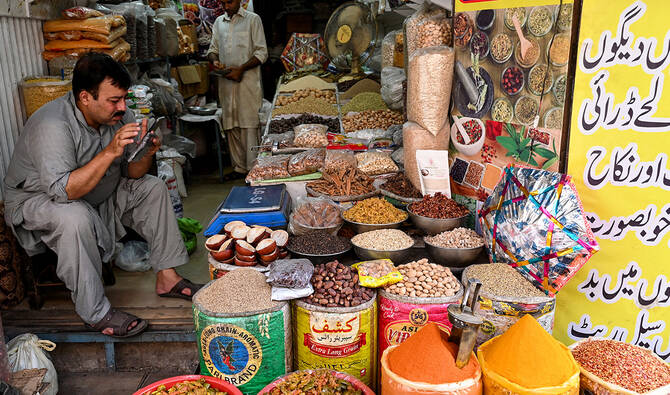
A shopkeeper selling spices waits for customers at a market in Lahore on June 9, 2025, on the eve of Pakistan's federal budget unveiling. (AFP/ file)
Short Url
Updated 03 November 2025
Follow

Pakistan October inflation rises to 6.2 percent, highest in 12 months

  • The government had projected 5–6 percent range for Oct.
  • Floods, trade disruptions strain supplies, lift prices

KARACHI: Pakistan’s consumer price inflation accelerated to 6.2 percent year-on-year in October, the highest reading in 12 months, data showed on Monday, as food prices rose following floods and temporary border disruptions strained supply chains.

On a month-on-month basis, prices were up 1.8 percent, the Pakistan Bureau of Statistics said. The data came a week after the State Bank of Pakistan kept its key policy rate unchanged at 11 percent for a fourth straight meeting, saying inflation was expected to stay above its 5 percent to 7 percent target range for a few months before easing next fiscal year.

Inflation has moderated from nearly 30 percent a year ago to below 6 percent in mid-2025 before edging up again, as the fading base effect and temporary supply shocks began to lift prices.

Last week the government forecast inflation in the 5 percent to 6 percent range for October, noting that flood-related supply pressures and border closures with Afghanistan had pushed up prices of some essential goods. Floods in August swamped farmland and industrial hubs in Punjab, killing more than 1,000 people, displacing 2.5 million and damaging crops and factories, tightening food supplies across the country.

The pressure was compounded by border clashes with Afghanistan that shut major crossings used for food and fuel trade. The two countries later agreed to extend a ceasefire, but crossings remained restricted after October 11, disrupting commerce and deepening shortages in Pakistan’s northwestern regions.

The central bank said the overall economic outlook had improved, with better-than-expected crop yields, stronger industrial activity and a rebound in high-frequency indicators, though risks from global commodity volatility and domestic energy prices remain.

A private survey, meanwhile, showed manufacturing activity contracted for a second straight month in October, though the pace of decline slowed.

The HBL Pakistan Manufacturing PMI rose to 49.6 from 48.0 in September, with firms citing weak demand, higher taxes and power outages as key drags, even as business confidence remained cautiously optimistic. A reading below 50 indicates a contraction.


Pakistan president meets UAE counterpart, explores trade, investment opportunities

Updated 27 January 2026
Follow

Pakistan president meets UAE counterpart, explores trade, investment opportunities

  • Asif Ali Zardari is in UAE on four-day visit to strengthen bilateral ties, review bilateral cooperation
  • Both sides discuss regional, international developments, reaffirm commitment to promote peace

ISLAMABAD: President Asif Ali Zardari met his UAE counterpart Sheikh Mohammed bin Zayed Al-Nahyan in Abu Dhabi on Tuesday during which both sides explored new opportunities in trade, investment, energy and other sectors, Zardari's office said. 

Zardari arrived in Abu Dhabi on Monday evening with a high-level delegation on a four-day official visit to the UAE to review trade, economic and security cooperation. 

"The leaders discussed ways to further deepen the longstanding and brotherly relations between Pakistan and the UAE," a statement from Zardari's office said about his meeting with the UAE president. 

"They reviewed the full spectrum of bilateral cooperation and explored new opportunities in trade, investment, energy, infrastructure, technology, and people-to-people exchanges, highlighting the significant potential for expanding economic and strategic partnership.

Zardari highlighted the significance of Al-Nayhan's visit to Pakistan last month, the statement said, expressing appreciation for the UAE's continued support for strengthening bilateral ties.

It said both sides also exchanged views on a range of regional and international developments, reaffirming their commitment to promoting peace, stability and sustainable development.

The meeting was also attended by Pakistan's First Lady Aseefa Bhutto-Zardari, the Pakistani president's son Bilawal Bhutto-Zardari, who is also the chairman of the Pakistan Peoples Party, Interior Minister Mohsin Naqvi and Pakistan's ambassador to the UAE. 

ZARDARI MEETS AD PORTS CEO

Zardari earlier met AD Ports Group CEO Captain Mohamed Juma Al-Shamisi to discuss the group's investment initiatives in Karachi. 

"Both sides agreed that the expansion and modernization of port infrastructure would strengthen trade flows and support Pakistan’s broader economic development and country’s seaborne trade," the President's Secretariat said in a statement.

It added that Zardari described the AD Ports Group's long-term investment and expanding role in Pakistan's maritime and logistics sector as a key pillar of Pakistan–UAE economic cooperation.

Pakistan and the UAE maintain close political and economic relations, with Abu Dhabi playing a pivotal role in supporting Islamabad during periods of financial stress through deposits, oil facilities and investment commitments. 

The UAE is Pakistan's third-largest trading partner, after China and the United States, and a key destination for Pakistani exports, particularly food, textiles and construction services.

The Gulf state is also home to more than 1.5 million Pakistani expatriates, one of the largest overseas Pakistani communities in the world, who contribute billions of dollars annually in remittances, a crucial source of foreign exchange for Pakistan’s economy.

Beyond trade and labor ties, Pakistan and the UAE have steadily expanded defense and security cooperation over the years, including military training, joint exercises and collaboration in counter-terrorism and regional security matters.