More than $2m in weapons seized in deadly Rio anti-drug raid: government

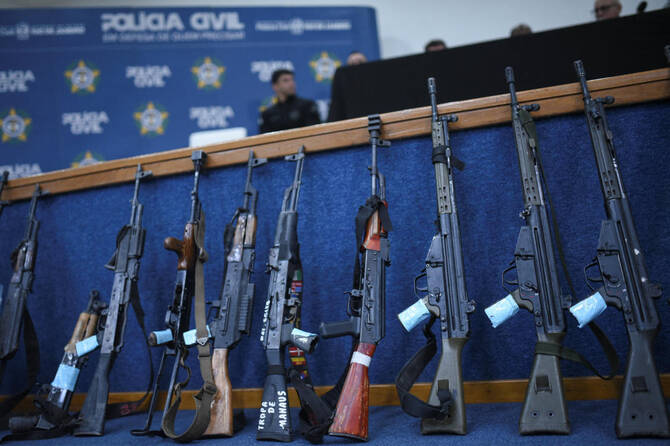
Officials display firearms during a press conference, which the police said were captured during what was the deadliest police operation in Brazil’s history, in Rio de Janeiro, Oct. 29, 2025. (Reuters)
Short Url
Updated 02 November 2025
Follow

More than $2m in weapons seized in deadly Rio anti-drug raid: government

  • The Rio de Janeiro state government announced “one of the largest seizures” of military weapons in a single day from the raid
  • According to authorities, some of the weapons come from other countries such as Argentina, Belgium, Germany, Peru, Russia and Venezuela

RIO DE JANEIRO: Authorities confiscated more than $2 million worth of weapons during a recent anti-drug raid in Rio de Janeiro, the deadliest in Brazil’s history, the state government said Saturday.
On Tuesday, the massive police operation in two favela complexes left at least 117 suspected criminals and four police officers dead, according to the latest official tally.
The Rio de Janeiro state government announced “one of the largest seizures” of military weapons in a single day from the raid — 120 weapons in all, including 93 rifles, valued at 12.8 million reais (about $2.4 million).
They also found ammunition, explosives, drugs and military equipment in the raid, which targeted Comando Vermelho, one of the oldest and most powerful gangs in the country, which controls large swathes of Rio de Janeiro.
According to authorities, some of the weapons come from other countries such as Argentina, Belgium, Germany, Peru, Russia and Venezuela, and included models used in conflict zones such as the AK-47 and the FAL.
Some rifles belong to foreign militaries.
“We are looking at an arsenal typical of a war scenario,” Rio de Janeiro Civil Police Secretary Felipe Curi said in a statement.
Curi said authorities would investigate the routes used by criminal groups to bring the weapons to Rio de Janeiro.
The police raid has drawn condemnation from human rights organizations, and the United Nations has called for an investigation.
Relatives of some of the victims denounced summary executions. An AFP journalist on the scene saw a decapitated body.
Polls, however, show that the majority of Brazilians approved of the operation, which was described as a success against “narco-terrorism” by state Governor Claudio Castro.
Even leftist President Luiz Inacio Lula da Silva, accused by critics of being soft on crime, has sought to project a tougher stance against the gangs in his response to the raid.
“We cannot accept that organized crime continues to destroy families, oppress residents, and spread drugs and violence throughout the cities,” Lula wrote on the X social media platform.
He has presented a bill to Congress proposing a 30-year prison sentence for members of criminal gangs.
On Thursday, Lula signed new measures into law to strengthen the fight against organized crime.


New deadly clashes break out on Afghanistan-Pakistan border despite truce

Updated 7 sec ago
Follow

New deadly clashes break out on Afghanistan-Pakistan border despite truce

  • At least 5 people were killed, 5 injured on the Afghan side, Taliban authorities say
  • Latest clash comes amid reports of back-channel negotiations between the two countries

KABUL: Overnight border clashes have broken out between Afghan and Pakistani forces, authorities in Afghanistan said on Saturday, as tensions between the neighbors escalated following a fragile ceasefire. 

The latest exchange of fire that spanned Spin Boldak and Chaman, a key crossing between southeastern Afghanistan’s Kandahar province and Pakistan’s Balochistan, marked violations of a ceasefire that has been in place since October. 

The truce brokered by Qatar and Turkey has mostly held for the past two months, after dozens were killed on both sides in what was the deadliest confrontation in years between Afghanistan and Pakistan. 

But heavy gunfire and shelling erupted again late on Friday, with each side blaming the other for sparking the deadly violence. 

“Unfortunately, last night the Pakistani side once again attacked Spin Boldak in Kandahar. The forces of the Islamic Emirate had to respond,” Hamdullah Fitrat, deputy spokesperson of Afghanistan’s Taliban government, told Arab News on Saturday. 

He said five people on the Afghan side — including four civilians — were killed in the violence, while five others were injured. 

Mosharraf Zaidi, spokesman for Pakistan’s prime minister, said that the Taliban “resorted to unprovoked firing” along their shared border. 

“An immediate, befitting & intense response has been given by our armed forces. Pakistan remains fully alert & committed to ensuring its territorial integrity & the safety of our citizens,” he wrote on X. 

Local residents in Spin Boldak told Arab News that Friday’s clashes forced families to flee their homes. 

“Mortars and bullets smashed into houses and public places,” Samiullah Malang said. “It was difficult … (to) watch women and children flee on motorbikes, tractors and on foot in the cold night.” 

Although the fighting largely subsided around midnight, sporadic gunfire continued into the morning, he added. 

The overnight violence also reached the Friendship Gate, an official crossing point between Spin Boldak and Chaman, which was closed by Pakistan authorities after the fighting. 

Clashes at the border have led to repeated closures of the key border crossing, devastating commerce and disrupting the movement of thousands. 

“Every time Pakistan shuts the gate, our fruits rot inside the trucks,” said Afghan businessman Haji Rahmatullah. “Hotels are filled with patients waiting to cross for treatment.”

After the ceasefire agreement in October, subsequent talks for a long-term truce have so far yielded little progress. The latest deadly exchange of fire comes amid reports of back-channel negotiations between Afghan and Pakistani officials, which neither governments have openly confirmed. 

Both sides remain deeply divided on core security issues and repeated clashes highlight the absence of an effective de-escalation mechanism, according to Asad Waheedi, a political analyst based in Kabul. 

“The talks are not bearing fruit because the demands are unrealistic,” he said. “Pakistan asks the Taliban to guarantee the security of their country. This is impossible. Even when America had all its troops here, it could not guarantee Afghanistan’s security. The Taliban have no presence there (in Pakistan). It is an impractical demand.”

Clashes between Afghan and Pakistani forces along the Durand Line — their 2,640-km border — have occurred for decades but intensified after the Taliban took control of Afghanistan in 2021, following the withdrawal of US-led troops.

Pakistan accuses the Afghan Taliban of sheltering fighters from the banned Tehreek-e-Taliban Pakistan and allowing them to stage cross-border attacks — a charge Afghanistan denies, saying it does not allow its territory to be used against other countries.

The deadly violence in October was triggered by an unclaimed explosion in Kabul and another in the southeastern province of Paktika, for which the Afghan government blamed the Pakistani military. 

“The facts show that the distance between them is huge,” Waheedi said. “Until the demands become practical, these talks will go nowhere, and the fighting will continue.”