

French court jails Bulgarians for up to four years for Holocaust memorial defacement

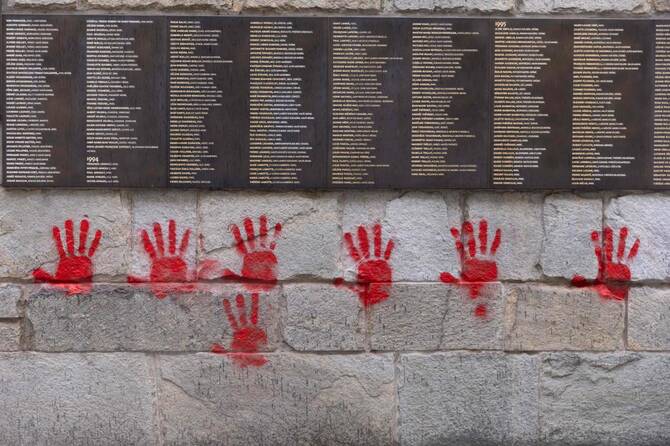
Four Bulgarian nationals were sentenced on October 31, 2025 to prison terms of two to four years, found guilty of tagging “red hands” on the Holocaust Memorial in May 2024. (AFP)
Short Url
Updated 31 October 2025
Follow

French court jails Bulgarians for up to four years for Holocaust memorial defacement

  • All four were also banned from entering French territory for life
  • The four defendants were not tried for acting on behalf of a foreign power

PARIS: A French court on Friday sentenced four Bulgarians to between two and four years in prison for desecrating a Jewish memorial with red handprints last year, in what prosecutors think may have been foreign interference linked to Russia.
The Paris Criminal Court handed down two-year sentences to Georgi Filipov and Kiril Milushev, described as the perpetrators, and four and three years respectively to Nikolay Ivanov and Mircho Angelov, considered the operation’s “masterminds.” Angelov is still at large.
All four were also banned from entering French territory for life.
The trial was the first of its kind in France, one of a series of similar cases suspected of having been orchestrated by a foreign power with the aim to destabilize.
The four defendants were not tried for acting on behalf of a foreign power: that aggravating circumstance was only added to France’s criminal code after the incident took place.
However, in their judgment, the judges said foreign interference was “indisputable” and aimed to “stir up public opinion, exploit existing divisions and further fragment French society.”

-’Russian intelligence’-

The vandalism was staged during heightened tensions in France over the war between Israel and Palestinian militant group Hamas that broke out in October 2023.
The wall daubed with red handprints by the perpetrators lists 3,900 people honored for protecting Jews during the Nazi occupation of France in World War II.
Several other red handprints were found in nearby areas of central Paris.
The prosecutor’s office said a security agent had caught two people placing stencils on the memorial.
Investigators identified them with security footage, then discovered that three had caught a bus to Belgium the next morning, then a flight to Bulgaria.
The defendants present were quick to blame their absent accomplice, calling Angelov the “leader,” denying any ideological motivation.
Defendant Georgi Filipov swore he did not realize he was tagging the Wall of the Righteous.
During the trial, he also rejected accusations that his recruitment was related to his apparent neo-Nazi affiliations, including having a swastika tattoo and appearing in social media posts giving Nazi salutes.
He said he’d left that behind — “I’ve made bad choices in the past.”
The Paris prosecutor’s office said the red handprint incident, possibly “orchestrated by Russian intelligence services,” was one of nine such suspected acts of foreign interference.
Other suspicious incidents include Stars of David stencilled in the Paris region in October 2023; coffins bearing the words “French soldiers of Ukraine” left at the foot of the Eiffel Tower in June last year; and in just this September, pigs’ heads left in front of mosques in the Paris region.
Viginum, the French authority monitoring foreign interference online, said the red hand incident had been exploited by “actors linked to Russia” on X.


Europeans push back at US over claim they face ‘civilizational erasure’

Updated 6 sec ago
Follow

Europeans push back at US over claim they face ‘civilizational erasure’

  • “Contrary to what some may say, woke, decadent Europe is not facing civilizational erasure,” Kallas told the conference

MUNICH: A top European Union official on Sunday rejected the notion that Europe faces “civilizational erasure,” pushing back at criticism of the continent by the Trump administration.
EU foreign policy chief Kaja Kallas addressed the Munich Security Conference a day after US Secretary of State Marco Rubio offered a somewhat reassuring message to European allies. He struck a less aggressive tone than Vice President JD Vance did in lecturing them at the same gathering last year but maintained a firm tone on Washington’s intent to reshape the trans-Atlantic alliance and push its policy priorities.
Kallas alluded to criticism in the US national security strategy released in December, which asserted that economic stagnation in Europe “is eclipsed by the real and more stark prospect of civilizational erasure.” It suggested that Europe is being enfeebled by its immigration policies, declining birth rates, “censorship of free speech and suppression of political opposition” and a “loss of national identities and self-confidence.”
“Contrary to what some may say, woke, decadent Europe is not facing civilizational erasure,” Kallas told the conference. “In fact, people still want to join our club and not just fellow Europeans,” she added, saying she was told when visiting Canada last year that many people there have an interest in joining the EU.
Kallas rejected what she called “European-bashing.”
“We are, you know, pushing humanity forward, trying to defend human rights and all this, which is actually bringing also prosperity for people. So that’s why it’s very hard for me to believe these accusations.”
In his conference speech, Rubio said that an end to the trans-Atlantic era “is neither our goal nor our wish,” adding that “our home may be in the Western hemisphere, but we will always be a child of Europe.”
He made clear that the Trump administration is sticking to its guns on issues such as migration, trade and climate. And European officials who addressed the gathering made clear that they in turn will stand by their values, including their approach to free speech, climate change and free trade.
British Prime Minister Keir Starmer said Saturday that Europe must defend “the vibrant, free and diverse societies that we represent, showing that people who look different to each other can live peacefully together, that this isn’t against the tenor of our times.”
“Rather, it is what makes us strong,” he said.
Kallas said Rubio’s speech sent an important message that America and Europe are and will remain intertwined.
“It is also clear that we don’t see eye to eye on all the issues and this will remain the case as well, but I think we can work from there,” she said.