

Pakistan invited to Muslim states’ meeting in Turkiye on next steps for Gaza peace plan

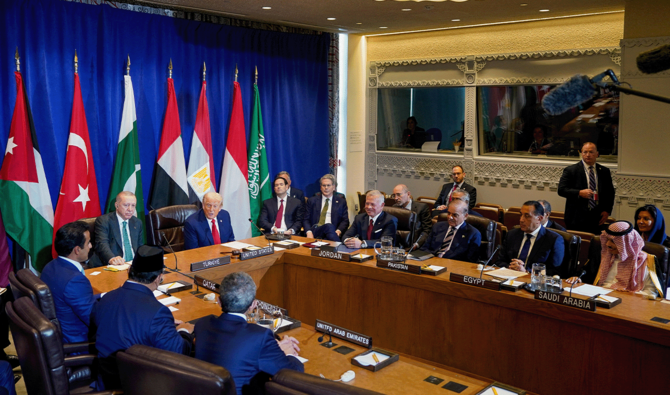
US President Donald Trump (center) speaking next to US Secretary of State Marco Rubio during a multilateral meeting with Turkey's President Tayyip Erdogan, Jordan's King Abdullah, Pakistan's Prime Minister Shehbaz Sharif, Egypt's Prime Minister Mostafa Madbouly, Saudi Arabia's Foreign Minister Faisal bin Farhan Al-Saud, Qatar's Emir Sheikh Tamim bin Hamad Al Thani, Indonesia's President Prabowo Subianto and United Arab Emirates' Deputy Prime Minister and Minister of Foreign Affairs Abdullah bin Zayed Al Nahyan, during the 80th United Nations General Assembly, in New York City, New York, U.S., September 23, 2025. (Reuters/File)
Short Url
Updated 31 October 2025
Follow

Pakistan invited to Muslim states’ meeting in Turkiye on next steps for Gaza peace plan

  • Invited countries met US President Donald Trump in September before the plan was unveiled
  • Turkiye says it will discuss implementation of the plan, accuses Israel of trying to undermine it

ISTANBUL: Turkiye will on Monday host a meeting of foreign ministers from Muslim countries to discuss a US peace plan for Gaza, Foreign Minister Hakan Fidan said.

Fidan told reporters on Friday that the Istanbul meeting would “evaluate our progress and discuss what we can achieve together in the next stage.”

A ministry spokesman said ministers from Egypt, Indonesia, Jordan, Pakistan, Qatar, Saudi Arabia and the United Arab Emirates had all been invited.

The foreign ministers of all these countries met US President Donald Trump on September 23 on the sidelines of the UN General Assembly in New York.

“A glimmer of hope emerged, offering a glimmer of hope for everyone,” Fidan said during a joint news conference with his Estonian counterpart Margus Tsahkna.

There were a number of issues that needed to be addressed at the meeting, he said.

“What are the obstacles to its implementation? What are the challenges to be faced? What are the next steps? What will we be discussing with our Western friends? And what support is there for the ongoing talks with the United States?“

Fidan accused Israeli Prime Minister Benjamin Netanyahu of “looking for a pretext to violate the ceasefire [in Gaza] and relaunch the genocide under the eyes of the whole world.”

Turkiye sent an 81-strong distaster response team to Gaza a week ago to help with search and rescue operations.

But it is still waiting at the border for Israeli approval to enter the Palestinian territory, said Fidan.

The foreign ministry was still “working intensively” and its army was discussing the possibility of joining the international force to oversee the ceasefire, said Fidan.

But Israeli Foreign Minister Gideon Saar said on Monday it would not be reasonable for them to let Turkiye participate because of their “hostile approach” to Israel.

“So it is not reasonable for us to let their armed forces enter [the] Gaza Strip, and we will not agree to that, and we said it to our American friends,” said Saar.


Pakistan raises fuel prices by Rs55 per liter as Middle East conflict drives oil surge

Updated 06 March 2026
Follow

Pakistan raises fuel prices by Rs55 per liter as Middle East conflict drives oil surge

  • Government says adequate fuel stocks in place despite global energy shock
  • Oil prices jump from about $78 to over $106 per barrel amid regional conflict

ISLAMABAD: Pakistan on Friday increased petrol and diesel prices by Rs55 ($0.20) per liter each as escalating conflict in the Middle East sent global oil prices sharply higher and disrupted energy supply routes, officials said.

Global oil markets have been rattled since coordinated strikes by the United States and Israel against Iran began last week, triggering retaliatory attacks across the region, raising fears of disruption to key energy shipping routes and pushing petroleum prices sharply upward.

The price adjustment in Pakistan was announced after a joint press conference by Finance Minister Muhammad Aurangzeb, Deputy Prime Minister and Foreign Minister Ishaq Dar and Petroleum Minister Ali Pervaiz Malik, who said the government was monitoring international energy markets and domestic supply conditions amid the crisis.

“So, the decision we have made by changing the levy a little bit is that we are going ahead with increasing the price of both fuels, petrol and diesel, by Rs55 ($0.20),” Malik told reporters. 

“And as soon as this matter settles, we will revise the prices downward with the same speed and take steps on how to increase people’s income and purchasing power.”

He said Pakistan entered the crisis with “comfortable energy reserves” due to earlier planning but rising global prices had forced the government to adjust domestic fuel rates to maintain supply continuity.

He said international petrol prices had climbed from roughly $78 per barrel on March 1 to around $106.8 per barrel, while diesel prices had risen to about $150 per barrel.

Malik added that the government had taken steps to minimize the burden on consumers, noting diesel plays a critical role in agriculture, transportation and public mobility.

Malik also warned that authorities would take strict action against anyone attempting to hoard fuel or manipulate supply for profiteering.

The minister said Pakistan was working with international partners to secure additional energy supplies, including arrangements with Saudi Aramco and the use of Pakistan National Shipping Corporation vessels to transport crude oil imports.

Finance Minister Aurangzeb said a high-level government committee formed by Prime Minister Shehbaz Sharif had been meeting daily to review developments in global petroleum markets and their potential impact on Pakistan’s economy.

“Pakistan currently maintains adequate energy stocks and macroeconomic stability,” Aurangzeb said, adding that the government’s response was based on preparedness rather than panic.

He said the committee, which includes senior ministers, the governor of the State Bank of Pakistan and other officials, was assessing short-, medium- and long-term implications of the crisis for inflation, foreign exchange reserves and broader economic indicators.

Deputy PM Dar said the regional conflict had significantly disrupted global energy markets, with international petroleum prices rising by as much as 50–70 percent in recent days.

The deputy prime minister added that Pakistan was also engaged in diplomatic efforts aimed at de-escalating tensions and restoring stability in the region.

Petroleum prices will now be reviewed more frequently, potentially on a weekly basis, and any reduction in global oil prices would be passed on to consumers.

Pakistan, which relies heavily on imported fuel to meet its energy needs, is particularly vulnerable to global oil price shocks that can quickly feed into inflation and pressure the country’s external accounts.